THEY FIGHT CRIME! THEY SOLVE MYSTERIES! THEY…wait, no, this isn’t that kind of film.
Previously on Midlife Crisis Crossover:
It’s that time again! Since 1992 my hometown of Indianapolis has presented the Heartland International Film Festival, a multi-day, multi-theater celebration of cinema held every October. Local moviegoers have the opportunity see over a hundred new works in the realms of documentaries, narrative features, shorts, and animation made across multiple continents from myriad points of the human experience. Some participants stop in Indy on their grand tour of Hollywood’s festival circuit; some are local productions on shoestring budgets; and a wide spectrum of claims are staked in the innumerable niches between, projects with well-known actors screening alongside indies with enormous hearts.
Heartland’s 33rd edition runs October 10-20, for which I’ve made plans to catch at least eight films in all (Lord willing). Longtime MCC readers know the rule: every film I see in theaters gets its own entry…
Last year one of my favorite Heartland entries was Fancy Dance, a Native-focused drama co-written and directed by Erica Tremblay, who’d worked on the most excellent TV series Reservation Dogs (11/10, among the best ever) and Dark Winds (whither season 3?). Its star Lily Gladstone had appeared in a few Rez Dogs episodes, but commanded wider attention as the Oscar-nominated costar of Martin Scorsese’s Killers of the Flower Moon, where she had to put up with being surrounded by powerfully attention-grabbing white men, and so did her character.
Once an artist emerges from such overshadowing as an independent force on their own terms, it’s absolutely cool seeing them use their newfound fame to encourage and enable other storytellers to come forward and take a shot at reaching a wider audience. Just as Taika Waititi “co-created” Rez Dogs and directed its pilot, thereby launching it with an extra little push (though the show was obviously, lovingly Sterlin Harjo’s baby), I braked while reading Heartland’s Narrative Feature roster when I spotted the listing for Executive Producer Lily Gladstone affixed to Jazzy, an adorable coming-of-age drama that premiered at Tribeca Festival last June and might’ve gotten overlooked among Heartland’s voluminous offerings if not for her name standing out to me.
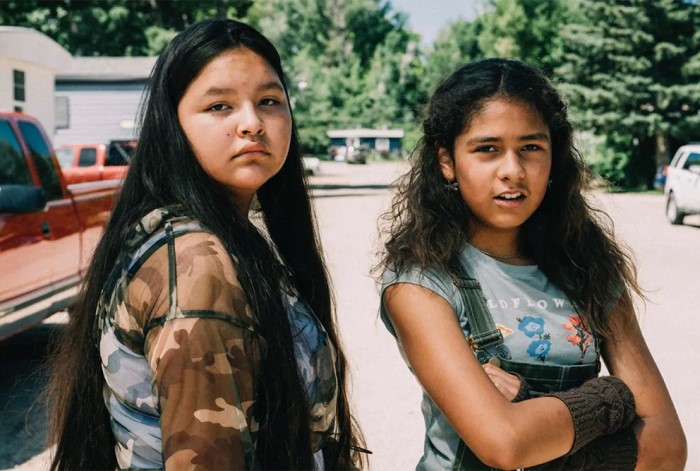
Jazzy centers on two preteen Lakota girls named Jazzy and Syriah, played respectively by Jasmine Bearkiller Shangreaux and Syriah Fool Head Means, each using their real first names (as do all the classmates who have lines, pretty common for films made with nonactors). We follow along with their day-to-day BFF experience, from their trailer park at a remove from South Dakota’s Pine Ridge reservation (distant enough, and for long enough, that they don’t know the language) to the middle school where they’re seemingly the only nonwhite kids (which nobody brings up, everybody’s cool) and play in the school band, which gave me flashbacks to my three years with fellow disaffected kid musicians, plodding rhythms, familiar tunes mangled, goose-squawk woodwinds and constantly breaking reeds. Theirs is a shiny happy world of stuffed animals, art, stickers, in-jokes, and misuse of makeup. They’d rather live in the now than imagine the future because, as Syriah correctly surmises, “Growing up sounds ugly.”
Director Morrisa Maltz works with three additional writers, based on the girls’ own real-life stories, and invites us along for shoulder-to-shoulder immersion and nostalgic reminders of the awkwardness and the simplified delights of that phase as the duo are inseparable until one day when they…just suddenly aren’t. Whimsy and girly chitchat halt without warning one day on the bus. We continue following their respective strands after this jarring pivot, but we barely know much more than they do, Jazzy in particular. And we were having such a pleasant time with them.
Suspended female friendships aren’t too common a theme in film. One of the best I’ve seen was Frances Ha with Greta Gerwig, who particularly comes to mind because Jazzy follows the same storytelling and editing model as her own Lady Bird — i.e., largely a series of seemingly unconnected micro-vignettes, most 60-90 seconds long, viewed through Neorealist lenses, though the mostly electronica score distracts a tad with dramatic crescendos at the oddest moments (perhaps reflecting the girls’ sense of Drama more than the audience’s). Whatever adult dealings are trickling down to affect their relationship remain vague and unknowable (again accurately reflecting my childhood) as the grown-ups are mostly offscreen, out of focus, or have their heads turned from the camera.
The shift from idyllic amity to low-key separation anxiety keeps us uneasy until the final act brings the community-at-large together (for almost exactly the same reason as Rez Dogs‘ wonderful finale), moved from in-town to the nearby Black Hills and the Badlands, where no photographer or cinematographer can go wrong. Out in the open, two kids can escape the grown-ups’ hangups and figure things out on their own — with or without fancy speeches or punches. All they need are time, space, and all the frybread they can carry.
…
Meanwhile in the customary MCC film breakdowns:
Hey, look, it’s that one actor!: Fun trivia: Jazzy is a sequel! Maltz’s first narrative film The Unknown Country featured a few familiar folks who reprise the same characters here — Gladstone as Jazzy’s Auntie Tana; Raymond Lee (Top Gun: Maverick, the recent Quantum Leap reboot ) as Tana’s boyfriend; and Richard Ray Whitman (Rez Dogs‘ Old Man Fixico!) as the family patriarch. Jazzy is fine as a standalone, but now I’m curious to see what I missed. It’s available for rental on the usual streaming services.
How about those end credits? No, there’s no scene after the Jazzy end credits, but as they scroll, each side is decorated by symbols the two young ladies drew themselves, earning them additional credits for “End Titles”. At the very end comes one last handwritten message as if lifted from a classroom note:
“I ❤ U — Jazzy."
Discover more from Midlife Crisis Crossover!
Subscribe to get the latest posts sent to your email.

