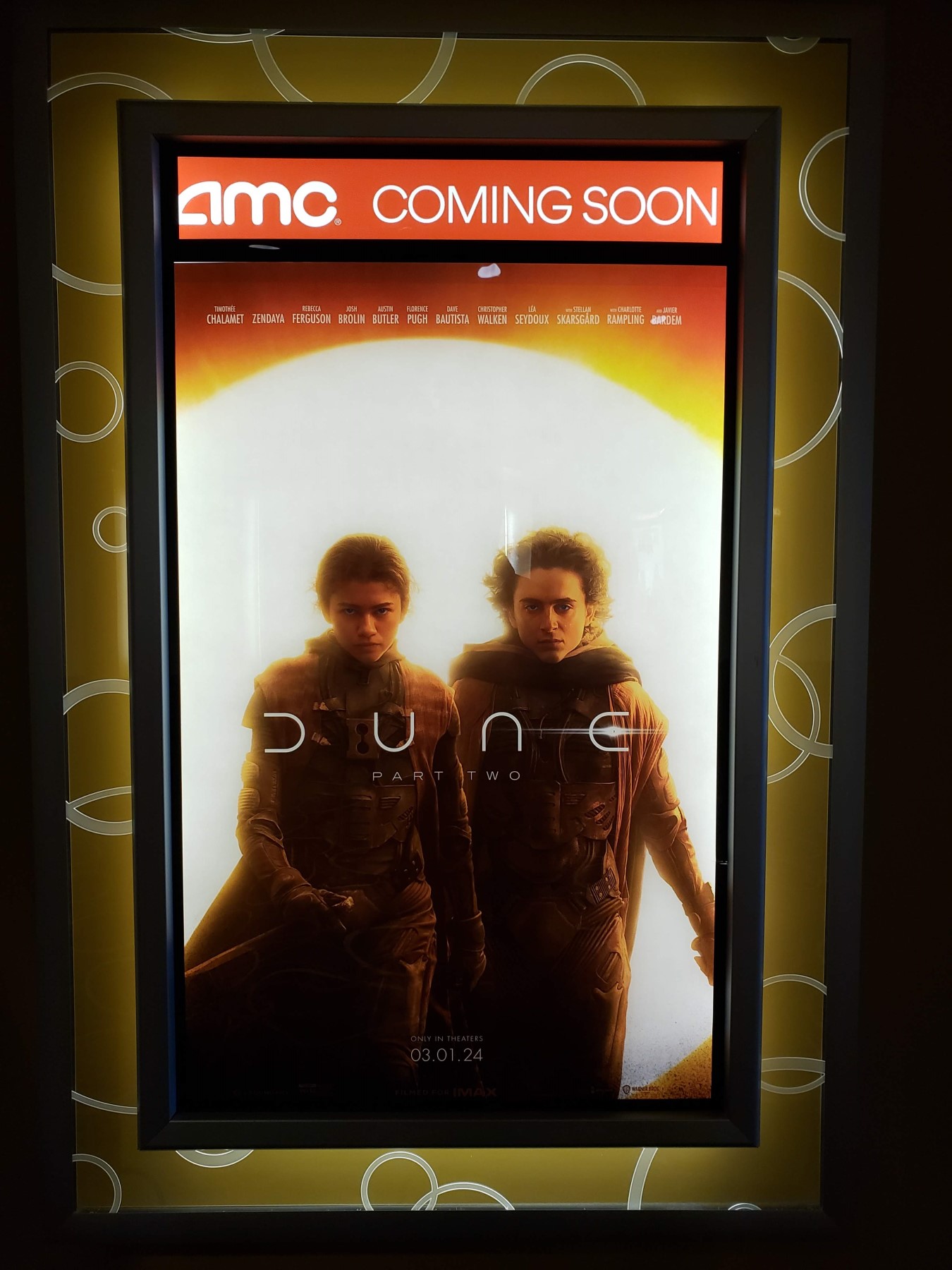
Fresh off Oscar Quest ’24, we bring you a sneak peek at Oscar Quest ’25.
Previously on Dune: director Denis Villeneuve brought his gloriously ponderous, A/V-intoxicating, starkly symmetrical majesty to Frank Herbert’s universe, the quintessential American “Chosen One on Planet Sahara” space opera, and helped me heal from the childhood trauma of sitting through David Lynch’s compromised beach-ball of confusion. Villeneuve gambled on a dissatisfying To Be Continued ending for Part One with no guarantee he’d be permitted to keep going. Dune: Part Two ties up a thread or two, but to viewers who never pored over the sacred Herbertian texts (or who, like me, tried and failed to slog through), it was perhaps a surprise to find To Be Continued shall apparently be the saga’s status quo evermore, for as long as capricious Warner Bros. execs permit.
When last we left our fugitive scion Paul Atreides, he was on Arrakis with his mother, when she was researching spells just before her husband died. Yes, the infamous Madame Web trailer has ruined the amateurish art of clunky prepositional phrase-trains and clause convolutions, but it’s my art and I’m clinging to it. In the two years since the first one, Timothée Chalamet now looks over 18 and Rebecca Ferguson has since exited the M:I franchise and rocks her own beguiling SF gig, Apple+’s Silo. After the sinister House Harkonnen overturned their takeover of Arrakis, Paul and his pregnant mother Lady Jessica embedded with the Fremen, a rebellious underground comprising thousands of extras and three whole speaking characters who cannot quite bring an entire civilization to life on their own. A round of E’s for effort are awarded to Academy Award Nominee Javier Bardem as Stilgar the unshakable true believer; Zendaya as Chani the skeptic and love interest, in that order, especially later on; and the other one (Souheila Yacoub from Gaspar Noé’s Climax) as the other one.
Mother and son acclimatize to hard-knock desert life and work toward restoring the honor and power of House Atreides that was wrested from them by the domineering House Harkonnen. Each has their own path to investigate: Jessica rises to power within the Bene Gesserit shadow-conspiracy witches’ coven that pulled the strings of their overthrow; Paul seeks to unify the disparate Fremen factions into one massive guerrilla revenge squad, starting by demolishing Spice-mining operations and working their way up to increasingly larger, louder set pieces. When time permits, he pursues romance with Chani and trains to become the Sandworm Surfer Supreme. Call his little side-arc Space Point Break.
But all throughout, precog visions — some his own, some not — have him second-guessing his every action or inaction. He’s humbled by them at first, but his flashes are as ambiguous as Madame Web’s, and never articulated to anyone else with enough detail to invite contrasting interpretations. In his modest hubris, he figures only he can interpret them, as is the case with many an aspiring ruler-turned-madman. Stilgar believes his choices will be correct by definition and everything will work out; the more pragmatic Chani feels her dread escalating as she is, incredibly, not blinded by rom-com puppy-love. She never thought she was dating a capital-M Messiah, but suspicions nag at her about just what sort of leader her boyfriend’s becoming.
Meanwhile back in the kingdom, the proudly gross Baron Harkonnen (Stellan Skarsgård) has had it with those meddling Fremen and the royal family he thought had been eliminated. Once he realizes he was too hasty to place all his hopes in his nephew Rabban (Dave Bautista), whose losses make him look like an ineffective Evil Drax, the Baron calls a new player from the bench: his other nephew na-Baron Feyd-Rautha Harkonnen, played by Academy Award Nominee Austin Butler (best known as Colonel Tom Parker’s lackey in Elvis). A fair improvement over Sting’s version from Lynch’s Dune, his Feyd-Rautha is an indiscriminate killing machine, wicked with blades and knee-jerk homicidal at the slightest inconvenience. I question how a feral temper translates into better tyranny-management skills than Rabban, but the Baron doesn’t seem like the sort of big-bad who puts deep thought into his hiring or promotion practices among his nepo-nephews.
As if to drive home the point (with literal daggers) that Feyd-Rautha is the wrong Harkonnen to mess with, his intro is a stunning art installation unto itself — a panoramic arena tournament rendered in otherworldly white-‘n’-off-white, bedazzling in its lack of shadows and as brutal as a mandatory PG-13 rating might allow. Several deaths later, the stage is set for the inevitable clash of armies in the Arrakis sands and of course one final duel between Our Hero and this glowering, monarchy-sanctioned psychopath. Will good triumph over evil? Will House Atreides rise or fall? Will Paul ascend to his father’s position with sand getting in everywhere, the sandworms his chariot?
That’s more than enough intergalactic melodrama for a nearly three-hour installment from Villeneuve and his co-writer Jon Spaihts (Prometheus, Doctor Strange). As we all expected and demanded, everything looks magnificent and thunders at max volume, reverberating hard enough to pulverize your bones from the inside if you dare endure a Dolby Cinema showing as our family did. The colossal mining machines, the sandworms larger than any creature of our own reality, the requisite army and flying-ship battles, the returning Hans Zimmer and his juggernaut orchestra, and even the smaller, more mystical flourishes — Bene Gesserit machinations, Skyrim power-shouts, and so on — are a delight for fans of giant-sized speaker-stacked action. If that’s all you ask of it, you’re guaranteed an overdose of happy sensory overload.
In between its eventual For Your Oscar Consideration reels for Best Sound and Visual Effects, Dune: Part Two takes the time to interrogate the faith and trust invested so easily in the quasi-anointed Saint Paul. The controversy among the Fremen is positioned as a religious debate of sorts, but it’s more akin to fervent hero worship, with Paul acting as his own prophet, foreseeing his destiny as a worldly king or possibly something worse. His blockbuster narrative might veer off the well-worn George Lucas path, perhaps a selling point for distinguishing Dune from other works it doubtlessly inspired. As humility gives way to pride, the question is begged: when is a Chosen One not a Chosen One? Possibly when he chooses himself. Funny how in such cases it’s always a “he”.
On the downside, that abrupt heel-turn comes with few possible explanations, none of them especially organic. Villeneuve is so busy raising his baton high on the maestro’s podium that he tramples past the delicate pivot. What might be intended as foreshadowed subtlety feels more like afterthought. What’s meant to be shocking is instead bewildering, which is a less satisfying viewing sensation. The saving grace of those final scenes — besides, like, way-cool knife-fighting — is Zendaya as the lone holdout in the ticker-tape parade. I won’t be watching Euphoria in this lifetime, so this is my first time seeing her really go all-out. In the Spider-films her Mary Jane has been an above-average love interest-in-distress, sharp-tongued in their personal interplay yet never fully independent of Peter’s shadow. In the closing scenes of Dune: Part Two, Chani realizes the time has come for her to take on a greater responsibility. All she needs now is more power to complement her own. Zendaya brings it and then some.
All this and more may or may not be addressed in our next thrilling installment however many years from now. This time the cliffhanger presumably follows the source material, rather than executive runtime fiat. In Herbert’s era I imagine publishing was a smaller gamble that allowed authors such as him to plan ahead with less trepidation about having their universes cut short. Reservations aside (including some renewed online complaints of cultural appropriation outside my lane), here’s hoping Dune will be allowed to go on, rather than suffer the undignified fate that seems to have befallen that other WB IP, fellow desert-dweller Wile E. Coyote.
…
Meanwhile in the customary MCC film breakdowns:
Hey, look, it’s that one actor!: Mentioned but never seen in Part One, the Emperor of the universe deigns to arrive at last, embodied by Christopher Walken as a regal gent who sounds an awful lot like Christopher Walken, which makes some of his scenes really hard to take seriously. The ubiquitous Florence Pugh (Black Widow, Oppenheimer, et al. ad infinitum) tags along as his mostly ornamental daughter, who delivers some initial exposition, retreats to the imperial locker room, then is summoned forth at the end for some light flabbergasting of us unread non-Herbertites. Other newcomers include Léa Seydoux (from James Bond’s recent run) as a Bene Gesserit member who surely isn’t one-and-done; and one special surprise cameo tease from House Atreides’ distant future.
Familiar faces from Part One include Charlotte Rampling as Lady Jessica’s former Bene Gesserit boss; Roger Yuan (Shanghai Noon, Skyfall) as the soldier who betrayed House Atreides and remains unrewarded for it; and Babs Olusanmokun (now costarring in Star Trek: Strange New Worlds) in a cameo as his corpse. Late in the game, yet another old friend pops in and reminds us that in all things geek, if you didn’t see a body, they’re not really dead.
How about those end credits? No, there’s no scene after the Dune: Part Two end credits, but they do confirm Chalamet and Zendaya each had their own personal chefs in addition to the production caterers. Name-checks in the Special Thanks section include two good sports who wound up in the film’s deleted scenes: Stephen McKinley Henderson (a super-powered House Atreides aide in Part One) and Tim Blake Nelson, who was…uh, no idea, maybe playing lost country-cousin Jethro Harkonnen.
Discover more from Midlife Crisis Crossover!
Subscribe to get the latest posts sent to your email.
