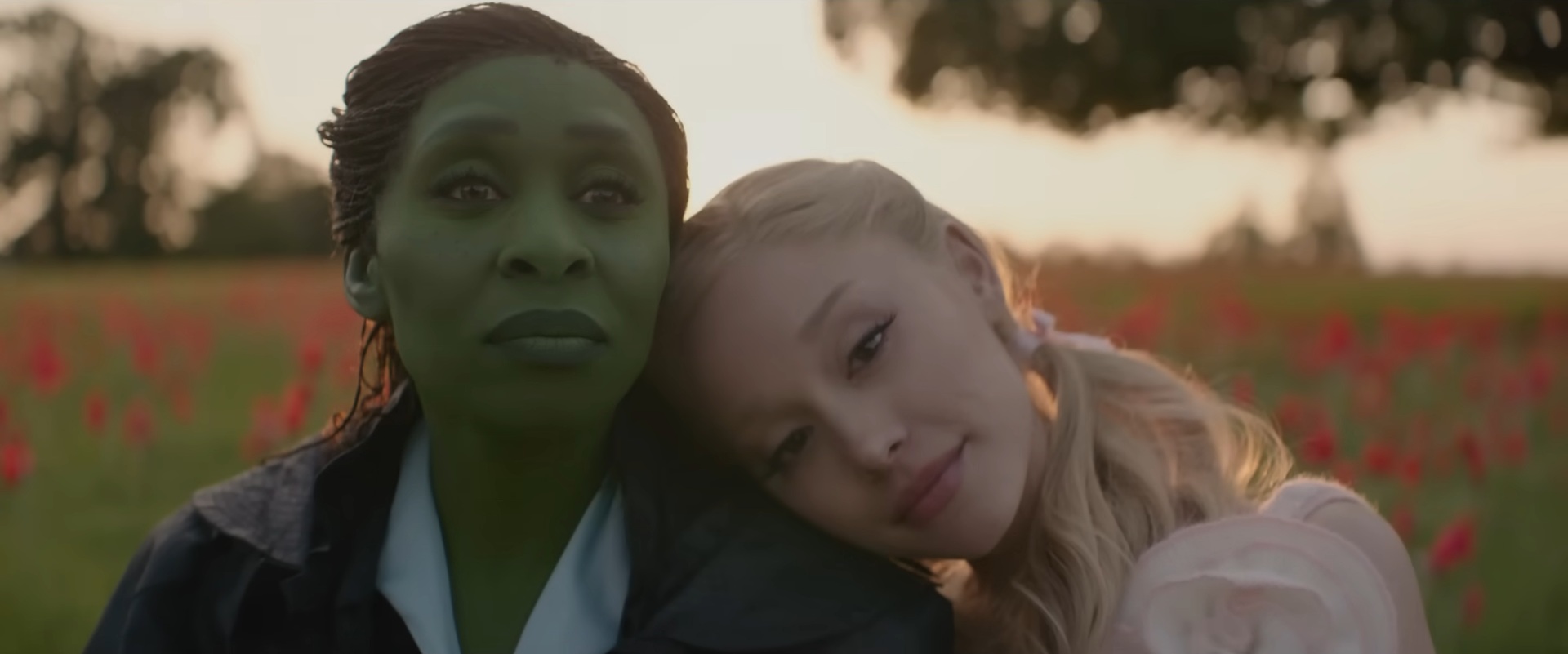
Down the witches’ road, one last time…until Universal decides this should be a prequel trilogy.
The best thing I can say about Wicked: For Good is how heartening it was to confirm that communal experiences can still happen if we want them. Our showing was the most crowded Tuesday night I’ve witnessed in months, and certainly the most responsive, at two points in particular. One was the film’s funniest scene — a wacky slapfight that garnered loads of laughter and audience backtalk, maybe because it was the only scene with that kind of spark — and the other was, as a Wicked fan would expect, the tender BFF-breakup duet “For Good”. I can’t remember the last time I heard that many people crying and sniffling at the same time.
Its box office grosses certainly reflect a tsunamic response from the public at large. I’m glad so many people have enjoyed quality time out of the house and away from their phones, maybe even the lady with super-sized elbows who sat next to me and only dug her phone out of her purse twice to check the time. I like to think that’s far fewer times than she’d normally check her phone if she were bored. Good on her for showing self-restraint! Anyway, here came headlines trumpeting, “CINEMA IS BACK, BABY!”
If you were among the millions of Americans who super-loved it, gave it an 11/10, and won’t shut up about it for the next month or two, enjoy your convos with other fans in your usual social spaces, you’re free to go and we’ll see you the next time Google brings you to my virtual hobby-shack’s tiny doorstep. Cheers! Have a nice day! Yay Elphaba!
…
…
…are they gone?
Okay, so, yep, I regret to inform me that I TOLD ME SO. Previously on Midlife Crisis Crossover: we saw Wicked: Part One in theaters, which was fine even though it was…
That box-office smash no one will shut up about because they traded bins full of emeralds to ensure no one ever shuts up about it, least of all the six thousand cross-promotional advertisers in on the take. Cynthia Erivo and Ariana Grande inherited the witch-frenemies’ mantles and soared toward their own horizon amid the best parts, which translated well to the big screen in the hands of Jon M. Chu as long as you don’t mind the surrounding bloat, which…well, it IS a movie musical. Or, more accurately, a movie musical based on half of a stage musical based on a novel that’s a prequel to a movie based on a novel. But all the show’s flaws fell after the intermission, so call me skeptical of the imminent follow-up Wicked II: The Battle of Five Armies.
That came eight years after our family saw the Broadway musical for ourselves in New York City in 2016…
In general we were sufficiently blown away, albeit with a few asterisks. Our seats were so far away that, until it was brought up for the sake of a clichéd gag, I had no idea Elphaba was wearing glasses. One aspect of the final act had the three of us unanimously cocking an eyebrow and thinking, “…Really?” because sometimes revisionist fun can maybe tangle one knot too many. I thought well enough of the songs that after the show I insisted on waiting in the otherwise all-female line at the merchandise booth to buy a copy of the soundtrack…
…which, upon occasional spins since then, I still enjoy up through “Defying Gravity” because original headliners Idina Menzel and Kristin Chenoweth were phenomena unto themselves. But after “Gravity” — i.e., the entirety of Act Two — the CD loses my attention and I find myself mentally sorting my latest to-do list until the final choir reprise wraps up and I can put it back in the jewelbox. Fast-forward to 2025 and I was not eagerly looking forward to the next movie musical that’s a sequel based on the other half of a stage musical based on a novel that’s a prequel to a movie based on a novel. I went in with pre-disappointed expectations and the film descended to reach them, from the opening superhero-action set piece onward.
When last we left our witches, Erivo’s green-skinned sorceress Elphaba was a Shiz University dropout, a spellbook thief, an outraged talking-animal-rights activist, and a fugitive from the corrupt law enforcement of Oz who’s been nicknamed the Wicked Witch of the West by the the Emerald City’s propaganda machines. (Why “of the West”? SHUT UP, that’s why.) Grande’s ultra-pinkified Glinda was the new face of Oz’s facade, a powerless figurehead who understood her BFF’s motives and was 95% sure her bosses were shady, but her new job sates her cravings for the fame and adulation she never merited as a dimwitted mean-girl. Jeff Goldblum’s gadget-reliant charlatan Wizard and Michelle Yeoh’s Madame Morrible are the secretly evil rulers of the land, arbitrarily speciesist and desperate to cling to power for power’s sake in the face of Elphaba’s one-woman rebellion. As with any postmodern fairy-tale inversion from Shrek on up, when it comes to Oz, Everything You Know Is Wrong.
(Obviously Shrek didn’t pioneer the whole idea of retelling old tales from the villain’s POV, nor was Gregory Maguire’s novel the sole 20th-century example. See also: Jay Ward’s Fractured Fairy Tales, John Gardner’s 1971 book Grendel, Jon Scieszka and Lane Smith’s awesome children’s books The True Story of the 3 Little Pigs and The Stinky Cheese Man and Other Fairly Stupid Tales, etc., etc.)
After Chu spends For Good‘s first half recapping and stalling for time, the back half largely rehashes The Wizard of Oz itself, but Forrest Gump-style from the periphery around the MGM classic rather than daring to reboot it. We’ve had so many other Oz projects since 1939, yet everyone in entertainment — apart from a few crappy direct-to-video animation studios — remains deathly afraid of being burned at the stake for replacing Judy Garland, whether out of decorum or cowardice. Dorothy is technically here, but played by a nearly faceless body double. We’re only allowed to glimpse her from a moving sniper’s roost a hundred yards behind her at all times, as if her countenance is indeed Zombie Judy Garland herself with a Medusa-like gaze that’d turn the audience to stone.
Thus goes Act Two’s later acts as retold by Chu and the returning screenwriters, My So-Called Life creator Winnie Holzman and Cruella prequelizer Dana Fox. Whereas Wicked covered nearly all the forward plot motions, albeit in bloated fashion, For Good exists only to tie up any dangling plot threads, to climax, to play connect-the-dots with the beloved classic that existed perfectly fine without them, and, of course, to double the studio’s grosses as their reward for cleaving a single film’s worth of story in twain. It’s like an academic writing chore shared with other tedious sequels-to-prequels — Revenge of the Sith, Alien: Covenant, the fourth and fifth Fantastic Beasts movies that exist only in Dream’s library, and so on. My son pointed out to me a more accurate comparison would be Solo: A Star Wars Story, one of the most egregious examples of utterly unnecessary, hours-long backstory.
Dorothy has no real lines and is afforded no new personal details whatsoever, but we discover how each of her road-trip companions became who they were. The viewer can bring along a handy checklist to track other familiar concepts that needed no introductions. If you guffawed at The Secret Origin of Han Solo’s Dumb 1940s Pulp-Serial Moniker That Was Made Up in the ’70s, wait’ll you get a load of the Secret Origin of the Tornado! The Secret Origin of the Yellow Brick Road! The Conclusion of the Secret Origin of the Flying Monkeys! The Secret Origin of the short-lived Wicked Witch of the East! The risible single line of dialogue that is the Secret Origin of the Wicked Witch of the West’s flimsy fatal weakness! And so on. I’ve never read the novel and have no idea which parts were Maguire’s fault and seemed less clunky back in 1995, versus which ones were invented for the stage, versus which are brand new. Regardless, any fellow geeks suffering adult-onset prequelitis may get migraines from eye-rolling at all the contrivances regardless of their carbon-dating results.
The jaded viewer might have more fun charting what doesn’t get overexplained. We get no Secret Origin of the Grumpy Apple-Hurling Trees, no Secret Origin of All Those Poppy Fields, no Secret Origin of the “Ohhh-WEEE-Oh!” Marching Chant, and hardly a believable comment why the serfs of Oz are collectively nicknamed “Munchkins” despite their unremarkable heights and complete lack of munching. “Because they live in Munchkinland” is not a valid answer. WHY is it called Munchkinland? Was it named after its founder Bjorn Munchkin and their Constitution forbids changing it? Also, how did the tornado breach another universe? Given that Glinda has no magical powers, did she actually walk up, take the shoes off the corpse before rigor mortis set in, hand them to Dorothy and say, “Here, put these on”? Did they still allow Dorothy to warp back to her own dimension at the end, or is she still stuck in Oz? And what about Scarecrow’s brain?
Again, some of these lapses were in the stage version, and maybe even in the book for all I know, but I wasn’t enthralled enough just to relax and let it ride. Live Broadway spectacle went a long way toward making our 2016 NYC experience 100% worth it despite our reservations on fundamental storytelling levels. The movie doesn’t have that cachet of experiential reverence to excuse it, and doesn’t do much in the cinematic medium that couldn’t be done onstage, apart from pricey CGI effects meant to dazzle and distract. Even those fall flat, as Wicked: Part 2 renders Oz deathly pale to match the oncoming tragedies, drained of color as if the Wizard replaced the sun with a dusty low-watt bulb. I’m old enough to remember when the annual TV reruns of the 1939 classic were a really big deal in the age before home video was invented, and as a kid I can tell you from beginning to end it was delightfully magical even when it was scary at the same time. The cliched grimdark approach is miserable and unflattering, though I appreciated those shadows being put on time-out during the few Munchkinland moments.
As I feared, the whole “musical” part remains “meh” apart from the reprises of Act One material. Two new songs are added For Your Oscar Consideration, which only help perpetuate Part I‘s bloaty tendencies. Each diva gets one new solo, though I can’t remember a note of Erivo’s. I might’ve liked Grande’s self-censuring “Girl in the Bubble” if she hadn’t pitched it so high that I couldn’t understand half the lyrics. (Subtitles will help, should I revisit this at home someday. No current plans, though.) I couldn’t even get into “For Good” because I was too disgruntled by then. I’d forgotten the original “Wonderful” was pretty okay too (even as sung by Peter Scolari in 2016), though they wisely task Grande to bear half its yoke to save it from Goldblum. (Much as we dig him elsewhere, he’s no Joel Grey.)
The balance between our two leads gets more precarious here, too. For an actress who’s been so magnetic in other roles, from Bad Times at the El Royale to her tour de force episode of Poker Face, Erivo is too constrained by Elphaba’s narrowed scope, which only experiences two modes — righteous fury and doomed yearning. Grande has the greater challenge as Glinda faces the steepest narrative arc this time, journeying from the put-upon shallowness of Pink Fantasy Blair Warner to a subverted Glinda the Good Witch who’s seen harsher traumas and had her heart broken way more times than Billie Burke’s chirpy simpleton. Her comic reflexes remain on point the few times they’re called for, and her cutesy running gag of extrasyllabizing her verbs is still fun, but her Margaret Keane eyes convey a wider gamut of tougher emotions — disillusionment, betrayal, determination, grief, and, in the end, maintaining her girlishly stoic facade to her still-adoring public despite the painful knowledge that Everything the Munchkins Know Is Wrong. Because Grande is afforded so many of those opportunities and makes the most of them, whether intentional or not For Good‘s screenplay favors Glinda over Elphaba by a noticeable margin.
Their dual dominance doesn’t leave much room for the other actors. Returning as joint love interest Fiyero, Jonathan Bailey bounces back from the even bigger letdown of Jurassic World: Rebirth but doesn’t get nearly enough time to explore the inner turmoil of a soldier torn between duty and righteousness within the limits of his gossamer love triangle, whose offscreen march toward his post-prequel destiny sloppily avoids all the questions it begs. The rest of Wicked: For Good‘s cast is more or less left hanging. In this superficially tables-turned version of Oz, it’s a witch’s world and they’re all just standing in it, left staring in helpless disbelief with so many questions, just like the rest of us.
…
Meanwhile in the customary MCC film breakdowns:
Hey, look, it’s that one actor!: Other returnees from Part I include Ethan Slater (fresh off his Gen V stint) as the prominent Munchkin Boq, whose unspoken last name is a spoiler; Marissa Bode as Elphaba’s sister Nessarose, who’s now Munchkinland’s governor; Bronwyn James (who had a bigger part in the How to Train Your Dragon remake) and SNL‘s Bowen Yang as Glinda’s biggest sycophants; and Sharon D. Clarke (Doctor Who) as the voice of the kindly Dulcibear. Newcomers include Academy Award Nominee Colman Domingo (concurrently in theaters in The Running Man) as the voice of the Cowardly Lion, and veteran voice-guy Dee Bradley Baker as the head Flying Monkey.
How about those end credits? No, there’s no scene after the Wicked: For Good end credits, though they reveal much of the preceding film was performed on lavish real sets festooned with practical effects, judging by the plethora of craftspeople named — a few dozen carpenters, even more dozens of plasterers, and so on. Costume design aficionados will appreciate an entire team of milliners dedicated their talents to so much behattifying.
Discover more from Midlife Crisis Crossover!
Subscribe to get the latest posts sent to your email.
 Midlife Crisis Crossover!
Thanks, Randall! I totally relate; loved seeing the energy of the crowd and the performances, even if the story sometimes felt a bit overdone.
LikeLiked by 1 person