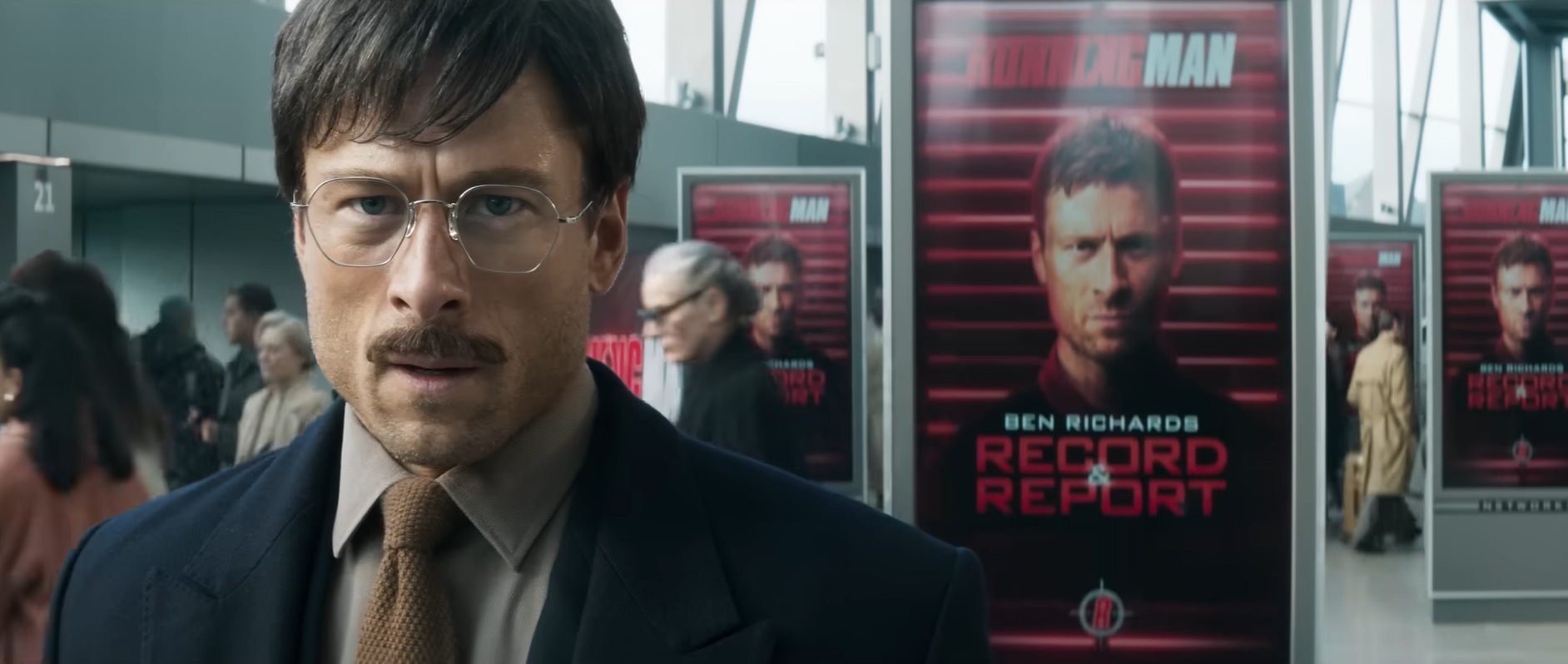
Hit Man is back! And this time, it’s personal!
Imagine you’re in a harsh alt-reality episode of Who Wants to Be a Millionaire? and the next question — for, I dunno, a cash prize of six bucks — is “How does this entry about Edgar Wright’s The Running Man begin?” The possible answers are:
- A. “In the wake of The Long Walk and The Life of Chuck, the best-ever year for Stephen King film adaptations maintains its batting record with yet another home run…”
- B. “As with his last feature film, the glam-noir psycho-thriller Last Night in Soho, Edgar Wright once again spins nostalgic flax into a new generation’s gold…”
- C. “After his charismatic turns in Top Gun: Maverick, Devotion, Hit Man, Twisters, and more, Glen Powell keeps flying high toward A-list cloud-nine…”
- D. “I read the book in high school and watched the Schwarzenegger adaptation on late-night cable around the same time, so I wrote 2000 words on all the differences I noticed…”
If you picked an answer, you’re wrong! They’re all lies. And in this harsh alt-reality the producers could drop your loser self into a boiling vat of Crystal Pepsi, film your embarrassing demise, have an A.I. Regis Philbin hologram deliver a mocking eulogy, and sell action figures of you covered in third-degree burns and sticky soda. But if you’re an average sci-fi citizen, of course the part that’d make you maddest in your final seconds of life on Earth is how you’re out the six bucks.
Call it dystopia burnout, but Wright’s take on The Running Man doesn’t add much new to the totalitarian-satire subgenre. Pop culture had no shortage of such feel-bad soapbox commentaries even before the current era of seemingly ultimate American suckage. Now that we can all produce and consume doom-and-gloom tirades and alarmist what-ifs for free online everyday, why pay extra for someone else’s derivative surplus, unless it comes packaged with Something Different? And this retread’s most enticing selling point was my biggest letdown: it could’ve been so much better if it’d actually felt like an Edgar Wright film. Like, at all.
Wright reunites with his Scott Pilgrim vs. the World co-writer Michael Bacall and once again imagines a hero whose life turns into one big video game. Powell is Ben Richards, a family man whose enormous chip on his shoulder from A Dark Past Incident gets him fired from the few jobs for which he’s ever been qualified, here in a broken future whose through-line is “what if some kinds of murder were legal”, practically in the same area code as The Long Walk. Whereas the latter’s American nightmare is government-run, this America takes its marching orders from a singular TV/internet entertainment supergiant called The Network, which is one one-thousandth as scathingly written as anything by Paddy Chayefsky. Josh Brolin is all smarmy grins as big-time Network producer Dan Killian, this future’s answer to Merv Griffin with several different game shows in his unfettered empire, most of which parcel out big bucks to rare winners and cheerfully kill off losing contestants without consequence or remorse. They’re so hardcore, they don’t even send the widows a consolation copy of the home game.
So we’re already on familiar ground. Here in a not-too-distant future of Mr. Terrific flying-ball cameras, smart parachutes, and 4K deepfake videos cranked out mere seconds after the original footage, once again another unseen lineup of The Powers That Be has legalized certain forms of murder. As always, the powerless populace surrendered to that fiat long before the story starts (“Eh, it sucks to watch people dying on live TV, but whattaya gonna do?”), but we’re joining in media res to discover that they’re also threatening our money, so NOW THEY’VE GONE TOO FAR. That’s where Ben comes in: his wee daughter needs basic flu meds, and his palpable desperation leads him into the deadliest show of all, which has the simplest objective to sum up and the biggest prize to covet. Contestants on The Running Man need merely survive for the next thirty days. Winner gets one billion New Dollars; second place is you’re dead.
(Yes, the currency of the times is called “New Dollars”, worth way more than today’s eventually obsolete tiny dollars. That wee touch was one of my favorite parts. Sometimes it’s the little things that put a glimmer in my eye.)
To “survive” doesn’t just mean going home and watching the calendar: runners must evade a team of professional assassins, led by a masked and underused Lee Pace (Foundation, Pushing Daisies) and given carte blanche by the authorities. Kinda like Jeopardy! or Wheel of Fortune, viewers can play along! But instead of pretending to shoot 8-bit running avatars in a phone app, they can win smaller cash awards by calling in tips if they spot the TV fugitives in their area. Same as most post-Constitutional fictional Americas, the inured audiences are passive mobs glued to their screens and rooting for whoever’s doing the lynching as long as the victims aren’t one of their own.
Again, bloodlust as an entire nation’s ingrained culture is familiar ground. Killian mentions Roman gladiatorial arenas so I don’t have to, but I’m mentioning them anyway along with…well, for the sake of gratuitous recency bias among the easy comparisons let’s also name-check The Hunger Games. This game even has its own analog to wacky host Caesar Flickerman, though Academy Award Nominee Colman Domingo is weirdly less flamboyant here than he was in Rustin, as if he didn’t fret the typecasting till after he signed the contract. Once again it’s all our faults as a species that violence is the one true way to get things done, though this call-to-action feels less wired and more tired as sentient civilization continues its cognitive decline, and barely qualifies as “satire” in a world where an entire ghoulish subculture wishes Tiger Beat were still around so their dreamboat idol Luigi Mangione could make the cover.
Anyway, from there it’s one big man-on-the-run movie for Powell as his killer road trip whiplashes through a series of disguises, ruses, hideaways, and EXPLOSIONS, with occasional reliance on The Kindness of Others. The numerous fights and chases are mostly just-okay in an old-fashioned sense, not shocking enough to generate any real tension and bringing little of that Scott Pilgrim inventiveness or Baby Driver‘s audacious verve. The cockpit free-fall sequence at the climax might’ve thrilled a tad more if it hadn’t already been the trailer’s entire climax. (That was practically an edited-for-TV airing of the entire scene.) It takes a while to accept Powell as a grim-and-gritty Rebel With Cause till he finally loses all his remaining cool in the second half and sheathes his too-charismatic smile and affable nature for a spell.
Almost none of the friendly insurgents or bystanders along the way stick around long enough for us to appreciate their contributions or lament their departures, with two exceptions. Michael Cera, Scott Pilgrim himself, boosts the energy needle as an invasion-prepped counterculture zinester. The most anarchically Wright-like sequences feature Daniel Ezra (star of The CW’s All-American) as an underground truth-teller calling himself the Apostle, keeping it real with primitively DIY wisdom-dispensing videos that stand a better chance of fomenting revolution than anything else in corporate sight.
A good 35+ years have passed since I read the book as part of the original Bachman Books 4-in-1 collection. I can’t remember whether I saw the movie before or after the book. I remember the scene with the chutes slightly redone here, Arnold’ corny one-liners (which Powell mostly resists — mostly), and original Family Feud host Richard Dawson’s believable turn as his own mirror-universe twin. If nothing else, I’m unburdened with how this stacks up against those.
My fading memory notwithstanding, if you’re new to game-show sci-fi allegories writ large, The Running Man might suffice as a textbook primer, but it plays largely like a work-for-hire audition, as if Wright still regrets parting ways with Marvel on the first Ant-Man and wanted to prove he’s willing to work within major-studio guardrails after all. The worst offenses in his tryouts might be the last two tacked-on scenes, which reek of focus-group concessions. I cheated and looked it up: neither scene was in the book. I’m guessing Wright’s real-life Network bosses thought King’s original ending was just too bleak for us to handle and we’d all need happy pills so we wouldn’t feel self-conscious about going back to watching underemployed, under-talented wannabe influencers degrade themselves for a living on reality TV or TikTok.
Which, again: not really cutting-edge commentary on my part, either. If I keep seeing films repeating each other, chances are I’ll get just as repetitive on my end. Maybe that’s what I really resent most. The clarion calls for us not to be numbed by all humanity’s sins become, in their sheer tonnage of redundancy, just as numbing themselves.
…
Meanwhile in the customary MCC film breakdowns:
Hey, look, it’s that one actor!: Powell’s fellow runners include his Twisters colleague Katy O’Brian (M:I-VIII, Christy). The other hunters include Karl Glusman (Devs‘ missing husband).
Jayme Lawson (Sinners, The Batman‘s Gotham mayor-elect) is demoted here to Ben’s Concerned Wife. Happy helpers in Powell’s path include William H. Macy (Fargo, Mystery Men) and Emilia Jones (CODA, Locke & Key) as a fashion-conscious driver who learns a Very Special Lesson about the authorities she trusts.
Sean Hayes from Will & Grace hosts a murder-forward TV quiz show. Debi Mazar (Goodfellas, Batman Forever) stars in an ubiquitous reality show about screaming rich wives. David Zayas (Law & Order) is an old acquaintance of Ben’s. Character actor Corey Johnson (last spotted in September 5) owns a motel.
Blink and you’ll miss the aforementioned screenwriter Michael Bacall — who started out as a teen actor and was a onetime Buffy villain — cameo as a bald stoner.
How about those end credits? No, there’s no scene after The Running Man end credits, but they’re fun to look at — static cards mocked up like punk zines from way back when. The design nods to a key plot point, even though the supernaturally handsome aw-shucks Mr. Powell looks about as punk rock as the Mighty Crabjoys.
Discover more from Midlife Crisis Crossover!
Subscribe to get the latest posts sent to your email.
 Midlife Crisis Crossover!