Reservoir Dogs x V for Vendetta.
Two-Time Academy Award Winner Emma Stone has earned the clout to do only whatever she feels like after La La Land and Poor Things cemented her in the Hollywood history books, not to mention her nominations for Birdman and The Favourite. She could easily coast for the rest of her career playing unstoppable world-changing women with the best fashions, hairstyles, and male costars equal or lesser to her in power rankings. She’s more than earned the right to just sit back, relax, and coast along as the headliner in a network or streaming legal drama for the next ten years.
Instead with her latest she’s doubled down on her current outré mood. Anyone who hasn’t seen her previous black comedies she made with the idiosyncratic director Yorgos Lanthimos — not just The Favourite and Poor Things, but also Kinds of Kindness, which I have yet to endure — may be unprepared for their latest collaboration Bugonia. Technically it could be reduced to a too-basic streaming-menu logline: “Resourceful businesswoman must escape the madmen who kidnapped her.” Sounds like it could be slotted snugly in between 20-year-old basic-cable remainders and Netflix’s increasingly middlebrow offerings, right? Like a prime candidate for an inaugural Investigation Discovery TV-Movie of the Week? You could maybe even con subscribers into thinking it’s a vanguard in that burgeoning new pop culture market, “Based on a True Crime Podcast”. Eventually — and it does take a while — the viewer realizes with growing horror that it’s none of those things as Lanthimos gets down with his outlandish Lanthimosian self.
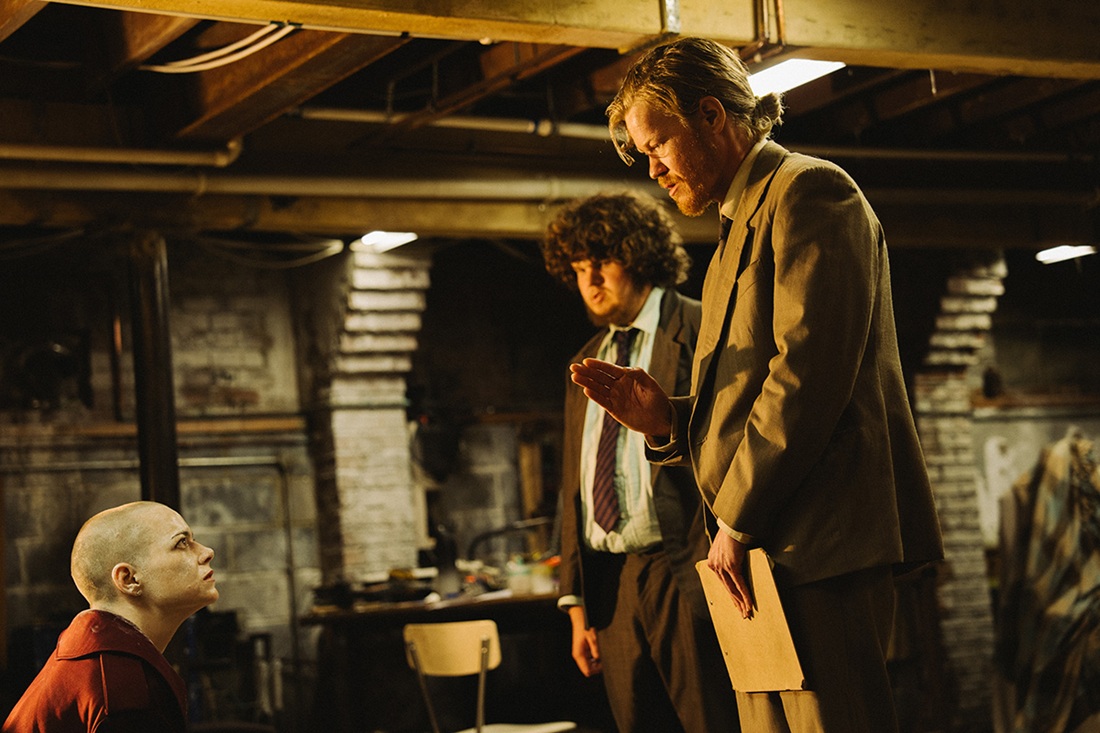
Stone plays Michelle Fuller, a type-A Pharma-Sis who enjoys self-defense exercises a little too enthusiastically in between her company’s board meetings, passive-aggressively connives employees into working longer hours by reframing their meek compliance as their own self-empowered choice, and feigns boilerplate regret for some products’ past untoward side effects in unsuspecting patients. Her routine is interrupted one day when she’s accosted by two bumblers who manage to overpower her despite themselves and drag her to their basement lair out in The Woods. (Locations are kept vague but at least one Atlanta skyscraper sneaks in a cameo.) Her captors don’t have any ransom demands and aren’t in it for money, perfectly content in their rustic house, likely inherited from now-dead relatives who knew how to take care of it. They just want her to confess she’s actually an alien invader who’s helping take over Earth and need her to set up a meeting with her overlords. To ensure she doesn’t alert any nearby alien soldiers, they shave her head, thus cutting off what they believe is her alien hotline.
That last part alone should separate Bugonia from the “ordinary kidnapping drama” herd, but the film’s first half plays so deceptively normally that you could redub a few key dialog bits and wrangle it right back into the herd. I’ve talked to more than one person who concur this stretch feels like Lanthimos’ least bizarre film to date — a melodramatic two-hander replete with the usual pleading debates between aggressor and victim, as well as a fairly subdued torture scene creating no more tension for the audience than the average Lifetime TV-PG evil ex-husband with a steak knife.
Fortunately for us Stone is more than a mere Strong Female Protagonist and our lead malcontent is an experienced pro. Her Kinds of Kindness sparring partner Jesse Plemons plays Teddy, a blue-collar schlub who’s Extremely Online and believes he’s unlocked her top-secret conspiracy by staring at the internet really hard for too long. He means to wreck her agenda once and for all, thus saving humanity and the ailing bee colony he keeps in his backyard whose slow-motion extinction was his bellwether of our ostensible doom from beyond the stars. (Insert .gif of Doom Patrol‘s panicky Rita Farr in her Beekeeper suit yelling, “MY BEES!”) Teddy has roped in a single follower as his accomplice: his much slower cousin Don (first-timer Aidan Delbis, self-described autistic), who more or less thinks whatever Teddy tells him and doesn’t have the mental capacity to ask probing questions, do his own research, or recognize Teddy as possibly being a tad aberrant. (Teddy probably does all Don’s doomscrolling for him.)
Plemons is deeply in his element here, having racked up typecast-cred over the past several years as a Hollywood specialist in serene, unself-aware, potential sanitarium residents who’re immune to external intellectual input — cf. Breaking Bad, Game Night, Civil War, Black Mirror‘s “U.S.S. Callister”, I’m Thinking of Ending Things, and so on. (And those are just the ones I’ve seen.) He’s laser-focused in his crusade, confident in his extremely vague evidence, and a lot less doughy than he used to be, as if Teddy spent so much time cyber-burrowing from one rabbit hole to the next that he forgot to eat. And yet he retains at least a light grasp on reality — when he and Don nab Michelle, they’re both wearing rumpled, ill-fitting business suits, probably a notion on Teddy’s part that they should try to act “dignified” in their roles as self-appointed faux-Feds.
Stone being Stone, she gives no quarter for as long as possible as their debates segue into interrogation, all the more disconcerting when Michelle finally hits a breaking point, albeit for just a short span. Between the two of them (with welcome interjections from Delbis to break up the grim off-Broadway vibe), it’s quite a strongly acted ordinary kidnapping drama. Then at some point Lanthimos reminds us who he is as he unveils left-field machinations courtesy of the film’s screenwriter, Succession veteran Will Tracy, adapting a South Korean film called Save the Green Planet! (It’s now streaming on Kanopy.) Tracy’s last film The Menu was a terrifying satire of one-percenter largesse, the service-industry pros who damage themselves catering to their whims, and what madness might drive the latter to arguably disproportionate responses to upper-class greedy shenanigans. To an extent that theme continues here — Michelle the evil exec is no innocent, but Teddy’s grievance has mutated beyond burn-the-billionaires rhetoric into something even wilder.
So it’s not just rich-vs.-poor feuding — it’s their very realities clashing. Each is just as online as the other; when one quotes a diagnosis they read on the internet, the other rebuts in equal quote-retweeted measure. And so it goes back and forth, the discerning pop-culture viewer mesmerized and yet allowing a both-sides impartiality at first: what if Teddy’s right? Might the universe have indeed produced a sort-of interstellar social class above humanity’s own? This is Lanthimos, after all. And hey, odds are at least one of the zillions of ludicrous conspiracy theories out there just has to be true, right? What if this is the one? Fifty million flame-war veterans can’t all be wrong!
While a Stravinsky-esque score by Jerskin Fendrix (who also handled Kindness and Poor Things) reflects the shifting mental battlegrounds and disrupts our own complacency, Michelle and Teddy keep pushing and pulling in their existentialist tug-of-war (with poor Don occasionally grasping on in the back) until finally — FINALLY — stuff gets too real. Select flashes of graphic mayhem intrude, questions are answered definitively (or ARE THEY?), and the last fifteen minutes escalate in radical fashion, in a manner so contrarian to expectations, it’s…well, it’s the sort of thing we’d’ve seen in a bygone era if anyone had ever written Rod Serling a check for tens of millions and told him to make the Best Twilight Zone Ever. Bugonia isn’t quite to Serling’s level, mind you. I’m just saying it reminds me of a few episodes.
After the dust has settled, further meditation on what’s just happened might reveal the clever trick Lanthimos pulled right under our noses. At one point a character gives a lengthy speech that seems to give away the entire game, but if you can hold onto your impartiality for a few more minutes as you’re trying to outguess the filmmakers, you can still imagine how the other version of reality could be true despite what’s being said if just a few key things have been happening offscreen whenever the camera was turned away. Then, same as happened to me, a day later you might realize you’re doing exactly what it seems Teddy’s been doing all along: explaining away logical gaps through the lens of your own confirmation bias — rationalizing the film’s final moments so they fall in line with any number of pop-culture precedents, when in fact Lanthimos has conned you into eagerly trying to swallow Occam’s Razor whole.
…
Meanwhile in the customary MCC film breakdowns:
Hey, look, it’s that one actor!: Special guest Alicia Silverstone (Clueless, Batman & Robin) is Plemons’ mom in a flashback. Standup comic Stavros Halkias (Netflix’s Tires) is the only local cop with lines.
How about those end credits? No, there’s no scene after the Bugonia end credits, which flash by in Lanthimos’ preferred combo of static cards and unreadable font. For a change of pace, one letter in each line is rendered extra-large in the font used for the film’s logo and lined up in a single column. If you read the extra-large letters all in a row, they’re an acrostic that says…, uh, absolutely nothing. Unless it’s an anagram. Or the words are in Andromedon. OR THEY’RE ANAGRAMMED ANDROMEDON. THEY HAVE TO MEAN SOMETHING! THEY JUST HAVE TO!
Discover more from Midlife Crisis Crossover!
Subscribe to get the latest posts sent to your email.
 Midlife Crisis Crossover!
Great review!
LikeLike
Thanks very much!
LikeLike