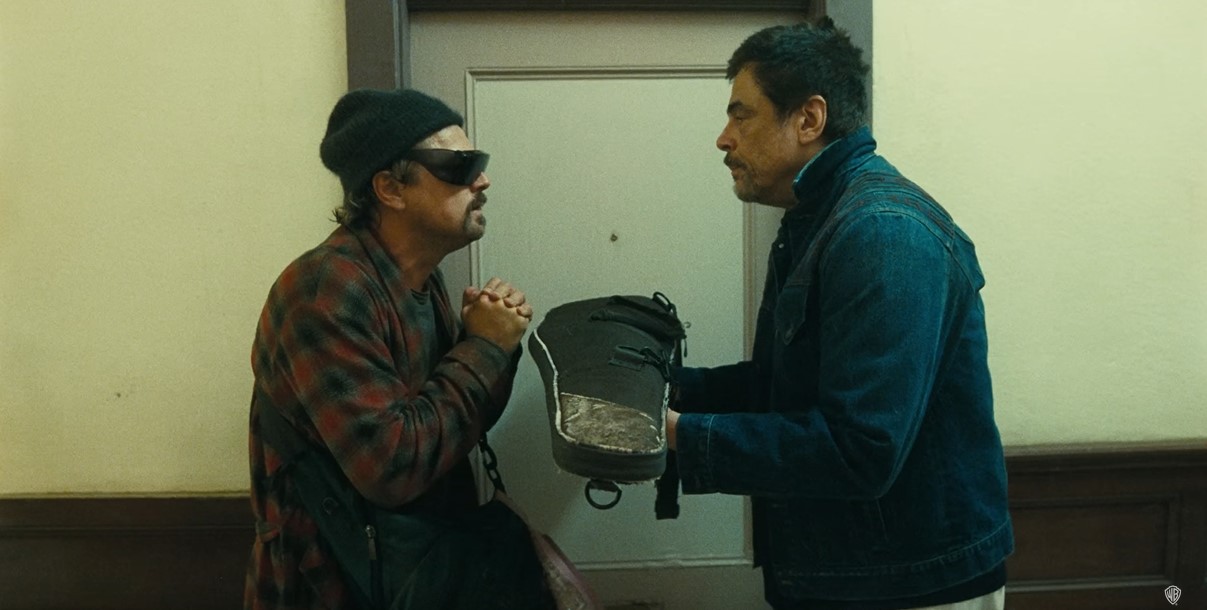
“Help yourself to a sniper rifle.”
“THE NEW PAUL THOMAS ANDERSON IS THE GREATEST FILM OF OUR TIMES AND CAPTURES THE ZEITGEIST LIKE EGON SPENGLER WITH A GHOST TRAP!” screams the internet consensus for One Battle After Another, as pro critics tend to every time they’ve seen a new Anderson film at least three times at festivals. I’ve only seen six of his films (counting this one) and responded to There Will Be Blood with that sort of awe. The rest varied for me — Phantom Thread was an intriguing battle of repressed wills, but I couldn’t connect with his California ode Licorice Pizza. His tenth feature, Battle is an effectively pulse-pounding thriller that’s exactly the sort of antihero conflict I do enjoy — call it “bad guys vs. worse guys” — but somehow I thought it’d be much more complicated than it actually is. Maybe that’s on me for declining to remain Extremely Online these days.
Once upon a time in the not-too-distant past — sometime after 1996, judging by a quick crack about Set It Off — our main man Leonardo DiCaprio is a milquetoast mad bomber named Pat who’s newly recruited into a hyper-militant faction called the French 75. His extreme-left clique is running around California doing crimes as a form of “protest” — freeing caged immigrants, shouting about open borders and other wish-list demands, blowing up various buildings and institutions, and enjoying whatever other large-scale felonies will help them make The MAN cry. They’re like the Weather Underground held a successful recruitment drive for angry Black women, led by Teyana Taylor (Coming 2 America) as one Perfidia Beverly Hills, which is presumably not her “government name”. If it is her character’s real name, I can only assume her dad was a cruel Latin teacher, which would explain a lot.
Pat and Perfidia hit it off and grow closer while sowing destruction and death hither and yon. Soon we realize she isn’t just in it to (somehow) overthrow the government and turn America into her kind of utopia: she’s getting off on the thrills. The courtship continues through the carnage till Perfidia eventually becomes a mother, but li’l baby Charlene cramps her revolutionary style. When forced to choose between mothering or mayhem, it’s the deadbeat-mom life for her, because America must PAY for what it’s done, and not just because she’s enjoying it a little too hard.
The merry malicious misadventures continue till her team commits an old-fashioned daylight bank robbery, which goes down by-the-numbers at first and surely aggrieves The MAN in his secret underground throne room. Then the unthinkable happens: a Black bank guard refuses to back down, leaving her no choice but to respond in bullets. This, of all things, is too much for her conscience to bear, as if he’s the first Black person she’s ever knowingly murdered because up to this scene their terrorism victims had all been white. Or! Or maybe we’re meant to believe the French 75 had been so studiously careful with their flamboyant demolitions that they’d racked up nary a casualty till just now.
(Either way, I’m reminded of a particular ’90s Marvel comic that expected us to believe the Hulk had retained so much of Bruce Banner’s hyperintelligence that in all his decades of rampaging through various downtowns, he’d actually been subconsciously calculating his “HULK SMASH!” fits to ensure that not one innocent person ever died amid the billions in Godzilla-level property damage. Sure.)
Sixteen years later — even farther beyond Set It Off but long enough ago that there’re still working pay phones around — the French 75 have disbanded, but several members were never caught. Pat the Midnight Bomber What Bombs at Midnight and li’l baby Charlene are now stoner burnout Bob and his teenage charge Willa (Chase Infiniti, from Apple’s Presumed Innocent). Willa has grown up levelheaded even though Bob won’t let her have a cell phone (or maybe she’s levelheaded because of that?), while Bob mostly sits on the couch and numbs himself into a blissful stupor in between bouts of…well, however in the world he managed to parent her into competence. Alas, it’s only a matter of time before Pat’s past catches up with him and The MAN demands justice, revenge, and/or tyranny.
Hunting everyone in both the near-past and the quasi-present is Sean Penn in one of his most loathsome roles yet, as military commander Steven Lockjaw (who sullies the good name of the Inhumans’ lovable super-dog). Back in the day, he was just the officer who oversaw the detention compounds, failed to foil the French 75 much, and had more than one run-in with Perfidia. Here in the present, he’s kept his job anyway and even been promoted ever higher, to the point of attracting the notice of the highest-ranking villains around: a racist cabal called the Christmas Adventurers Club whose rituals elevate St. Nicholas as their idol. These buddy-buddy culture-warriors pull strings behind the scenes in their never-ending fight against “lunatics, haters and punk trash” and surely aspire to Make Christmas Great Again. Lockjaw is such an aggro hero in their estimation that he’s being considered for full membership, assuming he keeps up the evil work and hasn’t shown the slightest positive emotion toward a nonwhite, which of course would be the worst possible culture-war atrocity in their strict whites-only bylaws.
[Imagine a deleted reference here to Peacemaker season 2 that would be far too much of a spoiler while that’s still in progress.]
Over half the Battle is Bob and Willa on the run from Lockjaw’s forces, who’ve tracked them down to their modest digs in a sanctuary city called Baktan Cross, where folks are living perfectly peaceably (though cops later dig up a spacious drug lab when mass arrests begin). Luckily for them the locals have contingencies in place for just such an incursion, led largely by Benicio Del Toro as Sergio, the sensei of the “ninja school” where Willa’s been a highly ranked martial-arts student. Successors to the French 75’s legacy are embedded among them and coordinate with Sergio’s people as well. Down in the trenches out of The MAN’s line of sight, anarchy is out and command structure is in.
The struggle against the Lockjaw clampdown is real. A skirmish ensues — not a riot per se, as the defenders clearly aren’t looting their own stores. A stupendous tracking shot follows a fleeing Bob and other street-smart folks as they bound across the rooftops over the neon-lit nighttime fray. Unfortunately Bob isn’t quite the rebel he used to be, thanks to all those darn substances. The film’s most hilarious scenes involve Bob repeatedly trying to call the Rebel Alliance for help but can’t get past their call center, which is a thing they have, staffed with reps who’re such sticklers for procedure that they refuse to grant an exception to the legendary Bob when he can’t recall all the correct code-phrases. Because of course Bob should’ve never stopped refreshing his memory through all these years if he really cared about changing the world.
Bob isn’t the only guerrilla with issues, though. One of the recurring motifs is how every single one of his ostensible compatriots is tested and sooner or later every single one of them fails La Revolucion in some fashion. It isn’t far removed from the events of Andor and its hard-hitting take on the uncompromising extremes that a truly effective revolution would require of every single believer, with no allowances for innocent discrepancies and no forgiveness when the enemy takes advantage of their mistakes. But the French 75 have no Kleya to make the hardest choices — not even Perfidia, who once led with an obsessive ferocity, only to be undermined by the consequences of her own choices and contradictions. And so it goes with nearly every link in the chain, except maybe the highly organized Sergio, unless you count his flaw in his plan that assumes Bob could still handle himself.
Whither “the good fight”, then? Eventually this all lands on the shoulders of young Willa, ostensibly part of the next generation they hope might carry on this legacy. The film’s second half likewise depends on the performance by Infiniti (full disclosure: she’s from here in Indy!) as…well, not exactly the French 75’s Chosen One, but at the very least she becomes the living MacGuffin who has to choose to accept that baton from the elder firebrands, assuming she survives the ordeal at hand. That’s no easy feat in the malevolent face of Lockjaw himself and the full force of Penn’s fury aimed firmly at her.
As time goes on, though, Anderson begins to hedge his bets and diverts the struggle away from The MAN with a single line of dialogue that asserts Lockjaw’s minions are a separate party from the local authorities, who maybe aren’t all directly reporting to the racist cabal. Though the surface commonalities are obvious between Battle and current events in Portland or Chicago or whichever American city the American government is rattling its sabers at today, at no point did I feel, “Yes, all this is happening RIGHT NOW! Preach it, Anderson! Trump sucks!” In the manner of many a film that aims for a “timeless” feel (so to speak), setting it in a fictional city and avoiding specific references to any personalities of the current moment — no politicians or social-media titans singled out by name — arguably makes it easier for future audiences to imprint with the elected boogeyman of their choice.
Obviously Anderson favors one side more than the other, and I can’t imagine he’s really hoping “both sides” come see this (DiCaprio’s and Penn’s well-publicized leanings aren’t exactly selling points in red states), but there’s a disconnection between the domestic-terrorist aggression in the extended prologue (where any potentially “evil” authority figures besides Penn are invisible) and what’s largely staged as the Baktan Cross community’s self-defense against an unsanctioned rogue army in the back half. Other viewers might infer the entire point of Battle is a ripped-from-the-headlines stance as simplistic as “fascism = bad”. I’ve yet to see Anderson pander that easily…or do anything easily, for that matter. The next day after seeing this, I finally checked out Inherent Vice, whose existential interconnected American Dirk Gently hippie-noir is a lot messier and more ambitious, and consequently makes Battle‘s plot feel like an ordinary fugitives-on-the-run drama.
That said, One Battle After Another well exceeds the fugitives-on-the-run suspense baseline so enthrallingly, its 140+ minutes flew right by with no breathing room for dull pauses. Credit some of that relentless rhythm to Anderson’s composer pal Jonny Greenwood, who alternates occasional jazz piano — sometimes jaunty, sometimes absurdist — with some unconventional choices for instrument solos, and especially comes to the forefront in a climactic car chase up and down vast desert hills driven by a drums-and-horns assault you can practically feel reverberating through the pedal-to-the-metal engines.
The ensemble in general compels through each fraught moment — the aforementioned Infiniti adjusts as Willa regains enough composure to stand her ground, Taylor juggles Perfidia’s warring impulses, and an invigorated DiCaprio, who’s thankfully not just reprising his annoying Killers of the Flower Moon dimwit, has to fight through his self-inflicted haze and really show us what a strong father/daughter bond looks like, sixteen years in the making. That victory, above all else, is the real battle at hand.
…
Meanwhile in the customary MCC film breakdowns:
Hey, look, it’s that one actor!: Other French 75 members include Wood Harris (The Wire, the Creed series), Licorice Pizza‘s Alana Haim, Regina Hall (the Scary Movie series), and an unseen Jena Malone at the call center. Racist cabal members include Tony Goldwyn (Ghost, Hacks), D.W. Moffett (May December), longtime SNL writer Jim Downey, and Kevin Tighe, star of the ’70s fireman drama Emergency!
How about those end credits? No, there’s no scene after the One Battle After Another end credits, which once again flip past us in Anderson’s preferred static cards rather than the easier-to-read scroll. Musical accompaniment includes Tom Petty’s “American Girl” (not in the same context as when Jonathan Demme used it in The Silence of the Lambs), an Ella Fitzgerald Christmas carol, and Gil Scott-Heron’s “The Revolution Will Not Be Televised”, some of whose lyrics are a major plot point.
After the credit-cards comes one last image: the dedication “For Adam” with a photo of Adam Somner, an assistant director on several of Anderson’s films, including this very one before he passed away last November. A soundbite snippet lets us hear him doing, I’m guessing, what he loved doing most.
Discover more from Midlife Crisis Crossover!
Subscribe to get the latest posts sent to your email.
 Midlife Crisis Crossover!
Great review!
LikeLike
Thanks!
LikeLike