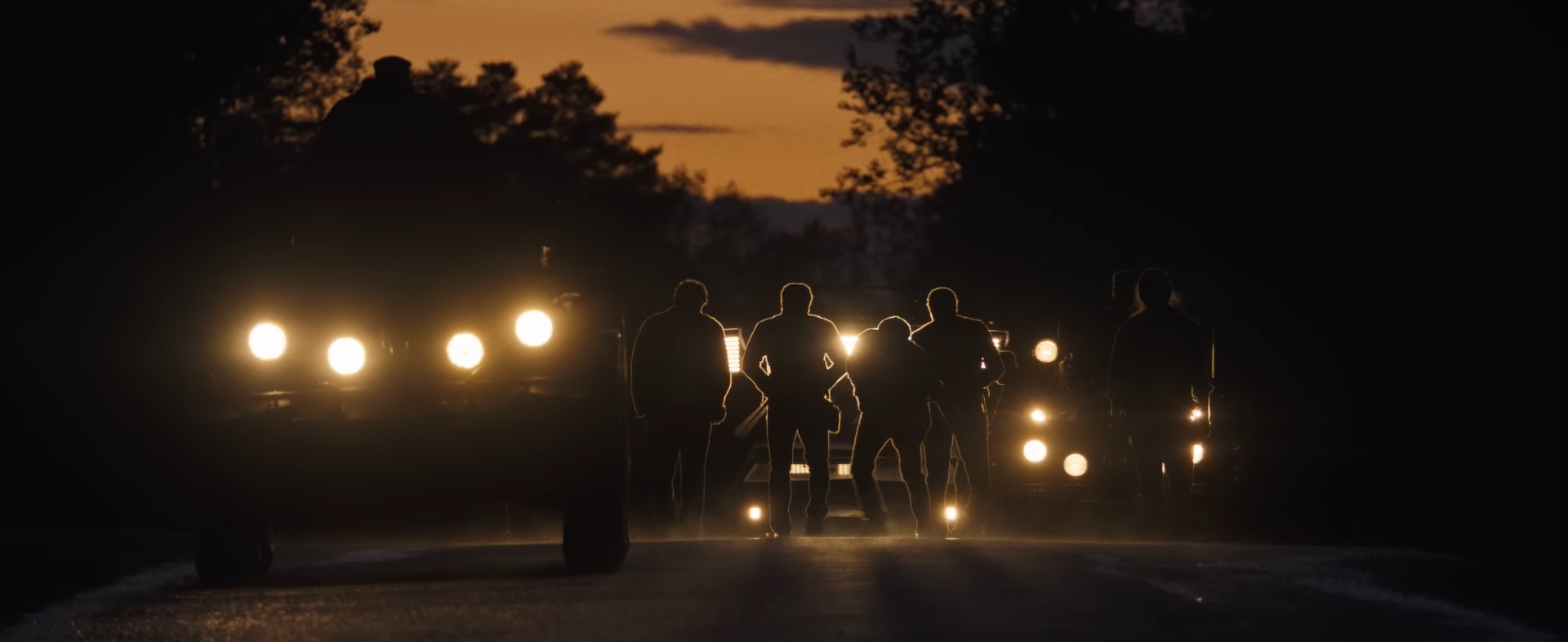
A moonlit stroll with a mounting death toll.
Rare are the harmonic convergences when at least two excellent Stephen King adaptations reach theaters within the same calendar year. I’m still upset everyone slept on the heart-melting sci-fi sweetness of The Life of Chuck (admittedly I’ve skipped The Monkey for now), but I can understand the muted turnout for the survival-horror bloodsport of The Long Walk. If I might understate to a subterranean degree: these past two weeks perhaps weren’t the best time for moviegoers to come out and watch young men be gunned down helplessly before their very eyes.
(Then again, when’s a good time for that anymore?)
In the film’s near-future postwar America, the titular event is held whenever The Powers That Be feel like it. Young men nationwide, some of them teens (I’m unconvinced they all are), willingly enter into a lottery, from which fifty are selected. (Sorry, no women — sexist regime rules, maybe.) The day of, those “lucky” contestants gather and begin striding together down an endless road, alongside military escorts headed by a bellowing taskmaster called The Major (Mark Hamill, relishing his Life of Chuck grandpa’s fall to the Dark Side). They just keep walking and walking and walking and walking, as there appears to be a “no fighting” rule that forbids anyone from just gunning everyone down in the first three minutes. They’re required to maintain a minimum speed of 3 mph; if they fall below for thirty seconds, or too many times within one hour…well, that’s what all the armed watchdogs are for. They keep going till they can go no further. Last man breathing wins. It’s fifty guys in a Speed RPG, summed up aptly by the Major: “One winner and no finish line.”
For one stubborn male who puts in the work and/or gets really lucky, the prizes are huge: untold wealth and one (1) wish granted. They’re free to dream big for the latter, so they don’t have to settle for being John Cena’s one millionth Make-a-Wish kid. The Long Walk isn’t just a desensitized reality show: its promise of a life-changing prize is what passes for hope in a world where all other inspirations have evaporated. Some days, this dysfunction doesn’t feel as “near-future” as it used to.
That’s it, that’s the movie. For me, that’s all my teenage self wanted. During my Stephen King binge in high school and college I read nearly all his novels from Carrie through Gerald’s Game (except the Dark Tower series), and The Long Walk was my favorite of his first five pseudonymous Richard Bachman pulp tales. Apart from an ambiguous subplot involving a shadowy figure following along the sidelines (omitted from this adaptation), King committed to the bit with a certain purity of focus and followed the death march through to its bitter end. To my teenage self, the thrill was like listening to the Indy 500 on AM radio — the only sporting event I ever had any interest in — but revamped with harsher rules that forbid pit stops and every car has to keep going till it runs down and then a bomb in the engine explodes.
Director Francis Lawrence, no stranger to dystopia (nearly all The Hunger Games) or post-apocalypse (I Am Legend), upholds King’s commitment with very few interludes after the surprisingly short prologue. Lawrence and screenwriter JT Mollner strip the standard And Then There Were None horror-story design down to its narrative spine — the metaphor of life as one endless path we’re all sharing, where the pains are more bearable if we’re empathizing rather than inflicting them on each other, taking comfort in that while knowing some of us will be left behind sooner or later, and of course realizing the real prize is the friends we made along the way, all of whom are just fellow survivors waiting their turns to become victims.
Yeah, it’s bleaker than bleak, but the nihilistic slog is at least a smidgen less soul-crushing than your epic-kill slasher-flicks that dispatch the entire cast, smash-cut to black with a silent “And then they all died, The End” and leave the viewer clutching at their antidepressants. Just a smidgen, mind you, especially whenever Lawrence zooms in a bit too lovingly on a brutal head-shot as if to showcase recent advancements in CGI blood-splatter techniques. What keeps us and them going is the company kept — a charismatic bunch of equally naive characters who convince themselves they alone shall be the Chosen One to brave the torturous exercise and win at life, in a country where the incumbent winners get to redefine “winning” for the peanut-gallery classes who’ll never be their equals.
The strongest performances come from the leaders of the pack — Licorice Pizza‘s Cooper Hoffman as the affably morose Ray Garraty, and Alien: Romulus standout David Jonsson is Pete McVries, who smiles and keeps his chin up higher than most. The newly met buddies have their own wishes and tragic pasts, but over the miles their personalities click and they take turns keeping each other’s eyes on the prize, as well as those of everyone else around who needs the encouragement to help forget their traumas-in-progress. From a certain perspective they’re doing exactly what the Major wants — role-modeling the “work ethic” that the oppressors want to see in their willingly subjugated populace.
Their tag-team sincerity helps distinguish The Long Walk from some of King’s subsequent works. I was often reminded of his classic novella “The Body” (a.k.a. Stand By Me) but with more kids, more walking, and way more than a single dead body. And instead of debating Goofy’s species, they take turns swapping Shawshank Redemption uplifting speeches about their individual purposes, What It All Means, What Matters Most and so on. (The word “Shawshank” is among the film’s Easter eggs!) An internet forum full of dudes typing such paragraphs back and forth would make for stultifying scrolling, but Hoffman and Jonsson give the monologues and dialogues a more passionate credibility as they’re literally walking themselves to death and mourning their fallen companions one by one — sometimes more than one, as in a harrowing sequence involving a nighttime thunderstorm on an uphill stretch.
Lawrence’s biggest challenge is to liven up the visuals. Occasionally he and cinematographer Jo Willems (a Hunger Games teammate) pull back so we can take in the horizon at various points — generally a series of glum facades, yet infrequently some natural glory shines upon the treading downtrodden. But much of the film looks shot from the back of the Major’s truck, with the camera sitting on his tailgate while Our Heroes bounce and bounce and bounce with each step and try to keep up. During the scarier moments they’ll switch to roadside dolly shots and roll apace with the cast. Virtually every scene is a road, which gets repetitive for us and its walkers, though that’s arguably a good thing in that it keeps us focused on the ensemble’s tribulations rather than anticipating the next set-piece.
Viewers may want to pack some extra suspension of disbelief for the journey as well. The Long Walk persists for hundreds of miles nonstop over several days — no sit-down meals, no naps, no time-outs whatsoever, not even bathroom breaks. (The latter is addressed in a few realistically disgusting waste-related incidents. We’re mercifully spared any closeups.) Some entrants sleepwalk through long stretches, somehow without falling below 3 mph. Quite a few go mad long before their bodies give out. One contestant loses his shoes but keeps going at least another hundred miles. Such a relentless drill would destroy your average invading army. Some sort of nationwide catastrophe must’ve really toughened everyone’s soles and shins to superhuman degrees.
That incredible feet-feat notwithstanding, The Long Walk isn’t a feel-good escapist romp or even a rousing adventure of anti-fascist rebellion (well, a few of our guys do try). The mood may be too real at times and more crushing than you can bear, in which case maybe save it in your streaming queue till, say, January 2029. If you pay closer attention, though, King and Lawrence aren’t here solely to make you think about death and get sad an’ stuff. The budding camaraderie between Hoffman and Jonsson, which they both know is necessarily transitory, radiates outward to everyone around them. Some will never get it; some catch the wave, and boy, do they demonstrate it. At the heart of this dark fable, Ray and Pete are role-modeling in metatextual defiance of the Major in the wisest way: showing us that in this murder-marathon game we call life, it’s not about whether you win or lose…it’s about what you do for the other players while you’re in it.
…
Meanwhile in the customary MCC film breakdowns:
Hey, look, it’s that one actor!: Quite a few familiar faces populate the field. Ben Wang (American Born Chinese, Karate Kid: Legends) broadly represents for Noo Yawk accents. Charlie Plummer (Emmerich’s Moonfall) is a snarky bully hiding his own issues. Roman Griffith Davis, li’l Jojo Rabbit himself, hasn’t exactly bulked up. Manifest‘s Garrett Wareing is a cocky jock at first. Some of these sound like stock characters, but that’s me trying to avoid the less guessable spoilers. All the most prominent costars reveal more nuances as they go, especially Tut Nyuot (Netflix’s upcoming Steve) as energetic team-player Art Baker, who endures quite the emotional roller-coaster ride.
Beyond all the anonymous audiences cheering on the bread-and-circuses gauntlet, the precious few other characters out of competition include Judy Greer (Archer, Jurassic World) as Ray’s Concerned Mom. Josh Hamilton, the Concerned Dad from Eighth Grade, shows up later on similar terms.
How about those end credits? No, there’s no scene after The Long Walk end credits, but we learn all the dying small towns and endless untended fields seen throughout this dark-timeline America were actually shot in Manitoba. Yet again someone’s vision of America is a LIE.
Discover more from Midlife Crisis Crossover!
Subscribe to get the latest posts sent to your email.
 Midlife Crisis Crossover!