A father/son coming-of-age zombie hunt? What’s the worst that could happen?
Once upon a time in 2002, 28 Days Later led a post-Romero zombie revival that’s technically never ended if you’re still following at least one Walking Dead spinoff. (No, thank you.) Its depiction of a paler-than-usual 21st-century England overrun by frantic super-speed vomiting jitterbuggers was an electrifying revelation up until it turned into a military action flick and we all learned Humanity Is The Real Monster. But within the span of that terrifying first half, no one could deny the harmonic convergence of Trainspotting director Danny Boyle, The Beach‘s novelist-turned-first-time-screenwriter Alex Garland, and young unknown Cillian Murphy. The audience’s scars from that first half never fully healed.
Boyle and Garland hopped from horror to sci-fi with the riveting apocalypse of Sunshine, leaving their zombie apocalypse in other hands. I never bothered with the sequel 28 Weeks Later unless you count Screen Junkies’ recent Honest Trailer, which seemed like all the recap I needed. Generations later Boyle and Garland reunite for 28 Years Later along with cinematographer Anthony Dod Mantle, whose early pioneering in digital video worked wonders with Days‘ haunting imagery and jump-scare nerve-shredding before jump-scares were played out. The old team ignores Weeks and once again cranks up the visual voltage for half a film, only to diverge yet again from the undead stampede for someplace else. This time the topical shift resonates more bittersweetly. Well, mostly.
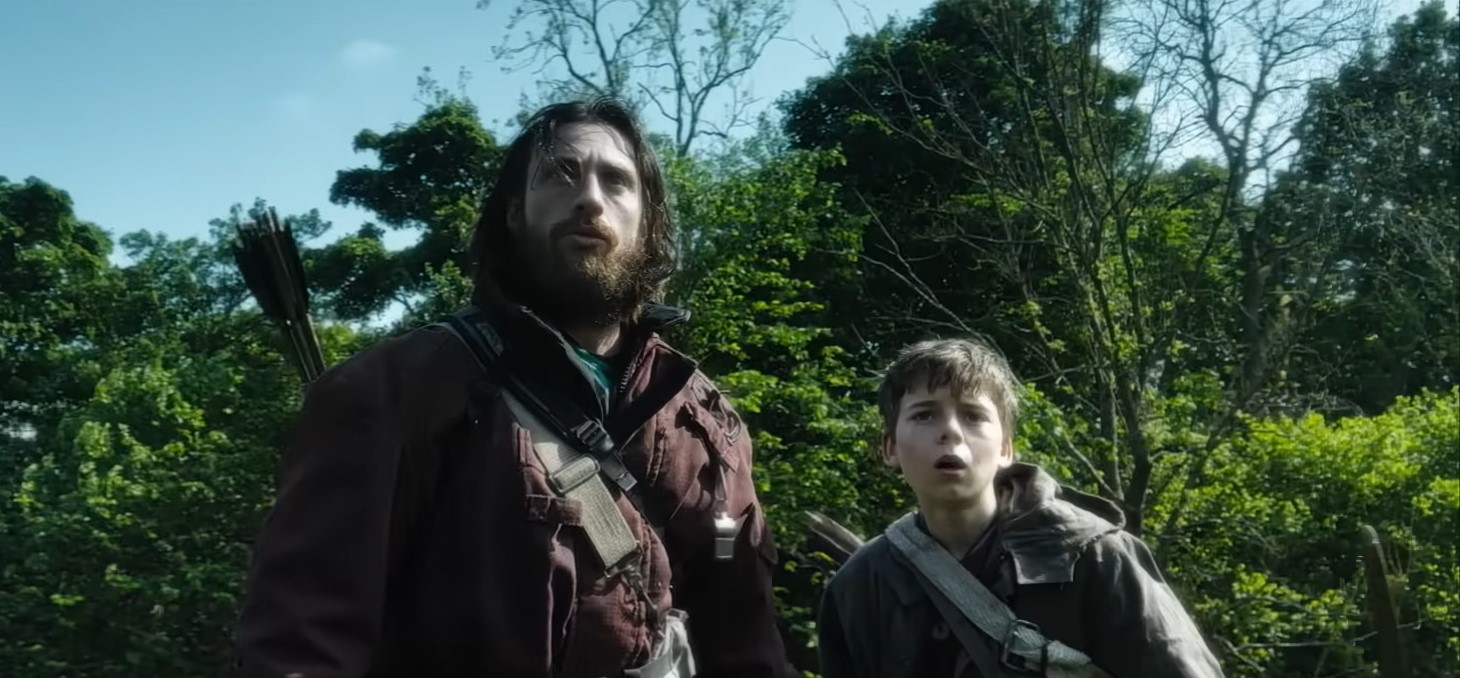
The series’ third film — not the conclusion of a trilogy — catches up with the former British empire, whose mainland as of the year 2030 is an unchecked wasteland where few dare tread because of all the rotting Olympic sprinters roving the terrain like escaped zoo animals or unleashed Jurassic World specimens. The zombies never quite figured out how bodies of water work, so the other nearby islands aren’t total write-offs. A small community lives and thrives on one nearby, where new traditions have arisen to meet the circumstances. To wit: whenever a boy lives to turn 12, Dad (if he’s likewise stayed upright) takes him on a zombie hunting trip over on the mainland. Even after the localized fall of civilization, coming-of-age rituals must carry on for the males of the tribe. (If girls likewise have the option to go play Elmer Fudd in lieu of coming-out galas, nobody brings it up.)
Franchise nomad Aaron Taylor-Johnson (Kraven! Age of Ultron! Godzilla! more!) is proud father Jamie; young Alfie Williams (who had a small role in Max’s His Dark Materials) is his son Spike, excited to notch his first zombie kill even though he’s scrawny enough that an overfed black bear could swat him across a river. Jodie Comer (Free Guy, The Bikeriders) is dear old Mum, who’s suffering from Mysterious Illness and can barely concentrate long enough to fret over her baby or tell him to bring a sweater. But the family does all right and Spike is well provided for, in a loving home where his bedroom decor includes a Power Ranger toy that wasn’t released till 2005, three years after England’s downfall. (Special shout-out to my son for catching the anachronism.)
Much of the film is Jamie and Spike embarking on their Dead Dynasty bonding romp, where circumstances of course go occasionally awry, against which they’re armed only with blades and bows-‘n’-arrows (because good luck carving bullets from trees). As with more than a few horror flicks, Our Heroes sometimes catch a break because the creatures have plot-dependent variable running speeds, but when those predatory prey zoom up-close in full-tilt thrasher mode, 28YL is the best kind of revival, vividly recapturing 28DL‘s adrenalizing frenzy. Amid the phantasmagoria and accompanied by the disorienting avant-industrial score by Scottish prog-hop group Young Fathers, Mantle crafts horrific little sidebars of picturesque madness that editor Jon Harris julienne-splices into the harsher moments, mid-period-MTV-style. Music videos don’t overuse the gimmick like they used to, so it’s all the more jarring in its comeback. Whenever the camera calmly retreats to a panoramic vantage, the vast miles of verdant English overgrowth are rendered beautifully and dangerously at the same time.
After the return home and the town’s ensuing Oktoberfest, Boyle and company pivot as Spike comes up with a quest of his very own, one that’s not a sanctioned town ritual but means the world to him despite the astronomical odds against it. On his next journey the zombies are reduced from quarry to incidental obstacles, though in the grand horror-sequel tradition some receive stat-boosts anyway. Among the hordes has risen an Alpha (Kraven stuntman Chi Lewis-Parry) who’s not just an intimidating man-mountain: he’s also smarter and more observant than the average shambler. He’s hardly pop culture’s first brain-eater with upgraded brainpower (also of recent vintage: The Last of Us season 2, or Zack Snyder’s Army of the Dead featuring multiple Alphas), but he stands out from this particular pack and comes so close to having a personality.
Other strangers show up along the path, such as a Swedish soldier (Edvin Ryding) who’s practically teleported into the film, wielding a big manly gun that would solve every problem in a more ordinary story. Viewer curiosity leaps ever higher when Three-Time Academy Award Nominee Ralph Fiennes arrives late to the party, looking more outlandish than Voldemort ever did as a resourceful hermit doused in red (though it’s not blood!). Upon his arrival those screaming masses drift back into the scenery and a rather different conflict unfolds beyond man’s control. Boyle shifts gears to a more measured pace as Garland reveals the film’s true heart — one of vain hopes in a hopeless environment, of love in an arena of rage, of reconnecting with inner humanity in the middle of the killing fields. (Mind you, the chain of events accelerates disturbingly rashly for one character.)
Audiences gripped by fiercer bloodlust craving their EPIC KILLS NOW NOW NOW might then revolt. Given Garland’s recent track record for sometimes denying our base cravings (the antiwar Warfare, the antipartisan Civil War), it’s worth wondering if maybe the best zombie movies are the ones that veer from the storytelling dead end by transforming into another kind of movie. I didn’t buy it when the best 28DL could do was “There will always be awful people” (which later became the only real moral of The Walking Dead ‘verse), but nearly three decades subsequent, the original filmmakers have matured enough to contemplate the optimistic possibility of whether other kinds of people might live on, too. Aiding that cause, our rising star Alfie Williams holds his own with far more seasoned actors and is surprisingly strong enough to bear the staggering weight he’s asked to carry.
And then 28 Years Later makes the fatal mistake of going on five minutes too long.
As it happens, it doesn’t bring closure to the previous films or even for its own sake. Rather, it’s Part One of its own trilogy and ends To Be Continued, with Part Two already completely filmed and planned for release early next year. It might hurt less to know that going in, but yep, it’s Dune and Deathly Hallows and Infinity War all over again, thoroughly aggravating for those who demand any given film be a functionally self-contained work in itself rather than one segment in an expensive TV series. (At least Wicked: Part One had the excuse of conforming to a template.)
And the final scene is…well, not exactly a cliffhanger. You just have NO IDEA. Nothing can prepare you for those final moments, an abrupt aberration seemingly extracted from a completely different concoction, possibly from a Saturday morning of yore. Yes, okay, technically the end is foreshadowed, with clues scattered hither and yon — many of which I spotted, but I deny the non-Euclidean math that would’ve been necessary to make them add up to me accepting such a “twist”.
In fact, here’s a suggestion: a few minutes before the end, as soon as the scene shifts to a quiet walk along a seemingly empty road, just RUN AWAY at top super-zombie speed. After the next film is on your local theater’s schedule the very next week, then maybe go-go back for that goofy coda. Otherwise, from now to then you’ll find yourself beset by the wrong kind of “haunting”.
…
Meanwhile in the customary MCC film breakdowns:
Hey, look, it’s that one actor!: Other happy citizens on Spike’s island-next-door include Stella Gonet (Spencer, El Conte). At the very end, Jack O’Connell is…well, if you thought he was remarkable as the banjo-twangin’ head vampire of Sinners, rest assured he isn’t done searing his image into your memory banks just yet.
How about those end credits? No, there’s no scene after the 28 Years Later end credits, but we learn original star Cillian Murphy netted himself an Executive Producer honorific even though he’s Sir Not Appearing in This Film. The copyright attributions mention footage from 28 Weeks Later appeared somewhere in the runtime. Also, SMASH-CUT ZOMBIE FLASHBACKS are spliced into the credits from beginning to end for value-added needle-pokes while you and the rest of the dumbstruck audience just sit there looking at each other and wondering about that ending.
Which, once more with feeling: To Be Continued!
Discover more from Midlife Crisis Crossover!
Subscribe to get the latest posts sent to your email.
 Midlife Crisis Crossover!