
Let the clipfest begin! From C2E2 2023, Anne and myself in a jazz-hands photo op with Chris Evans, the old Captain America.
Previously on Midlife Crisis Crossover: my wife Anne and I share a fannish love of attending entertainment and comic conventions together, whether in our hometown of Indianapolis or in adjacent states (or sometimes beyond). She’s been doing them since the early ’90s, and invited me to tag along as our relationship evolved from classmates to coworkers to neighbors to BFFs to married geeks, now twenty years and counting. We’re the Goldens. It’s who we are and what we do.
Every con is someone’s first. We’re happy to offer advice whenever we chat with newcomers to the scene. In the various Facebook groups dedicated to each of the cons we regularly attend, Anne has taken to posting practical advice for newer con-goers — the teen, the elderly, and everyone in between — who are beyond excited to mingle in all those crowds of merry hobbyists and scintillating costumes and vintage collectibles and character merchandise and rows of celebrities from their favorite movies, TV shows, animated works and streaming channels. It’s a lot. It can be daunting to figure out where to start. It’s normal to feel overwhelmed. It’s impossible to prepare for every possible contingency.
Cons are foremost on our mind in anticipation of our season beginning next weekend. As we discard the psychological shackles of a depressing winter and prepare to leave the house a little more often, we offer a selection of suggestions for coping with some aspects of the comic-con experience for the absolute beginners out there.
Part I: Intro to Conventions 101!
Comic/pop culture/sci-fi/entertainment conventions generally operate in much the same way, regardless of the company that runs them: fans gather at a convention center or hotel or whatever meeting space, run into other fans (in costume or not), buy merchandise, meet special guests, attend panels and Q&A sessions, support local and nationally known artists and writers, and survive on concession-stand food that might contain as many as two FDA-approved nutrients. There might be a few dozen of you in a single ballroom or teeming masses of 70,000+ sprawled across multiple hosting facilities. Attendance and square footage will vary, but they share a lot of the same framework.
Our kind of cons happen on weekends. Most last from Friday to Sunday, but schedules can vary depending on the showrunners’ budget and expectations. An admission ticket is required to attend — whether just a one-day ticket or a full weekend pass. Check the website to determine what each ticket option includes so that you can choose the best fit for you. Will you have enough time to attend more than one day? How long a hotel stay can you afford? Does the con’s schedule even contain three days’ worth of activities and events that interest you?
The admission ticket only lets you into the show; it typically will not include free autographs or photos with any of the celebrity guests. (Some smaller cons used to include those! That was 25-30 years ago. The game has changed.) You must purchase autographs and photo ops separately for each guest you want to meet. Conversely, photo-op and autograph tickets do not include admission. You will not be able to enter the show without an admission ticket, even if you have purchased a photo op or autograph ticket. Yes, all these tickets add up.
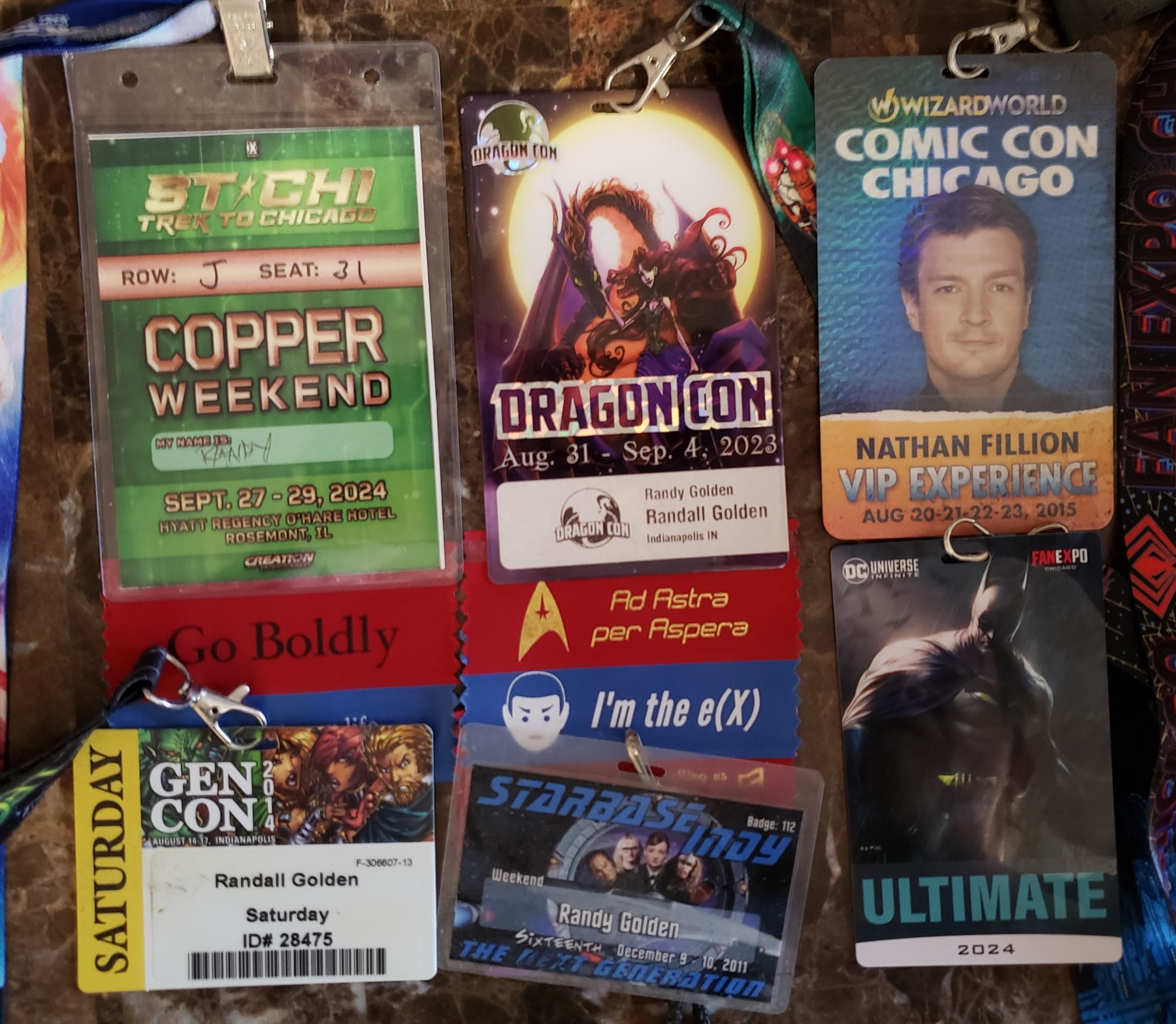
Selections from our convention badge collection.
Before you excitedly buy tickets with reckless abandon:
- Know where and when the convention is taking place. There have been fans who’ve assumed that shows were taking place near their own cities or at one particular hotel only to find they were in different states in cities with the same name, or at another hotel in the same chain on the other side of town.
- Make sure your schedule is cleared for the days it’s being held. If something comes up — an unexpected work shift, a family gathering, etc. — many conventions won’t refund admission tickets, or they enforce strict refund deadlines.
- Verify which days the guests you want to meet are scheduled to appear. Some guests have limited availability. If you’re only attending Friday and your childhood hero is only appearing Saturday, you’ll be two ships passing in the night.
- Familiarize yourself with the con’s website. Understand what perks your admission ticket comes with and, most importantly, what the show’s policies are in the event it’s cancelled for some catastrophic reason. Reading the convention’s FAQ is important.
- Check out the show’s social media accounts and fan groups (the official and the unofficial. Those accounts often update guest additions, last-minute cancellations, and other important announcements more quickly than the website will. Fan groups can be very helpful for asking questions from veteran attendees of that specific con. It’s a great way to learn from their past experiences, figure out which of the convention center’s myriad doorways is the con’s best entrance, find out where the best parking areas are, or get local restaurant recommendations.
You don’t necessarily have to purchase tickets in advance — some might be available at the door and you can save on online ticketing fees, but some cons also jack up in-person prices. Depending on the guest list, tickets can sell out ahead of time, especially full-weekend passes and VIP passes. Saturdays are the busiest day for any convention, so Saturday single-day tickets could also sell out. If a ticket is sold out online, it usually isn’t available at the door. (They don’t have standby options like Broadway.) One-day passes for Fridays and Sundays take longer to sell out because those days tend to have fewer guests and draw lighter crowds. School-age fans obviously have a Friday conflict; some churchgoers aren’t enthusiastic about breaking their Sunday routine.
For complete rookies who don’t get the differences among the kinds of tickets: single-day passes are good only for the specific day you purchase. If you purchase a Friday pass, you’ll get booted at the door Saturday. If you’re in a position to spend a little extra, you can bypass the “general admission” passes in favor of VIP passes, which allow you to attend the show and come with extra perks. Possibilities might include early access to the show floor (usually about 30 minutes sooner than general admission), better seats at panels, line-jumping privileges at the photo-op booths and autograph tables, or shopping bags full of free swag, most of which will be leftover unsold merch from various vendors, and maybe a reprint of a comic book everyone’s already read but with a new variant cover slapped on it.
If you’re patient, you should be able to meet your celebs with a mere general-admission pass and without the extravagance of going VIP. However, prepare for the disappointing reality that VIPs are empowered to jump ahead of you in line. That’s the privilege they receive for paying more than you did. If you don’t buy a VIP ticket, be prepared to wait until those attendees go first, no matter how many hours you’ve already been waiting when they stroll up and casually fast-pass their way ahead. Sometimes a few key guests will be so immensely popular and draw such ludicrously long lines that VIP passes might be the only way to meet them without spending your entire day standing in their line and doing nothing else. If you’re itching to meet many guests and you have the funds to cover them all, a VIP pass will cut down on your total line-times so you can actually check all of them off in a single day. We’ve gone VIP a few times, but we’re usually fine with general-admission and don’t begrudge those who upgrade. It’s all in the game.
Caveat Emptor: sadly, sometimes guests do cancel. It’s happened at almost every con we’ve ever attended. They’re human beings like us and stuff happens. They get sick, they have family emergencies, or they get called in to work just like we all do, which in their case means they won an acting part that’ll pay more than the con appearance would’ve, or their current ongoing gig changed filming schedules and needs them to shoot that weekend. The worst is when guests cancel the very day of the show. It sucks, but it can’t be helped. Most likely the con will refund anything you pre-purchased for that particular guest, but will not refund your admission passes. Be especially careful about planning to attend a show for the sake of meeting just one of its guests. It’ll hurt all the more if that lone wonderful person cancels on you later and you’re left with zero other guests that you’re interested in meeting.
Nevertheless, the show will go on and there’ll be other things you can do to distract yourself from your broken heart. Please don’t go on social media and scream, “THE ONLY ACTOR I WANTED TO MEET CANCELED! THIS SHOW SUUUCKS!” We sympathize, but if you keep harping on it in ceaseless protest, we’ll move on from you.
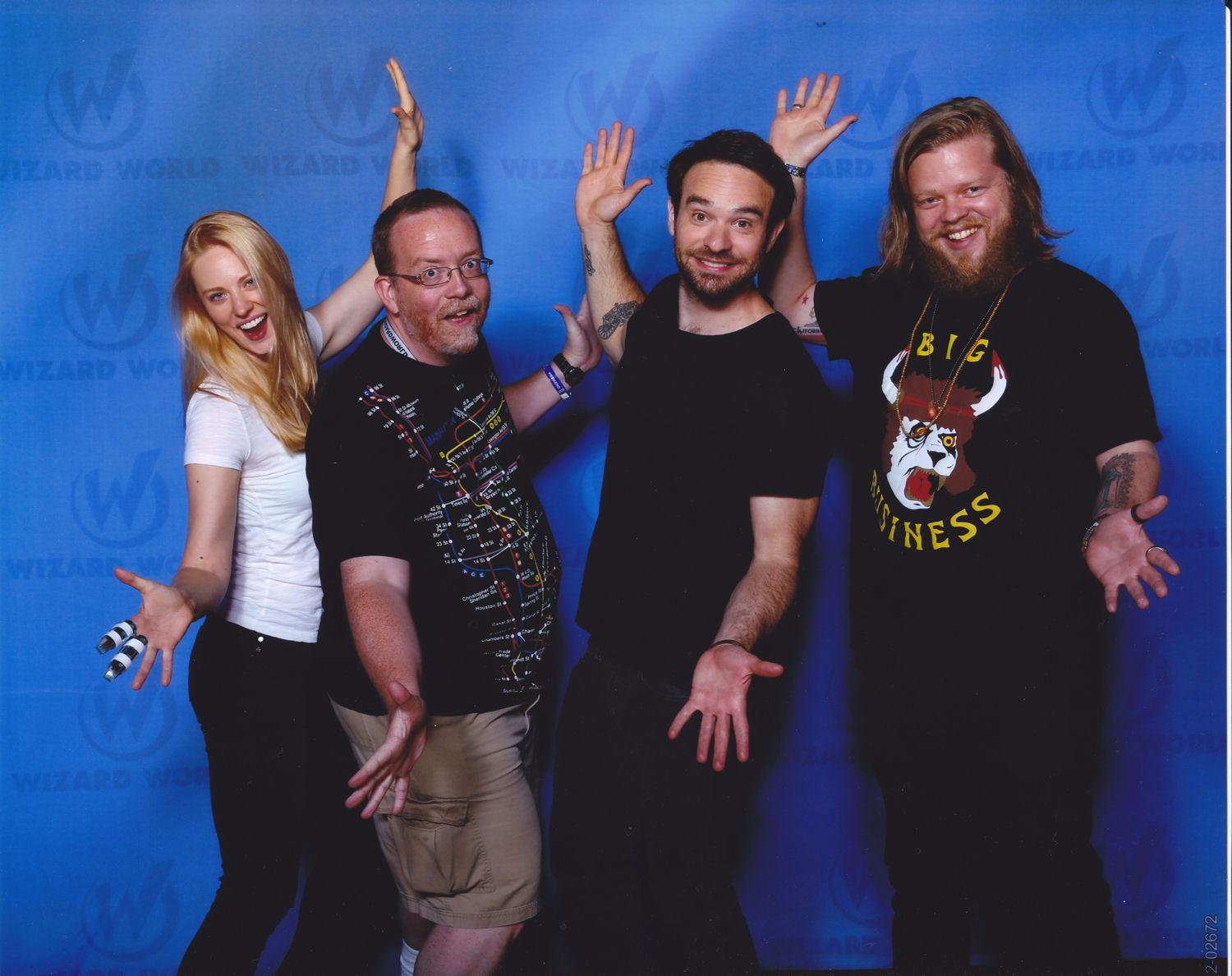
From Wizard World Chicago 2016: me in a jazz-hands quartet with Daredevil stars Deborah Ann Woll, Charlie Cox, and Elden Henson.
Part II: Photo Ops!
Over the past decade, photo ops with celebrity guests have become a major element of the comic-con experience. These are professional photos taken of you with the guest(s) in a booth and printed onsite for you. Digital copies might also be made available, sometimes for an extra fee or sometimes included in the price. As we said above, a photo-op ticket by itself does not grant admission to the entire con. You must also purchase a separate admission ticket for the show.
Keep in mind the differences between a photo op and a selfie taken at the autograph table. Photo ops usually cost about $20 more than the selfie, but are taken in a sequestered booth with brighter lighting by a professional photographer, and a hard copy is typically printed immediately. Table photos are taken with your device under the convention center’s lighting by either yourself (if your selfie game is strong), someone accompanying you, the guest’s assistant or the nearest con volunteer. At the table, you are at the mercy of the quality of your device and the skills of your ad hoc paparazzi. If you’re on a tight budget or the guest is only worth so much to you, the selfie might be fine. Some guests offer a discount if you buy a “combo” with an autograph and a selfie directly from them.
Should you opt for the pro photo op, your op will be scheduled for a specific time. You cannot simply drop by the photo-op area anytime and tell them you’re ready for your closeup. The photo-op schedule is usually released a week or so before the event. Be at the designated photo-op area roughly 15 minutes early — 30 if the star is massively popular and you’d like to get ahead of the stampede. Sometimes photo ops are taken in a large corner of the exhibit hall; sometimes they’re in a separate room in a distant hallway. The photo crew will let you know when they’re officially ready to begin lining up for your star. They may have monitors listing the guests, schedules, and the statuses of their respective lines. Sometimes these are automated, not constantly updated, and increasingly inaccurate. Listen for live announcements of any updates, if the crowd noise isn’t drowning them out.
Steel yourself for the possibility that they may not start on time. The later in the day you’re scheduled, the greater chance that earlier ops have run behind and caused all subsequent ops to be pushed back. Punctuality or delays will depend on the photography company’s efficiency, the guests’ cooperation, the showrunners’ logistical management skills, and the overall crowd turnout. Sometimes everything runs like clockwork and it’s amazing. In our direst situations, we’ve had to wait a couple extra hours. Yes, hours. In worst-case scenarios you’ll have to scratch a few panels you were hoping to see right afterward. Don’t be a jerk about it to everyone around you. You’re all trapped in the same nightmarish standing space that’s moving more slowly than an inner-city E.R. at 3 a.m. No, I don’t care if they started it, don’t be a jerk. Or hey! Maybe it’ll all be fine!
Once in line, your ticket or QR code will be scanned and you’ll be admitted to the curtained-off booth where there will be tables or shelves on which to place anything you don’t want in the photo — bags, coats, cool heavy objects you just bought at the show, etc. Everyone takes turns stepping in front of the camera, posing with the guest(s), and immediately exiting. Fetch your possessions and proceed to the photo pickup area, which will have rows of color printers staffed by volunteers. When they hand yours to you, let them know immediately if there’s a problem with your photo.
A quick supplemental photo-op mini-FAQ:
Q: Is this the best place to interact with the guest?
A: No, photo ops are not casual meet-and-greets. They’re an assembly line. You go into the booth, you pose, the photo is taken and you get out. It literally takes ten seconds at most. You might have time to say “Hi!” to the guest and share a very simple pose request. This is not the time to chitchat.
Q: If I want to talk to the guest and have a more personal experience, where CAN we chitchat?
A: At the autograph table, hopefully. Scroll down to Part III.
Q: What if I have two ops scheduled around the same time?
A: Talk to the nearest volunteers. They should have a sense of how each line is progressing and which one stands the best chance of proceeding first. They can help you coordinate between them so you don’t miss one or the other.
Q: Can I ask the guest for a specific pose?
A: Yes, but the guest reserves the right to decline, or to refuse to hold any props you brought along. Please make sure your posing idea is easy to do and can be explained quickly. You are not a director on a set in control of the situation. Respect the word “no”. Obey all instructions given. Photo-op staff will lay down their own ground rules in advance, especially if a guest has their own specific no-nos (no hugs, no touching, no props, masks required, etc.).
Q: I blinked in the photo! What do I do?
A: Many times, the photographer will catch closed eyes or lens glare before you leave the booth and take another one. If that doesn’t happen and you find a problem with yours at pickup, let a photo-op volunteer know immediately. You may be able to go back for a quick retake before their session ends. Do not come back hours later hoping for a do-over.

From Wizard World Chicago 2014: the autograph table of future Academy Award Nominee Sebastian Stan.
Part III: Autographs!
The autograph area will be marked on the convention map, which is generally accessible on the website and on the con’s official app (if they released one in time), or when the exhibit hall opens you can simply follow the fastest-running fans who’re eagerly sprinting to be first in line to meet their favorite guests. In fact, we strongly recommend if there’s someone you absolutely have to meet, get to the convention center ahead of opening and join the entrance line ASAP. Y’know those stories from the olden days when they were still making new Star Wars movies and hardcore fans would line up at the theater days in advance and bring lawn chairs and tents? Same principle here, except arriving a couple hours ahead should do just fine, no camping gear needed or allowed. Some facilities’ security guards will shoo you away if you start loitering too soon. Make sure you use the restroom and have snacks and drinks before you commence waiting.
Each guest will have a table and/or a booth with their name on a clear sign above. Sometimes a guest’s autograph is available for purchase online in advance. In most cases you’ll pay at the table. Advance purchase will incur those dreaded inflated fees, but could save you a little time onsite. We’ve seen extremely popular guests sell out before the show even starts. If they do sell out online, don’t expect them to have extras on hand the day-of.
Every con has its own autograph scheduling practices. Some post signing times in advance online and run a tight ship. Some hang small signs at each table that are subject to change without notice. Some don’t bother setting anything in stone and leave it up to each guest to come or go as they randomly please, though with the incentive in mind that the more they sign, the more they earn. Never expect them to be at their table bright and peppy the minute the con opens. You’re welcome to line up early and wait for their arrival. They might arrive fashionably later, sometimes by a couple hours; or they might be there in just a few. Some anime voice actors are reliable early-birds, as are the diligent British actors whose internal clocks are still on Greenwich Mean Time and who’re least likely to be hungover from after-con partying the night before.
If you wait till later and they aren’t around, the reasons can vary. They might be doing photo ops or appearing in panels, which are necessarily committed to fixed times. They might be on break, grabbing a bite or taking a breather somewhere in a backroom. If they’re away-from-pens for a bit, go find something else to do and check back later. You may have to keep checking if you keep missing them. Hopefully they don’t leave early and blow off the late afternoon, but it can happen.
Autograph prices are usually posted on the website. There will usually be a sign at the table breaking down your options and add-on fees. Some guests will charge more to sign collectibles (posters, Funkos, action figures, etc). Some charge extra if you want them to write their character name or catchphrase next to their signature; some will cheerfully throw this in gratis; some will only sign their name and refuse all other writings, often to speed up the line and get more fans through. Do not push them for an exception as if you’re special.
Prices will vary wildly throughout the guest list. We’ve paid $20 for character actors who were memorable in a few episodes of one beloved show and not much else. World-famous personalities who’ve starred in blockbuster classics and rarely appear at cons near you can run into the hundreds per signature. Those amounts are negotiated between the guest and the showrunners, based on their fame level and on how many fans they believe they can handle meeting within certain time frames. Cons are all in good fun, but basic supply-and-demand economics apply. Some prices that seem utterly heart-stopping to you are being forked over by upscale collectors, retailers looking to cash in, flush tech-bros, and youngsters who don’t understand how accumulating massive credit card debt will one day smother any sense of joy in their adult lives. Thankfully a lot of guests aren’t that pricey.
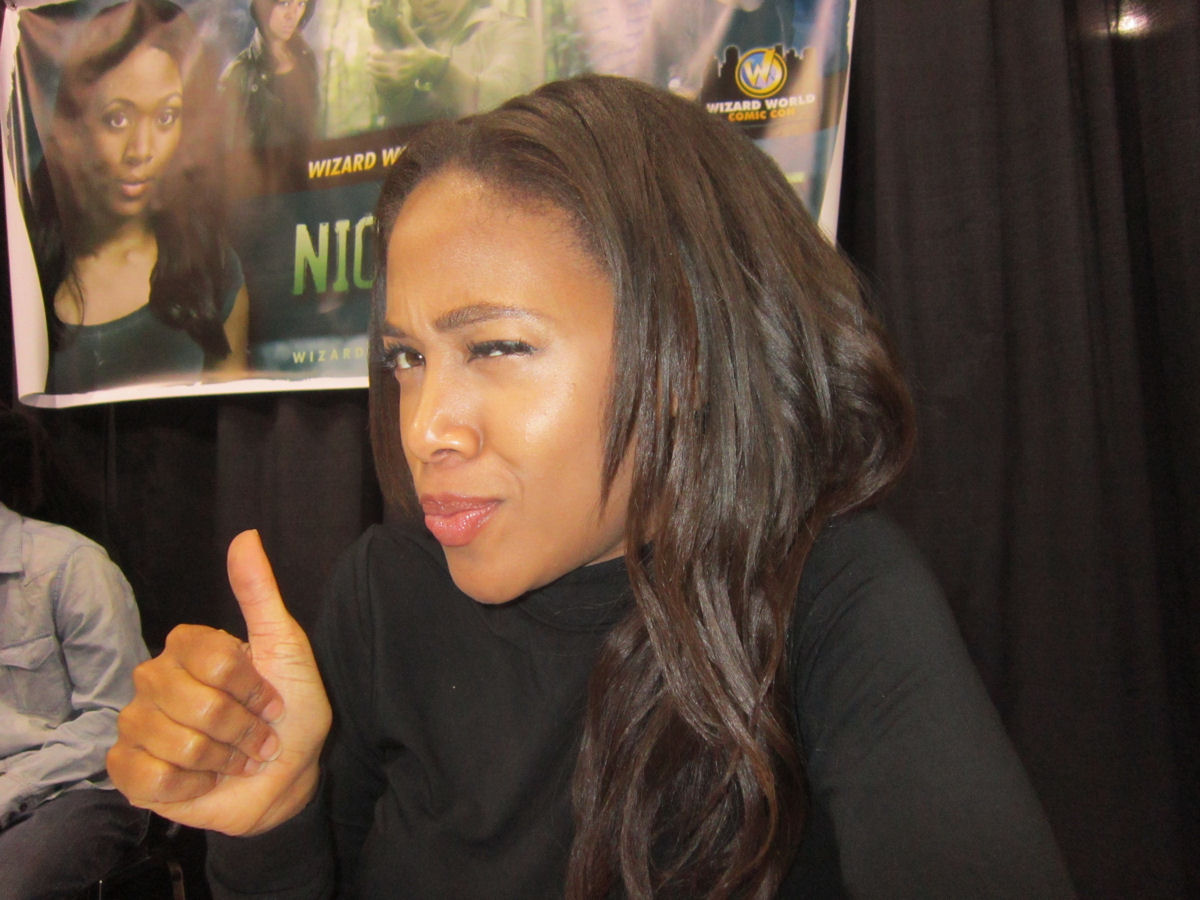
Fun memory from Wizard World Chicago 2014: Sleepy Hollow star Nicole Beharie at her autograph table.
Important knowledge: autographs at the table are, 99% of the time, cash-only. Autograph handlers who accept cards are a rarity; those who accept Venmo, or whatever digital methods you kids are using these days, are unicorns. Internet connections can also be spotty in the convention center, interfering with Square’s basic functionality. Cash makes a great Luddite backup immune to such modern disruptions.
If you didn’t bring something for them to sign, you can choose from their assortment of 8×10 photos depicting them in their most well-known roles. An 8×10 is almost always included free with the autograph. Occasionally a guest will bring their own books or merchandise. Some high-end guests have begun charging extra to sign non-flat collectibles, for fear they might be signing soulless eBay fodder. A handler — either a con volunteer or the guest’s own manager or relative — will assist them in managing the money and answering questions. Guests reserve the right to refuse to sign something they consider inappropriate, such as bootleg DVDs or Photoshopped images. (We once saw a guy bring a picture of an actress with her head pasted onto some other woman’s topless torso. We beg you: pretty please don’t be that guy.)
Familiarize yourself with the guest before asking questions. Make sure you know how to pronounce the guest’s name. Address the guest by their name — some will be okay with referencing character names, but some appreciate being seen for the person they are, just like you. Try not to compliment them for a show or film they didn’t actually have anything to do with. (We have witnessed this. I once did this to a comics writer, didn’t realize it till ten minutes later, and kinda wanted to crawl under a table and die.) It’s understandable if you’re nervous to the brink of feeling faint, but remember they’re flesh-and-blood humans just like you and us, not demigods descended from a higher dimension. Just be cool! I know this could take some practice, but it gets easier if you keep at it.
Gentle reminder: as we covered above, VIPs will get to go ahead of you, regardless of whether you got there first or how long you’ve waited like a good little customer. At some shows the volunteer managing the line might be merciful and alternate between VIP and general-admission ticketholders so the G.A. line doesn’t become an emotional pressure cooker priming to explode. We can’t guarantee every guest will have equitable turn-taking like that, though.
When it’s your turn to greet them at last, keep your comments brief and to the point. Other fans are patiently waiting their turn, just like you. The line length will determine how much time you have to chat with them. We’ve had mere seconds to say “hi” to some guests who had hundreds lined up. On the happier yet far rarer flipside, we once got to chat with Phil LaMarr for 25 minutes because the con had a poor turnout and no one else was behind us. (I promise we kept checking to make sure.) You may not be afforded time to deliver a 5,000-word speech about what they meant to your childhood. Be mindful of the situation around you.
Some of the best conversations we’ve had were sparked by questions that had nothing to do with their claim to fame or even about showbiz at all. Some actors will light up when asked about their hobbies or interests. You don’t even have to ask them a question. If you’re too nervous or don’t know what to say, it’s okay to just say, “Nice to meet you!” or “Thank you!”, bask in their presence and carry on. We’ve done it ourselves. Not every moment has to be a quotable anecdote for the ages…but if it is, relish it. It’s a warm memory to hold, and something you can share with other fans when you’re swapping war stories at your future cons. (Our favorite personal go-to is our Carrie Fisher story. Just about anyone who’s ever chatted with us in a line for more than twenty minutes has heard it. Anne will never stop retelling it.)
If you also want to take a pic of them while they’re signing your chosen object, that’s up to them or their handler. You might ask first. Some cons are severely strict about no one taking pics in the autograph area. After they’re done signing, next comes your selfie, if you decided to buy one as we described in Part II. Most will allow a few tries to get the pic just right, but don’t ask for multiple poses. Your one-time fee doesn’t buy you an unlimited mini-studio session.
On extremely rare occasions, a few celebs might be okay with you purchasing nothing from them and just letting you walk up and say hi for free. Don’t get your hopes up too high, prepare for rejection, and realize you are not entitled to anything from them. It’s entirely up to their schedule, their temperament, the con’s rules and their own managers’ rules. They may not be as totally chill as you imagine they are.
Some fans like to bring gifts to give to their favorite actor. Some cons allow it; some don’t, as a flat rule. While this is very nice of them, remember that part above when I mentioned they’re human just like you and us? That means when they fly out to these shows, they may also have our exact same luggage limitations on flights. They don’t bring extra empty suitcases in hopes of filling them up with fan-made handicrafts, which they’ll then have to check at the airport. Very small items or drawings might be acceptable and stand a marginally better chance of fitting in the crannies of their bags and actually going home with them. But the heartbreaking truth is most fan gifts — especially large, bulky ones — will be left behind and your favorite actor will never look at them again. They’ll be passed off to the volunteers to keep for themselves or toss in the trash. They’ll have no idea how much you spent, how hard you worked on it, or how meaningful it was to you. We’re very sorry this happens, but frankly, it does happen.
The ultimate rule of thumb that supersedes all of the above: when in doubt, ask the handler. Follow the handler’s guidance. If the answer to your query is “no”, do not try to find loopholes. People in search of loopholes are never endearing themselves to anyone. Even if you’re a newbie, as far as the guest is concerned, you are representing all of fandom in each and every encounter with them. We want them to have a good experience, just like us. We want them to encourage their reluctant costars to come out for these events. More than a few stars have admitted at Q&As that they didn’t do conventions until they felt encouraged by colleagues who shared their own good experiences. Obnoxious behavior on the part of even one fan reflects poorly on all of us. Be cordial and patient. You are not the protagonist of the con.
(For more cautionary tales about the dangers of fan entitlement run amuck, try digging up a copy of Harlan Ellison’s horrifying 1990 essay on the subject, “Xenogenesis”. I used to have it taped into a scrapbook, clipped from an issue of Comic Buyer’s Guide. It’s been reprinted in a few of his anthologies and I’m sure it’s still under copyright, but if the present administrators of his estate and/or Kilimanjaro Corporation could post it online — even as, say, a cheap eBook — present and future generations could learn from it.)
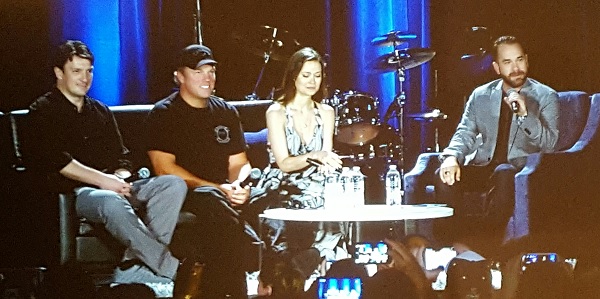
From Wizard World Chicago 2015: a Firefly panel with Summer Glau, Adam Baldwin and Nathan Fillion, whose offhand answer to one question led to comics-news sites posting in a mad rush on a slow day, “NATHAN FILLION WANTS TO PLAY BOOSTER GOLD IN A DCEU FILM!”
Part IV: Panels and Q&As!
If you can’t or won’t pay for photo ops or autographs, you may have another option to witness them in person, albeit from a distance. Many guests will be scheduled for live panels and Q&As throughout the weekend, where a moderator will interview them and field audience questions. Brave, inquisitive fans will line up in front of a microphone placed in the aisle and take turns asking questions when called upon. Be in your seat before the panel begins so you don’t miss any instructions. High-demand guests will naturally have high turnout, so consider lining up ahead of time for best chances of not being stuck in the back rows. Lines for really popular panels can begin as early as 30-60 minutes beforehand, maybe even longer. VIP ticketholders have it slightly easier, as the front rows will usually be reserved for their kind.
Panels run for a limited period of time, averaging 30-60 minutes, varying by con. Time-wasting should be avoided so that as many fans as possible can ask questions. Try thinking up a question ahead of time. If possible, think of more than one in case somebody ahead of you asks yours first. If you come up with more than one, on your turn ask only one, go to the back of the line and ask your next question when it’s your turn again if time permits that many questions. Practice your question ahead of time to make sure it makes sense. It saves everyone time if the guest doesn’t have to ask you for clarification.
If you ask about something from a specific episode, you may have a better memory than them. Chances are you’ve rewatched the show more than they have. They may not recognize episode titles instantly, so give them a one-sentence recap as a boost. (Maybe start with “The one where…”)
Ask questions about some of their smaller, more obscure works. Actors find it refreshing when they’re asked about something other than their big Marvel or Star Wars character. Geeks may prize long-running franchises more than other movies or shows, but with precious few exceptions, the actor’s one role that was turned into an action figure was not, in fact, the only notable work they’ve ever done in their entire lives. It might be your favorite, but it might not even be theirs!
Same as with the autograph area, do at least a little homework and get to know the actor’s life ahead of time. That’ll help you think of questions that can’t be answered with a glance at their Wikipedia page, like the time at a Trek convention when someone asked Jerry O’Connell if he was still married to Rebecca Romijn. (As of this writing: yes. Yes, he is.)
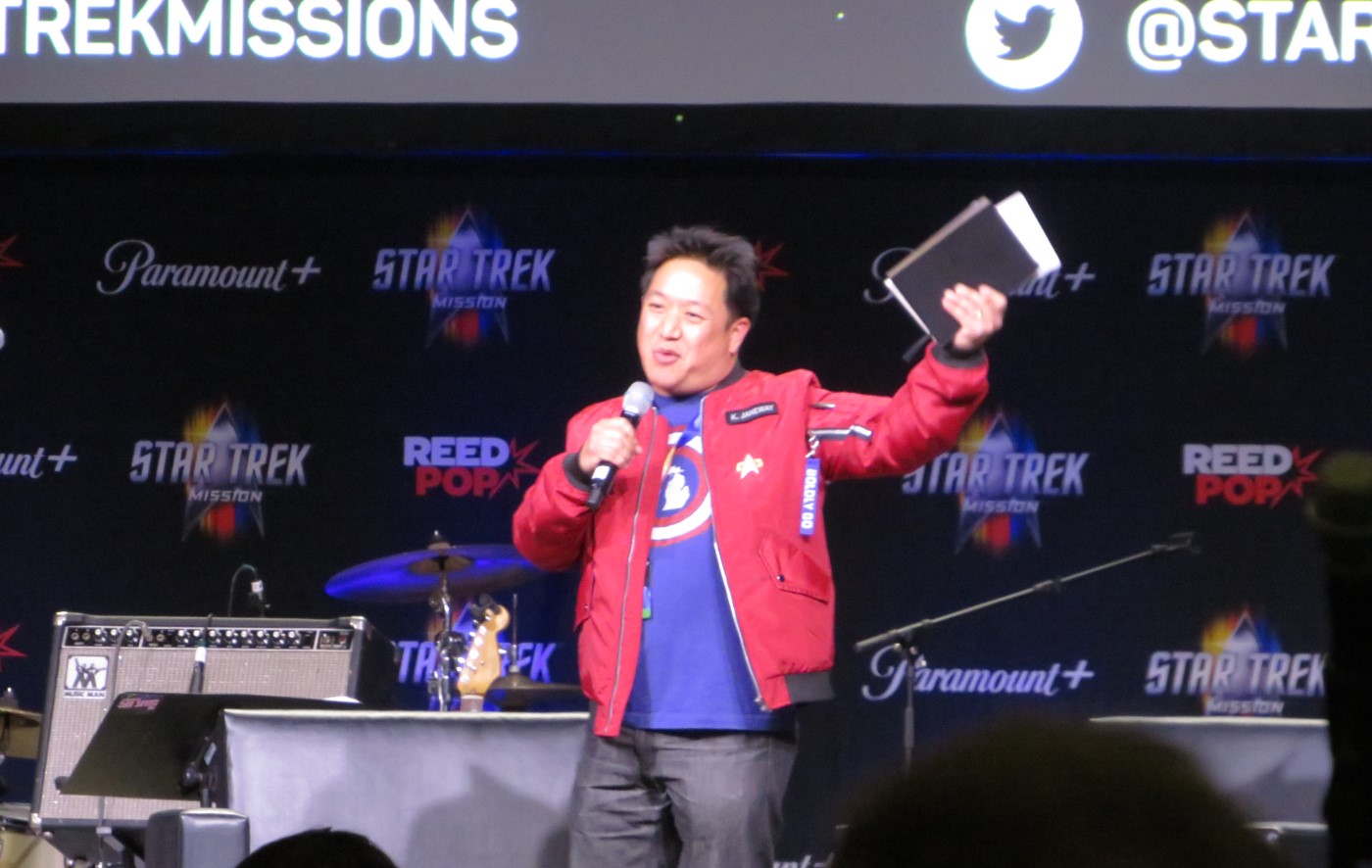
From Star Trek: Mission Chicago 2022: Ming Chen from AMC’s Comic Book Men served as moderator for Kate Mulgrew’s Q&A.
The moderator isn’t just there to engage the guest and entertain us; they can also vet the questions and sometimes even reject them, depending on how firmly they’re willing to keep a Q&A on track. Again: time is limited and they’d like to give as many fans a chance to speak as possible. The following are our personal suggestions of what not to ask at the mic. Some can be an inoffensive faux pas. Some are just our pet peeves as older fans who’ve cringed through so, so many awkward situations. Some are objectively rude or full-blown obnoxious. “Etiquette” is not a kind of French pastry. If your parents denied you those lessons, there might be YouTube channels for that. Your Mileage May Vary.
1. Questions about scripts or directors’ choices. The actors aren’t usually the directors or writers of what they do. A few might have insights, but many have no input and simply do the job. Asking about something the writers might’ve intended is likely to get you an “I don’t know.”
2. Questions about someone else besides them. Everyone loves the time-honored lead-in, “What’s it like working with…?” Sometimes this can spark the fan inside them to gush at length, especially if it’s a younger actor relatively new to the biz who can’t believe the blessings and phenomenal luck they’ve had in meeting and acting alongside some of their own heroes. More often, though, such questions read more like, “What’s it like working with someone we love way more than you and who we wish we could meet instead of you?”
3. Requests for favors on the spot. Panels are absolutely not the time to ask them for autographs, selfies, hugs, kisses, calls to a relative on your phone, or marriage proposals (either to the guest or to the loved one you’ve tricked into this) while the rest of us are held captive to your grand plan to make everything about you. Demerits are doubled if you use a cute li’l kid as your proxy while you hide behind them. (Anne’s “favorite” example happened at Star Wars Celebration II, when an older fan put on the most cloyingly cutesy routine possible to try finagling a free autograph out of Hayden Christensen — despite emcee Anthony Daniels instructing the audience ahead of time not to try it — by gushing about how his granddaughter thought Hayden was “the greatest thing since sliced bread.” Daniels shut him down hard.)
4. Statements instead of questions. Anyone who leads with “This isn’t a question…” or who just came to blurt “I love you!”, “I’m your biggest fan!” or “This is a long personal story that is only tangentially-related to you because it’s really about me telling it in the hopes that I will get sympathy or validation from you!” should step off and save it for your moment at the autograph table, which is better suited to sharing something so deeply one-on-one. The Q&A, on the other hand, is everyone’s chance to learn about the guest, not to learn about you. If your question takes longer than twenty seconds to verbalize, you’ve just cost another fan their turn at the end. If your speaking time at the mic can be measured in minutes, you are guilty of grandstanding bloviation and many of your fellow fans are imagining you launched into the sun. (We’ve witnessed this happen to extremes in past panels with fans of Avery Brooks and William Shatner, among others. Something about an eloquent starship captain brings out the monologuist in people, I guess.)
5. Multi-part questions. No. Just no. There is no such thing as a two-part question. There are only individual questions comma-spliced together or semi-colon’d into a Frankenstein’s monster of a run-on sentence, several of which I’ve written into this very article so you have examples at hand. One fan, one question. More than two questions is you trying to take two turns at once. If this were a board game, the other players would body-block you from the dice. Again: we have limited time. Please be courteous to others waiting their turn behind you.
6. Questions about controversial subjects. Politics, religion, social issues, and grudges dragged in from the culture-war battlefields are generally best left untouched, though (as you can imagine) these certainly come up more often than ever nowadays. Huzzah for the extremely touchy, armchair-warmongering society we’ve become. Some guests might proudly lean into internet activism and cheerfully leap onto their soapbox with little prompting, as is their call to make, but not all actors are in a position to opine on issues that risk alienating half their fans at best and, at worst, could cause them work-related problems. Since Q&As are often filmed by fans (or have listeners like me taking notes) and posted online, few celebs want to risk job opportunities or professional relationships because an out-of-context snippet (or even an in-context snippet) was turned into a viral soundbite that spiraled parsecs beyond their control.
7. Questions intended to provoke and/or embarrass the guest. Making a snarky comment to an actress about that nude scene she did in some terrible film she was in early in her career is a good way to convince guests that fans are jerks. We want them to come back and bring their friends. If they’re put on the spot in public, they won’t come back and will tell their colleagues not to come either. Again, here where’s that whole “etiquette” thing is useful in asking yourself, “Would an idiot ask this?” If they would, then do not ask that thing.
Pause for sidebar: a Parental Guidance caution for fans considering bringing their wee mini-fans along for the ride. Many guests do try to take their entire audience into consideration and keep their stage banter all-ages. Some don’t. Some guests conduct themselves pretty much in family-friendly fashion in all their public appearances. Some live their lives as a perpetual standup comic, whether that’s their actual career or just the everyday demeanor they’ve picked up from the Hollywood life.
Our experiences have run the gamut. There was the husband/wife team who were decent enough to ask if there were any children in the audience before asking parents to cover the kids’ ears for a minute before bringing up a particular sexytime scene from their show. Then there was the sci-fi supporting actor who went on a profanity-laden rant about religion without reading the room first, only for his face to fall when several audience members got up and left.
If the potential NSFW content isn’t your thing or isn’t something you think your kids can or should handle, you might consider confining your guest interactions to the autograph and photo-op experiences. Some cons do encourage an all-ages atmosphere, as well as other “best practices” from their guests — punctuality, friendliness, signing speed, etc. But the fact of the matter is that, in the end, some celebs cannot and will not be tamed. (Again we refer you to our Carrie Fisher story.) It’s your judgment call to make as to which behaviors or misbehavior you’re okay with.

From Fan Expo Chicago 2023: ace cosplayers as the Guardians of the Galaxy!
Part V: Cosplay! Exhibit hall! Artists Alley! And the rest!
Cons aren’t all about the actors. They are large; they contain multitudes.
Exhibit A: costumes! Behold the cosplayers! Fans in costumes are part of every convention. It’s fun to walk around and look at the work fans put into making their costumes realistic or whimsical. Some are store-bought Halloween get-ups; some were individually handcrafted labors of love that took them hundreds of hours to design, sew and assemble from the patterns on up to the intricate fake weaponry. You yourself do not have to wear a costume. Quite a few fans will be costumed, but not all of us are. You won’t look out of place. Most fans will be wearing jeans and T-shirts or sweatshirts, depending on your local weather patterns. (If you’re interested in costume pointers, a wealth of cosplay communities online are very good people and will welcome you into their world.)
One of the paramount rules of conduct around costumes: Cosplay is Not Consent. Someone wearing a “hot” costume is not giving everyone tacit permission to take photos of themselves or, for that matter, to touch them. At all. Ask first before taking their picture; if it’s a “no”, respect the answer. This is not solely about what’s legal, but about what is right. Treat cosplayers the way you’d want to be treated, or how you’d want your own loved one to be treated if they were cosplaying. (Imagine your mom showing up as Harley Quinn only to be groped by some unshowered troglodyte. Still turned on?)
Exhibit B: geek shopping! The main exhibit hall will have aisles upon aisles filled with booths and tables where vendors will be hawking all manner of pop culture merchandise. Old comics, action figures, T-shirts, posters, DVDs, Funko Pops, and other collectibles will be everywhere around you. Exhibit halls at larger cons may take a few tries for you to browse every single aisle. Some cons will have detailed floor maps on their websites or apps. Some are more accurate and useful than others. If something tempts you but you’re on the fence about buying it, or if it’s a massive object that’ll give you chronic back pains if you buy it at 11 a.m. and have to lug it around for the next eight hours (I speak from debilitating experience), take note (or a photo!) of the businesses and their locations as you pass them so you can find them again if you decide to come back later and pull the trigger.
Exhibit C: Artists Alley! Comic book creators, artists, writers, colorists, editors and self-publishers gather here to sign books, sell their latest creations, promote their upcoming gigs, offer sketches, or sell prints and pinups of well-known characters. Other creative talents bring oodles of homemade geek-based arts and crafts. Support them! They’re awesome! Their kinds are among the reasons comic cons were invented in the first place! Be kind to them.

From C2E2 2013: a moment with comics writer Kieron Gillen, future co-creator of my favorite current series The Power Fantasy.
When walking through aisles, be mindful. Some are narrower and more crowded than others. Watch what you do with your bags or your drinks to avoid knocking over their displays, spilling everywhere, getting tangled in other people’s costumes, or other mishaps. Try to avoid blocking aisles or obscuring people’s booths from potential customers. Cosplay photos are fun, but they should be taken where you aren’t impeding the flow of traffic. Be aware of your surroundings, keep your eyes off your phone, and mind the path.
And there can be more! More! SO VERY MUCH MORE to do! Cons will offer other activities, some of which aren’t our thing but just might be yours, including but not limited to:
- Panels that have nothing to do with actors or Hollywood! Comics creators giving how-to seminars or competing in “sketch duels”! Fan-led discussions about assorted hobby-related topics!
- Fan groups! Meet members of like-minded clubs, admire their costumes and props, maybe even join one!
- Interactive activities for kids! Arts, crafts, games, and so on!
- Charity fundraising drives! The fan groups will conduct quite a few of these!
- Gaming areas!
- Onsite geek tattoo parlors!
- Viewing rooms showing anime marathons or old Star Trek episodes or superhero blockbusters!
- A large lobby where you can just hang out and gab with whoever!
- Et cetera!
Part VI: Final Tips!
Here are still more random tips for preparing for the show ahead of time:
1. Familiarize yourself with parking options. Getting there a couple hours early helps with finding open parking. In larger cities the SpotHero app is a boon that’ll help find you a nearby space. If you’re taking mass transit, start early to avoid the day’s rush hours, or else factor those into your travel time.
2. Print out your tickets or save them as screenshots on your phone so that you don’t have to fuss with spotty internet connections in line. Convention center wi-fi is not a guaranteed utility and some larger structures can interfere with cell signals.
3. Download the con’s official app to your phone (if they released one) and avail yourself of its functionality, which varies from one con to the next. Some aren’t worth the storage space, but some are essential tools.
4. We cannot stress this enough and will not let it go: bring cash. All of it. Well, bring enough cash to handle any autographs you want to buy. The website may have some autograph prices posted so you can budget. Bring a little extra in case a personalization costs extra or there’s been a miscommunication between the celebrity and the convention, and suddenly the price at their table no longer matches the site listing. Cash can also be exchanged for food at the concession stands, but be prepared to spend upwards of $15-$20 per person unless you can eat less. Bring along still more cash in case you see something on the vendor aisle you want to buy. The majority will take credit cards; a few may not. Also, if the convention center’s entire wi-fi system crashes (which we have seen happen!), then no one can take your cards and cash will once again be king for a day. Most convention centers will have ATMs in the building, but they break down easily and empty out quickly. Go to the bank first, then go to the con.
5. If it’s a Midwest con (as most of ours are), check the weather forecast. Dress appropriately. An exhibit hall the size of football fields containing thousands of roving bodies will generate enormous heat if they fail to crank the A/C. Wear comfortable shoes with good arch support because you’ll probably be standing and walking on concrete most of the time. If your costume requires heels to look exactly right, your dedication to the character is admirable, but you may suffer physical consequences.
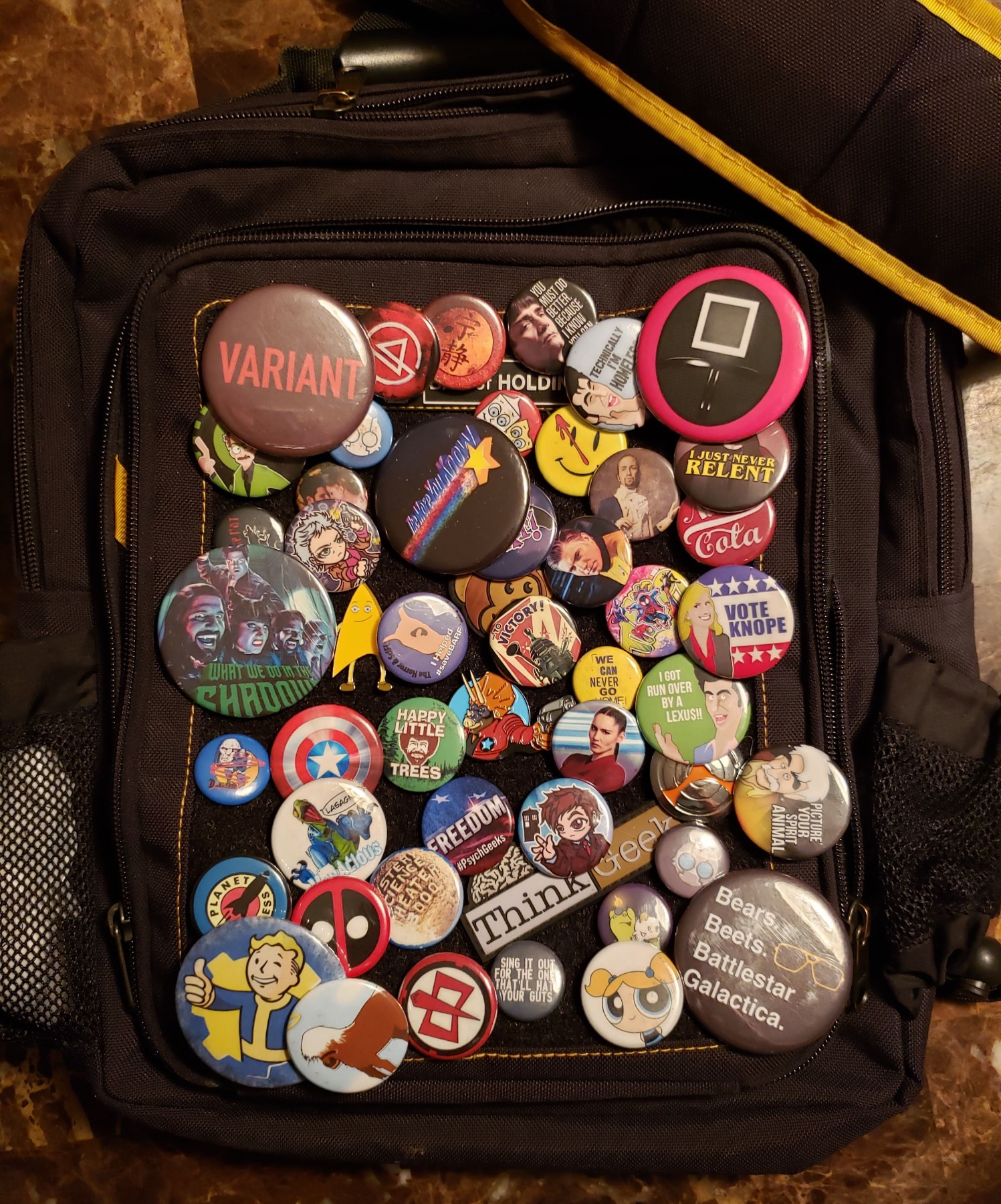
My convention carryall: a Bag of Holding from the now-defunct Thinkgeek. Buttons sold separately at myriad booths and places.
6. The night before, pack a bag with some or all of the following. Double-check the bag before you leave to make sure you got everything.
- Antiperspirant or deodorant (sooo many people don’t get how body odor works).
- Your wallet or billfold with the usual contents (ID, cash/credit card, insurance card).
- Your camera and/or phone with charging cord or battery backup.
- Any printouts of admission tickets, photo ops or autograph tickets.
- Anything you want to have your childhood heroes sign.
- Something to keep your photo-op hard copies and signed 8x10s flat, such as plastic sleeves or page protectors. (If you need more, these are generally sold at the show.)
- Your want-lists for any back issues, Funko Pops, Hallmark ornaments, or other artifacts missing from your collections.
- Pens and a notepad for writing down anything you’ll need to remember on the go — booth locations, panel quotes, recommendations from other fans, hot people’s phone numbers, whatever.
- Chapstick, for those who suffer the heartbreak of drying lips.
- Prepackaged snacks (e.g., granola bars, crackers) and bottled water. (Concession stand food is pricey and often lackluster. There might be restaurants outside in the vicinity, but any time you take to be seated and served is time away from the show.)
- Hand sanitizer or wet wipes, for those who’d like to avoid the dreaded “con crud” that gets passed around many a con.
- A couple of plastic sandwich bags to keep electronics dry in case of rain or to hold leftover food.
7. Eat a decent breakfast (or consume the coffee-shop equivalent) and give yourself enough time to arrive, park, and walk the possibly lengthy distance to the entrance.
8. Whenever you join a line, ask others and make sure you are in the correct line. Some con layouts can be confusing and have multiple lines parallel, adjacent, or criss-crossing each other.
9. If you have a particular need or complaint, know the difference between the con’s official staffers and volunteers, versus full-time employees of the hosting facility itself. They are not members of the exact same workforce. Convention center employees have very limited information about the con itself. They didn’t read or memorize the program and can’t tell you which events are where. They’re told when the show opens and maybe when to let exhibitors in as opposed to fans, as well as to check for wristbands or badges. They don’t know anything else. They hold strictly to the instructions they’re given. Direct any con-specific questions to people actually with the con — those wearing crew shirts with the con’s logo. The con’s showrunners aren’t responsible for misinformation provided by a convention center employee.
10. Your final reminder, because we know and lament how people are today: be kind and courteous to other fans and to the volunteers. These amazingly wondrous events cannot happen without those who serve. They have guidelines to follow and often have to deal with competing interests, such as the fans’ wants versus the guests’ requirements. They are not always given updated information quickly. They cannot fix the wi-fi, haggle with you over pricing, punish other fans for their crimes or rudeness, or tell celebs what to do. They do not make the rules. As always, the Golden Rule applies: please treat them the way you would want to be treated.
11. Some shows might have after-hours events on Friday and Saturday night, from adults-only panels to offsite “after-con” parties. We can’t really speak to those because neither of us can stand alcohol, we aren’t really the party-monster type, and staying up late doesn’t work too well if you have to be up bright and early to sprint to your childhood hero’s autograph line first thing in the morning. So we don’t really have advice about that aspect except, y’know, don’t do anything stupid.
12. If you just so happen to make new friends while you’re embedded in all those lines and crowds throughout the weekend, congrats! That’s awesome. But if you’re an intense introvert like me, keep your expectations realistic. We’ve been surprised how often folks pop up in fan-group chats afterward and complain how the con sucked because they attended alone but didn’t make loads of new friends. Without enumerating my own lifelong loner status at further extreme length, suffice it to say loneliness isn’t my favorite emotion either, especially when I’m surrounded by thousands of other couples and groups who brought someone to talk to and share those moments with, while I’m over in a shadowy corner lurking with envy. I’m sorry that was their experience. But do realize: such intensive, interpersonal interaction is quite possible but not guaranteed. Every con is made entirely of loud, shiny distractions from ceiling to floor. It’s impossible for every person to connect with every other person. This can also depend on your own receptivity to talking and listening to others. Connection is a two-way street. Be open to it, but if you hoped going to a comic con would solve one or more of your longstanding problems…there are some things even a convention center the size of football fields cannot contain.
13. Self-care is important. Don’t wreck yourself in the name of geek fun. Take breaks far from the madding crowds. Don’t forget to eat, as we used to when we too were giddy, overwhelmed youngsters. Stay hydrated. Sit and rest. (Panels are great for that purpose.) Hang back and people-watch while you decompress. Immerse yourself in the ambiance. Just be for a bit, then go jump back into the fray. Once more, with feeling: your time is limited! Carpe diem! But not at the expense of your well-being. If you haven’t got your health, then you haven’t got anything.
14. As Captain Kirk once said during one of his trips far from home: “Everybody remember where we parked!”
…
…and that’s plenty for now. Some lessons are better learned through your own experiences. Hopefully you picked up a few ideas along the way to adopt in your own convention strategies to come.
One last disclaimer for the road: no, we’ve never been to San Diego Comic Con. It’s on our bucket list, but the list of obstacles would take up another 1000 words. Some or all of the above advice may be null and void there. We wouldn’t know! If you somehow lucked into tickets and can afford California tourism prices, kudos to you and your successes!
As for the rest of you, at your future cons great and small: have fun! Play nice! Never forget antiperspirant! Wear it on a chain around your neck and pretend it’s a magic amulet if you have to! And BRING ALL THE CASH.
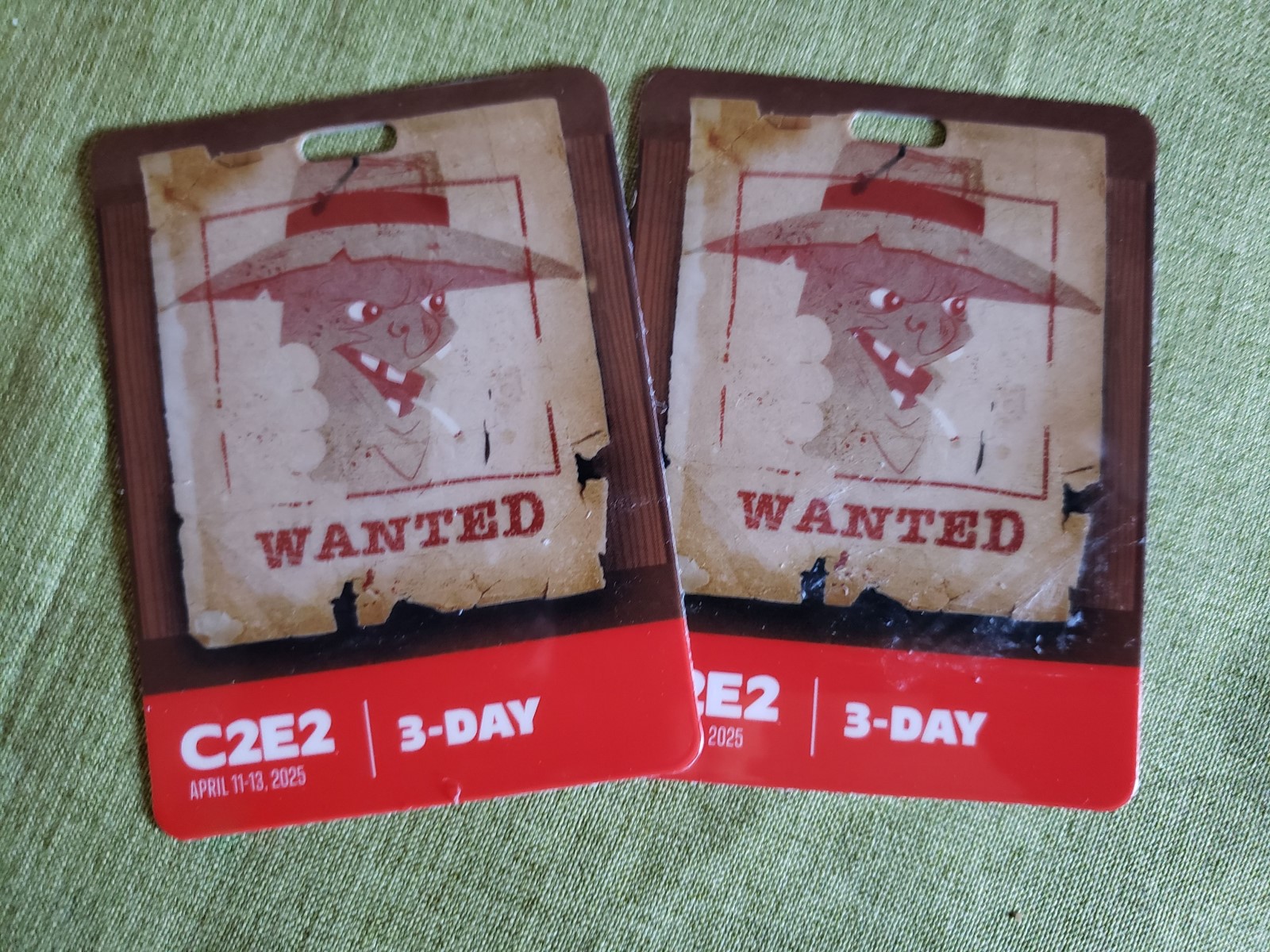
Teaser image for our upcoming April plans!
Discover more from Midlife Crisis Crossover!
Subscribe to get the latest posts sent to your email.
 Midlife Crisis Crossover!
Wow! What a great entry of MCC! and my thanks, as always, for writing it up and sharing it w/the world!
I call to your kind attention the following possible minor error — “If you something tempts you” — within the fourth paragraph of Section V. The one about Exhibit B! Geek shopping! That one! Is that there first “you” superfluous? Do with it what you will! As you like! As you see fit!
LikeLike
Thank you as always! I’ve deleted the superfluous “you”!
LikeLike
What an awesome post! Will be attending Comic Con in Cape Town very soon. This has inspired me to share some of my own tips and tricks. Keep geeking away 💚💚💚
LikeLike
Thanks! Hope your con’s a blast!
LikeLike