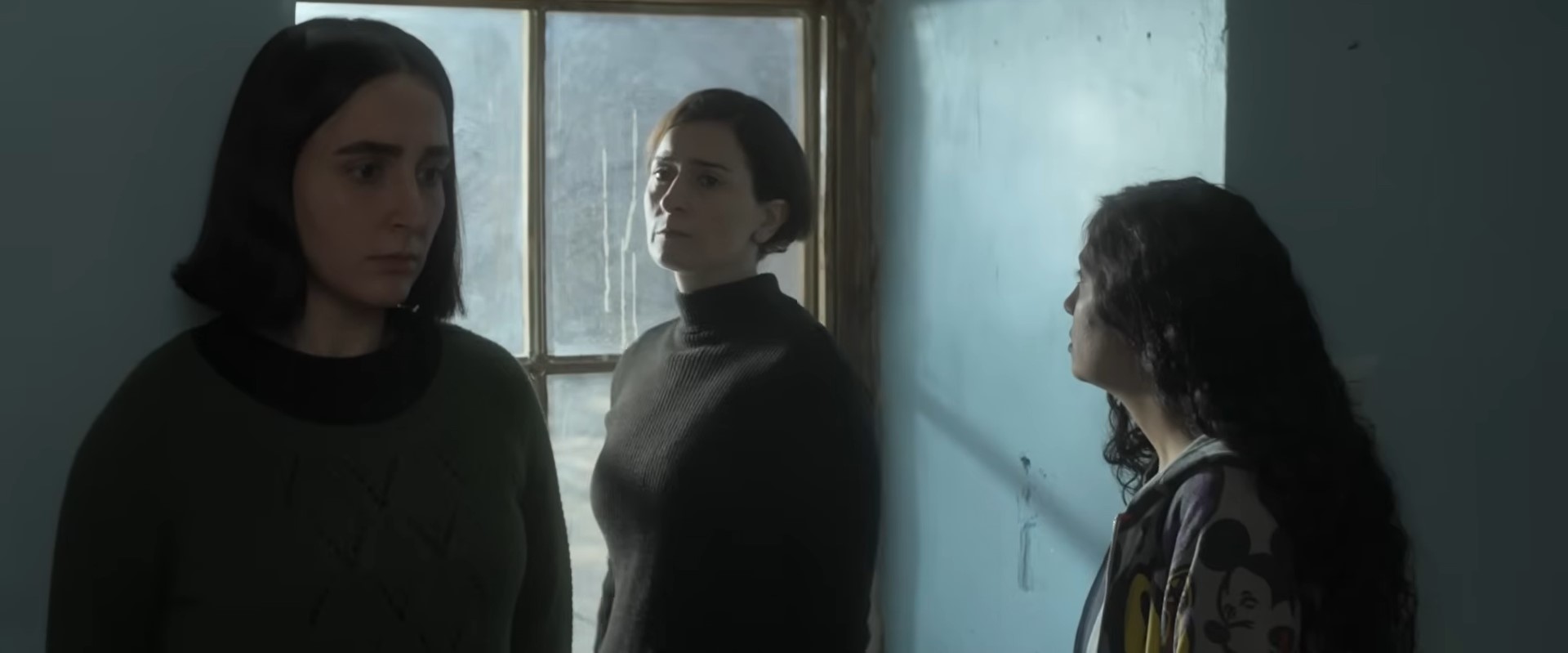
Women on the verge of a nervous breakdown.
Previously on Midlife Crisis Crossover: Oscar Quest ’25 continues! Once again we see how many among the latest wave of Academy Award nominees I can catch before the big ABC ceremony, some of which have had me driving all over Indianapolis to catch fleeting, one-week-only releases and sometimes having entire screens to myself.
Case in point: for the Iranian drama The Seed of the Sacred Fig on a late Tuesday afternoon, it was just me and one other fat, four-eyed white guy sitting in the way back who was hopefully not my evil twin. I’ve no idea whether or not he found it as chilling as I did, because we pasty introverts don’t run up and share our opinions with just anybody. The travel effort (to the other side of the city) and the social awkwardness were the least I could “suffer” for the sake of witnessing the work of writer/director Mohammad Rasoulof, who had to flee his home country so he could safely take a stand against it through his art.
I’ve seen very few authentic films from and/or about Iran — offhand I can recall Persepolis, A Separation, and Under the Shadow. Argo might be the gentlest (or at least have the lowest body count) of all the endless American films and TV shows I’ve seen where they’re terrorists. I’m definitely not an authority on the subject, but even with my flawed sampling size, Fig portrays the same land of eternal, relentless oppression. Rasoulof offers a few differences from my previous experiences. For a devil’s-advocate perspective, two of our characters who were brought up in the never-ending regime are in fact main characters, not nameless henchmen to be shot up. Also, now there are smartphones. Some films about the country act as if the first thing they outlawed after the revolution was electricity.
Family man Iman (Missagh Zareh) is a lawyer who’s toiled for years for the government, which has no Bill of Rights or most of our legal procedures, and is proud when he’s promoted to Investigator. According to the job description, his responsibilities include gathering evidence for the judges that will inform rulings on their various cases. Perks include a raise, a larger apartment, and one (1) whole handgun with bullets. No Bill of Rights means gun ownership is tightly controlled, so this is treated as A Big Deal. His wife Najmeh (Soheila Golestani) is so proud of his accomplishments and supports him in every way possible…even after he learns what his job really is.
The film is set in late 2022 in the wake of a specific, real-life incident in which a young woman was arrested for violating their theocratic dress code (i.e., not wearing a hijab) and later died in police custody. All throughout, Rasoulof and editor Andrew Bird insert actual social-media clips of the ensuing protests and the police beatdowns delivered in response to them. Amid that furious clamor, Iman is informed he really only has one duty: sign death sentences for any and every defendant that the judges order him to sign. No helping determine their guilt or innocence, no room for clemency, no questions or rebuttals, no exceptions. And there are a lot of defendants. They decide who lives or dies, and he signs every dotted line. Most days he’s working from dawn to beyond dusk.
But it’s a living. It’s why he worked so hard all those years to climb the church-and-state ladder to their definition of success. Somehow he rose all the way up with a rather naive impression of the higher rungs, but what can he do? If the government ordains it, therefore Allah ordains it, hence their will be done, and if there be casualties, they were meant to be. Najmeh is shocked when he confides in her…but she was raised in that system, same as him. It’s what they know. She stands by her man.
Their two daughters, on the other hand, have their own thoughts. Big sister Rezvan (Mahsa Rostami) is college-age and has friends joining the protests, though she downplays it to her parents, not to mention any possible involvement of her own. Kid sister Sana (Setareh Maleki) is still in high school and (allegedly) just wants to get safely to and from class, but can’t penetrate the rioting masses, especially when classes are canceled and everyone is sent home…which is a lot while all this is going on. Half the film is a bottle episode set in the family apartment because they can’t really go anywhere else without risking arrest or injury. Same goes for Rasoulof and his crew in reality — he’d faced charges for his previous filmmaking efforts (and had his own sentence pending during production), so the crew had to shoot carefully for short time spans. All the better to avoid drawing attention to themselves, I’m sure.
Najmeh goes to great lengths to ensure her daughters have no clear idea what their dad does for a living. Mom and Dad keep it vague and assure them everything is fine and the important thing is Dad is providing for his family and please never tell anyone who Dad is because him getting doxxed would be bad and they will not be taking any questions at this time. Back in their day, they walked five miles uphill in sandstorms every day to never ask adults any probing questions, and they liked it! They didn’t have networking or internet or political awareness to dispel their illusions. To them, such fripperies are a nuisance to be ignored lest they upset The Way Things Have Always Been.
Then one day, Iman’s gun disappears. He set it next to the bed one late evening after another long day of facilitating legal mass executions, woke up the next morning and, well, poof. His gun got gone, and he only has three suspects. After a meticulous setup of the family dynamics and the state of their nation, Rasoulof flicks over the first of many dominoes and we watch everything collide and fall as Iman questions the women in his household, all of whom are equally stubborn — or innocent and mystified, which probably looks the same to an ostensible “judge” who sees all subjects as guilty until proven even guiltier. But if he can’t find that gun, the shame of his incompetence might be the least of the punishments in store for him.
The Iranian generation gap widens ever farther as Dad’s questions become interrogations, suspicions become paranoia, and nobody will budge. Eventually their escalating turmoil outgrows their meager apartment and the film must move outward. A modest yet effectively tense car chase (!) involving activists brings truths to light in unexpected ways. The final act relocates to an abandoned cave village far from the city, its tunneled hallways as labyrinthine as the capricious demands of the system itself. I really didn’t feel the full weight of 168 passing minutes as Rasoulof leads the family to one last confrontation — a long chase through and around all those haphazardly laid-out doorways with no score to heighten the sequence artificially. (Admittedly I couldn’t help wondering what an Iranian cover of “Yakety Sax” might sound like.)
Among the many subtleties throughout, not every question is answered. Some motivations are left for the viewer to sort via the strong performance of all four leads. Though the gun’s fate is revealed, it comes with no soliloquy about freedom or rebellion or fear, no flashback to the heist, no indignant restatements of the obvious. Rasoulof’s answers to many of those questions lies in an earlier scene, long before the family is torn apart. On one of the many tumultuous days, Rezvan’s friend Sadaf (Niousha Akhshi), who’s proudly joined in the protests, receives for her participation and her stance a flurry of buckshot to the face. Mom is none too happy that the girls have defied Allah and his ostensibly appointed reps, but she can’t merely let a victim suffer. As Sadaf lies in agony, the camera moves us in close and won’t let go as Mom painstakingly plucks every single metal ball out of her face, one at a time. So, too, does Rasoulof excavate the sins of the homeland to which he may never be able to return.
…
Meanwhile in the customary MCC film breakdowns:
Hey, look, it’s that one actor!: Maybe Mom and Dad are big in Iran, but Best International Picture nominees tend not to cast familiar character actors. Often I can find at least one cast member with a tenuous connection to something from our hemisphere. This time, I got nothing.
How about those end credits? No, there’s no scene after The Seed of the Sacred Fig end credits, which are rather short, understandably so. If they’d had an entire Marvel city’s worth of crew working on this, Iranian authorities would’ve noticed and this film might never have existed.
Discover more from Midlife Crisis Crossover!
Subscribe to get the latest posts sent to your email.
 Midlife Crisis Crossover!