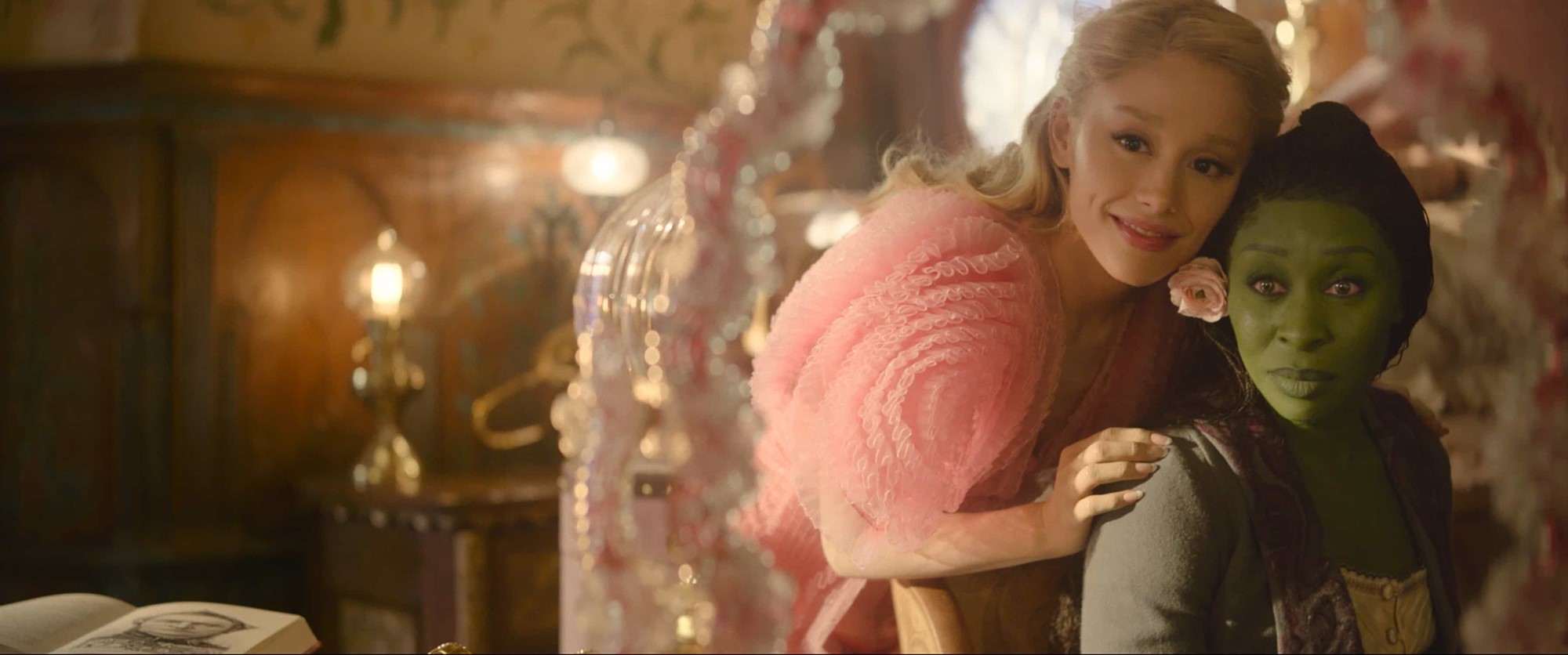
Emerald and Ivory, sing together in perfect harmony…
Previously on Midlife Crisis Crossover: our family has traveled to New York City twice and caught a genuine Broadway show each time. In 2011 a Minskoff Theatre matinee of The Lion King overwhelmed us with the big, big, BIG differences between plays performed at your rather capable local theater versus the big-budget pageantry of Actual Broadway™. In 2016 we bypassed Disney’s ongoing Broadway domination in favor of the equally tourist-magnetic Wicked at the Gershwin Theatre. We went in with no preconceptions or spoilers, knowing the basic premise but having never heard a single note of it. Years after the original cast’s departure, songs such as “The Wizard and I”, “Popular”, and “Defying Gravity” were a powerful revelation to hear for the first time. After it ended, I kinda didn’t wanna leave and I was the only male waiting in the long line at the merchandise stand.
One drawback to the latter experience: our seats were not up close. When Anne bought our advance tickets, she was pretty certain we’d be somewhere in the middle. In reality, the Gershwin had a tremendous middle. The wall-to-wall sound system ensured every note would carry to one and all, and we were wowed by the sets, the visual effects, the sweeping gestures and the broader emotions. From our vantage, though, faces and expressions were inscrutable dots — even the Wizard himself, played at the time by TV’s Peter Scolari, the only cast member we knew. We were so far from the stage that I had absolutely no idea Elphaba was wearing glasses until another character mentioned them. That afternoon remains an unforgettable milestone for us, but we weren’t affluent enough to afford the perfect experience.
For anyone who won’t be traveling to Manhattan anytime soon, or for anyone who’d love an encore with off-Broadway perks, Universal Pictures has just the prerecorded roadshow version for me and you! From Jon M. Chu — the director of such musicals as the stage-to-screen adaptation of In the Heights as well as the last G.I. Joe movie that’ll probably ever be made in my lifetime — comes the latest rendition of Gregory Maguire’s alt-timeline branch of L. Frank Baum’s public-domain Oz Expanded Universe, the novel-to-stage-to-screen partial adaptation Wicked: Part I. At 160 minutes long it’s only five minutes shorter than the entire Broadway production and its 15-minute intermission, but it only covers Act One and the intermission will be at least a year long. Thankfully attendees are permitted to leave the cinema and continue leading our lives while we’re waiting for Act Two to commence, though it’s a total ripoff that we’ll have to buy whole new tickets before we can return to our seats.
I still haven’t read Maguire’s novel, but I’m aware of its ancestral status in the Everything You Know Is Wrong retcon industry of villain-to-antihero overhauls, which had antecedents such as John Gardner’s Grendel) and has since spawned the likes of Maleficent, Cruella, Joker, the 2024 election, and other grimdark PR hack-jobs with varying fashion sensibilities. The basics for newcomers: Wicked tells the revisionist secret origin of the Wicked Witch of the West, who wasn’t born evil but was born abnormally green-skinned and shunned for it. Her name is Elphaba (a conflation of Baum’s initials) and she’s a new student at the same school attended by Glinda the Good Witch, who was born magical and privileged and with the full name Galinda. The two meet, loathe, forgive, and become good friends until everything goes awry. Yadda yadda yadda, and that’s how the Wicked Witch of the West came to be and then died from surprise showering. Or maybe that’s what The MAN wants you to think.
OG Wicked fans had the good fortune to witness original cast members Idina Menzel and Kristin Chenoweth before they respectively went on to Frozen and Schmigadoon! Moviegoers today are treated to a new yet no less capable pairing. Elphaba is played by Cynthia Erivo, whom I first saw in Bad Times at the El Royale and klutzily deemed “worth keeping tabs on in the future” because I am such an artsy wordsmith and, I guess, was in a weird mood for downplaying how much I enjoyed her singing in that role, even though her venue was a dingy, deadly motel. (I last saw her in Luther: The Fallen Sun, waaay out of her comfort zone.) Here she walks a tricky tightrope as the lifelong outcast who’s learned to suppress the rage borne of endless ostracism because her funny-lookin’ green skin offends the twee, shrill denizens of Oz who buy all their clothes from a bespoke Edwardian Sears outlet. She’s polite and prone to understatement, wielding politeness as a code-switching survival mechanism against everyday prancing bigotry, but you can feel the simmering under the skin, bottled up on the assumption that she’ll never have the chance to unleash it.
In Wicked‘s other corner flutters Ariana Grande (credited as Ariana Grande-Butera, including her paternal surname), whose career you probably know better than I do. Apart from a couple of random radio singles, I’d really only seen her in a bit part in Don’t Look Up (not a good meet-cute for me and her talents) and was only vaguely aware of her chops as a Nickelodeon comedy veteran because she was in the parade of retroactively alarming clips from the Quiet on the Set exposé documentary. In that sense, I basically went into Wicked: Part I with no preconceptions of how she’d do as the new Galinda. Within moments I was impressed and sad that I was just now getting her. Galinda is basically Middle-Earth’s answer to Blair Warner, a spoiled socialite with pretensions to pink-accessorized sorcery, who can barely wield a wand but carts along a shopaholic’s luggage collection full of makeup and beautification tools for maintaining her upper-class magazine-cover gloss. After she’s forced to share airspace and classroom time with Elphaba, though, Grande marvelously mugs to the camera with her Margaret Keane eyes, nimble in her slapstick undercutting and open to laughs at Galinda’s self-unaware expense. In a frequently funny film, all the biggest laughs are hers to earn.
(Looking back on those previous entries linked above, I just noticed spots of unexpected foreshadowing. Our 2011 pics include a billboard for the soundtrack to the Nickelodeon series Victorious, which costarred a young Grande. In the 2016 entry, a montage of ads for plays-based-on-movies is topped with The Color Purple, starring Erivo at the time. Funny coincidences, those.)
All around our two stars, everything is SPECTACLE! BOMBAST! EXTRAVAGANZA! Chu knows the camera can travel farther reaches than a single stage and delightfully expands the world of Oz and the grounds of Shiz University far beyond the reaches of a mere mortal theater. I was skeptical at first and dared the film to latch onto me, which didn’t fully happen until the entrance of Jonathan Bailey (who leapt from Broadchurch‘s kid journalist Olly toward London stage success ever after) as Fiyero, the suave, smirking, upper-crust boarding-school Bad Boy who connects a dotted-line love triangle between the two roommates and shines most brightly as Chu transforms his biggest number “Dancing Through Life” into a romp through the Shiz library, a magical playground unto itself with fun-house spinning tunnels made entirely of bookshelves where down is up and up is down, and the cameras and the backup dancers leap hither and yon ’round each other. It’s a certain level of audacity to choose the school library, of all possible places, to announce to the audience with your loudest megaphone that, Toto or no Toto, we’re not in New York City anymore.
Granted, the earlier numbers expand the university boundaries with bridges, waterways, and so forth, but those are more predictable adaptation benefits. We already knew Chu would go wider in upscaling from Broadway to Hollywood. Obviously Oz isn’t the grungy office of Glengarry Glen Ross. But the library is Chu’s best showcase for exploring the medium’s possibilities while keeping its track length economical. Elsewhere, Chu runs a bit more amuck and lets the Wickedness keep going and going and going and going. Diehard Wicked superfans may enjoy the extensions and the chance simply to linger in Oz for that much longer. Others might have their patience tested, as when Our Ladies eventually take a train to the Emerald City as invitees to the sprawling “Wiz-o-Mania” block party. That arbitrary celebration of their foreign-born leader The Great and Powerful Oz (Jeff Goldblum, all Harold Hill smiles belying a schemer’s edge) is an aimless, directionless holiday parade that drags far beyond the stage rollout that I only faintly recall. Its centerpiece “One Short Day” bloats up into an excessive Macy’s program begging for an Al Roker commentator to needle it, except then it would’ve been even longer. That number’s beefed up mostly because it’s Chu’s inroad for welcoming a pair of Very Special Cameos. (Mind you, their bits are great — a short, sharp shtick of one-upmanship between women.)
Any Wicked fan will have notes to give about the musical numbers, I’m sure. “Popular” receives the best treatment, granting Grande’s dexterity full use of her room and props while highlighting Galinda’s vanity and pipes. But in “The Wizard and I”, my favorite part of that 2016 afternoon, the final note that’s supposed to soar instead drags Erivo through an overengineered gunk filter, as if she needed the extra boost to reach the finish line. It seems less mismanaged on the soundtrack, but our theater’s sound system wasn’t kind to it. Sometimes even the smaller numbers drown in lavishness or get overshadowed by the blockbuster-ized Busby Berkeley revivals that bookend them — Erivo was halfway through the slowest ballad, “I’m Not That Girl”, before I realized I wasn’t paying attention, as if my brain had decided the film had suddenly gone too quiet and switched channels on me.
The better moments were the smaller ones — the little exchanges that would read like mere pinpricks through a backlit sheet if done in a live space of enormous square footage, but can fully engage a screen audience when intimately shot and writ large. Live performance boasts the immediacy of presence and the energy of an expert performance rehearsed and delivered and redelivered multiple times — sometimes with a sensation of spontaneity, sometimes rote if it’s maybe time for the actor to move on and let someone else inherit the role — but cinema generally gives us better seats, not just to the action but practically plants us ringside for more intimate exchanges.
In stark contrast to the flamboyantly CGI-explodo continent of Oz, Chu’s finest addition happens when Elphaba arrives at the big school dance as a mock-invitee, realizes she’s the punchline to a cruel prank, and counters by holding everyone captive for a silent, baroque, mortifying anti-dance number. It’s intentionally arrhythmic and confusing (and possibly Chu grasping at forced TikTok virality a la Wednesday), but Erivo plays it as petulant defiance — if they want to stare, she’ll give them something to stare at. Alone in the befuddled crowd, she’s joined by Galinda, who’s reeling from an act of undeserved grace, finally gets Elphaba in that moment, and responds in kind. It’s Galinda’s first act that could be described as “kind”, and serves as her critical pivot from comic-relief Mean Girl to sincere ally. And Elphaba responds in turn as well, so very tired of perpetual isolation. For anyone who looks past her “dance” moves that are about as lyrical as Dieter from Sprockets, it’s the most tear-jerking scene of the entire film. It’s exactly the sort of interpersonal connection that doesn’t work so well on a stage for audience members who’re 300 feet and dozens of decibels away.
From that point on, it’s Erivo’s time to shine, when she isn’t asphyxiating in superhero-movie gargantuan glitz. At first Elphaba’s magic is all Jean Grey telekinetic outbursts and little else, kept in check by side-eying self-restraint, but once we get beyond Wiz-o-Mania largess and she learns what’s really going on behind the Wizard’s curtains, it’s a stunner when she cuts loose. She and we relish the moment when, past the climactic chases and wing-flapping and so forth, a shell-shocked Galinda-turned-Glinda tells her in astonishment, “You can do anything!” and Elphaba says “I know,” with a newfound confidence and a tinge of fury that flies over Glinda’s head. All the while she’s leveled up and in the middle of the showstopping “Defying Gravity”, which soars when she soars, and nearly recaptures the Broadway glory with its orchestra working from John Powell’s take on Stephen Schwartz’s score…albeit perhaps too aware of its pop culture status, interrupted by dialogue and stretched thinner by longer dramatic pauses, the kind you typically get when you go see a band live and they’re playing the hits but drag them out twice as long so the fans who know the lyrics and beats by heart are waiting for their favorite bits and the band keeps stopping so the fans shriek louder in anticipation till the singer finally punches it and the triumphant flight climbs that final mountain and ovations ensue.
And then…To Be Continued! Sure, “Gravity” gives you an ecstatic hit before the credits roll, but it’s no less frustrating because movies that end To Be Continued get docked at least a full letter grade for turning in an incomplete assignment. Perhaps it’s for the best Chu didn’t cram the entirety of Wicked into a singular, four-hour test of moviegoer patience (plus intermission?), but I’m skeptical of Part II‘s odds of achieving nearly as much. Act Two chokes on soap-operatic twists that don’t resonate with MGM’s The Wizard of Oz (which is basically Earth-1 to Wicked‘s parallel yet irreconcilable Earth-2) and suffers a weaker set list. I’m still not clear how Elphaba goes from talking-animal rights activist to the attempted murder of a hapless Kansas farm-girl over her shoes. Unless Chu plans to insert a gratuitous Lord of the Rings army battle at the end (see also: the Narnia films), I’m not sure how they can top Part I‘s the-future-is-wide-open sendoff without some serious rewriting. Or maybe that’s when they bring in Lin-Manuel Miranda to add new tunes?
…
Meanwhile in the customary MCC film breakdowns:
Hey, look, it’s that one actor!: Yes, yes, Academy Award Winner Michelle Yeoh is great as Madame Morrible, Shiz U’s lead enchantress and the only adult who sees potential in Elphaba and encourages her to master her talents, little revealing how sometimes great power can be subject to great exploitation.
Ethan Slater, the Tony-nominated star of SpongeBob SquarePants: The Broadway Musical (yes, that was a thing), is Boq, the awkward Munchkin who pines for Galinda but obeys her direct order to settle. Boq is also Exhibit A for the modern interpretation of Baum’s Munchkins, almost none of whom are played by “little people” — mostly they’re happy villagers around Tom Cruise’s height, slightly better-dressed cousins of The Rings of Power‘s Harfoots.
Game of Thrones‘ Peter Dinklage voices Dr. Dillamond, the hircine history professor who swaps kindnesses with Elphaba until a virulent form of speciesism overtakes the formerly good people of Oz and they begin cheering tyranny. Galinda’s shallow entourage includes SNL‘s Bowen Yang. Andy Nyman (Peaky Blinders‘ first Winston Churchill) is Elphaba’s stepfather. And it’s my understanding anyone intimately familiar with the London stage or this film’s very makers will be wowed by several cameos from each world.
How about those end credits? No, there’s no scene after the Wicked: Part One end credits, though they confirm Erivo and Grande had permission from the holders of their existing music-recording contracts to perform here and on the soundtrack. Meanwhile all around us, after our crowded screening on the Tuesday night before Thanksgiving, the audience kinda didn’t wanna leave and had broken up into discussion groups for post-show analysis. I trust the theater kids enjoyed the experience.
Discover more from Midlife Crisis Crossover!
Subscribe to get the latest posts sent to your email.
 Midlife Crisis Crossover!