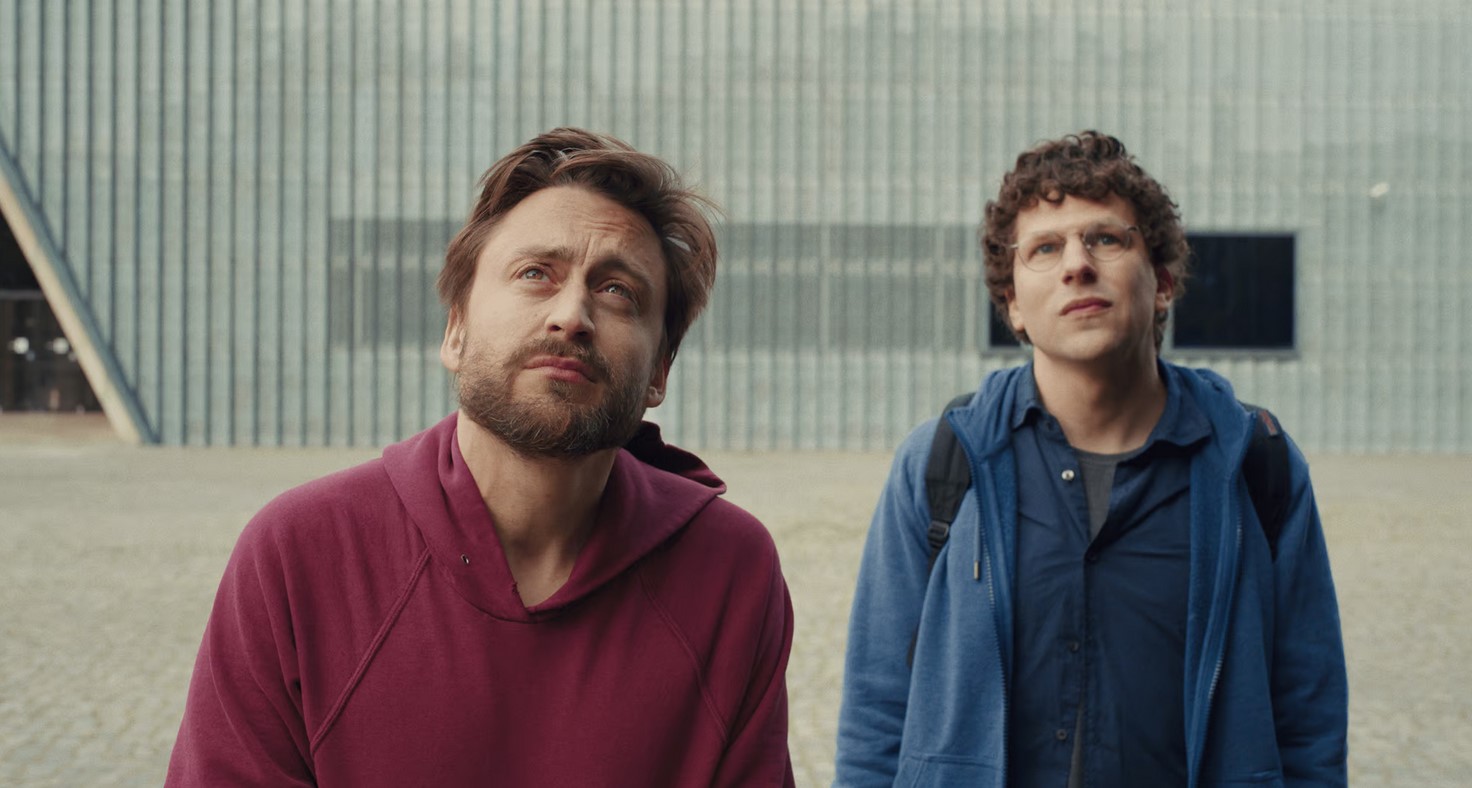
Every pro review site that’s written about the film has used this same pic, so here’s me trying to be mistaken for one of them.
Previously on Midlife Crisis Crossover: this year’s Heartland Film Festival was a cinematic cornucopia that overwhelmed me with FOMO and forced some hard choices. I was largely pleased with the eight films I caught, but quite a few big ones got away. Among the most high-profile entries I missed was their opening-night feature A Real Pain, a buddy-trip dramedy from writer/director Jesse Eisenberg (yep, the ex-Lex Luthor, the Now You See Me guy, the Zombieland rules-lister, The Social Network‘s Mark Zuckerberg, and so on and on) about family tensions, unpredictable grief, awkward group tours, and letting Kieran Culkin run amuck as an unbridled man-child who’s fascinating to watch onscreen at a remove but whom, if you were stuck next to him in real life, might have you searching desperately for an exit or at least a different seat to escape his orbit.
Fans of Succession know Culkin well from his four-season role as hyper-pervy co-scion Roman Roy, a snarky upward-failing exec who masked his daddy’s-boy complex with Gatling-gunned barbs sprayed at anyone in earshot and creative-profanity competitions with his siblings and their bottom-feeding hangers-on, each of whom reveled in their own forms of greedy brokenness. To my prudish ears Roman took the worst-of-the-worst crown more often than the other Roys, made me embarrassed to watch the show in front of other decent humans, yet was mostly likely to walk away with all the scenes. The show’s star Brian Cox, in his 2022 memoir Putting the Rabbit in the Hat, maintains Culkin wasn’t an improv whiz, that all of Roman’s coked-up soundbites were written for him, but the writers loved giving him a plethora of options. His mercurial prankster-demon self would run through them all with a seemingly off-the-top-of-his-head verve. It was the editors’ job — and, I imagine, their pleasure — to sort them for maximum Roman.
While Eisenberg is the auteur in charge of A Real Pain and technically plays our main character, Culkin is its showboating core, though not merely playing Roman in cheaper clothing. It’s neither a satire of the 1% nor the rapid-fire dialogue duel I’d expected from two actors known for playing motormouth males. Here they’re David and Benji, Jewish cousins from New York whose grandma just died and bequeathed them funds and plans to take a Holocaust-themed group tour in Poland. They haven’t spoken in six months — David lives in NYC with his wife and kid, while Benji has been staying with family in upstate Binghamton some 180 miles away — but now they have an excuse to reunite and get away for a bit. It takes a while to realize they packed a few troubles to take along.
After they meet at the airport, fly out, and get escorted to their hotel, the guys meet up with Will Sharpe (Max’s The White Lotus) as their fact-overfilled tour guide and the other four members of their cozy group with varying Jewish identities and comfort levels of sharing. Their route begins with a day-long excursion through scenic Warsaw’s historic and modern aspects (sculptures, tributes to the Ghetto, et al.), leaps some 110 miles southeast to the city of Lublin, then makes a solemn visit to the nearby museum of the Majdanek concentration camp, where an estimated 78,000 victims died during World War II out of an imprisoned 150,000. For a more personal coda, the cousins make a prearranged split from the group to go visit where Grandma used to live before she made her way to America. Most of their journey is set to Chopin piano pieces, which for me always bring to mind The Pianist, a sort-of distant cousin to A Real Pain on the extended family tree of films about WWII and/or its unending aftershocks.
if you can’t afford a trip to Europe, A Real Pain‘s ride-along seems a fair precis of one, from the city walkabout to the overwhelming gravitas of a preserved ruin where tens of thousands of innocents were murdered eighty years ago. In between Travel Channel montages, Eisenberg walks our group through an emotional ride of their own — from the tentative but excited introductions, where it’s obvious to all that Benji’s social filter is tissue-thin, which they mostly take in stride, on to the architectural and artistic highlights. Through the antics of the night-and-day cousins, Eisenberg negotiates the awkward balance between solemn respect for the tragedies and the vacationers’ hope that on some level it’ll be an experience they can actually enjoy.
In one of the most potentially cringe-y scenes, our group reaches the Warsaw Uprising Monument, which they’re each dutifully photographing for posterity and/or Facebook when Benji starts inviting everyone to sidle up to the soldier statues and assume their own big-hero action poses. After a few exchanged “Really?” glances, they each realize…well, why not? These guys were heroes! They were Nazi-punchers! It’s cool to identify with them and embrace their legacy! David, the lone holdout, questions the potential offense of it all but ends up holding all their phones in one big stack and playing staff photographer with each device one by one.
(We’ve found a lot of contrasts like that in our own, far more modest domestic travels. Any given trip to learn about much harder eras can only support so much solemnity before it turns into mental stress. And the clashes between yesterdays and today, between the Very Important and the mundane, bring other absurdities to the fore. One prime example not in the film, but which I tripped over while traipsing down a research rabbit hole for this entry: a mere half-hour walk north of Majdanek’s reminders of genocide and “Never Again”, there stands a Domino’s Pizza.)
Benji’s emotional state is in constant flux like that, often tuned to the opposite of what everyone else is feeling. Culkin flips from obnoxiously insensitive to hypersensitive empath on a dime, teeter-tottering atop the ambiguity of what’s really going on inside Benji’s head. No diagnosis is labeled per se — he isn’t a rude, crude narcissist like Roman Roy, but he can be a bit much, to the eventual annoyance of their oldest companions, a couple played by Liza Sadovy and Daniel Oreskes (Only Murders in the Building). A few clues imply he was off-kilter even before Grandma’s death may have flipped a switch. That’s doesn’t much help David, who has his own anxiety to medicate, and whatever he’s taking definitely isn’t strong enough to handle imbalances for two.
Thankfully Benji exhibits just enough maturity to doff his anarchic party hat when they arrive at Majdanek, revealed in the film’s cleverest shot. Out front stands the Monument to Struggle and Martyrdom — a massive gate 3½ stories tall and 115 feet long, a horizontal concrete monolith with a core of clay and gypsum. We have an aisle-seat view out the tour-bus window next to David, when suddenly into the clear blue sky peeks something huge and gray like It the Living Colossus. Eisenberg quickly cuts away, leaving us with a brief sense of “WHAT WAS THAT?” before everyone disembarks and he reveals the Monument’s end-to-end enormity. From that point till the end of the Majdanek experience, Benji keeps his fool mouth shut.
It’s a shrewd, humble move on Eisenberg’s part to focus so intently on Culkin at his own expense. Whereas an average self-directing star would keep their film all about ME ME ME, he only allows himself a single monologue, when his bottled-up nebbish finally uncorks. And even then, David only musters up the strength to sound off when Benji isn’t around for rebuttal. David otherwise consigns himself to the straight-man role that struggles to check Benji’s id-bursts. Inevitably there’s confrontation, but not in the standard For Your Oscar Consideration shouting match that solves everything. Grief, adulthood, family memories, and a quick reference to a single incident that neither can bring themselves to address in full — they’re like a two-man roadside attraction called the World’s Biggest Ball of Tangled Issues.
“Two characters work out their feels on vacation” is hardly a new film sub-subgenre, but through A Real Pain Eisenberg channels Culkin’s strengths into a modern approach to it, in that the search for answers doesn’t arrive at easy solutions, or even a codified compromise between the two. David feels he ought to “figure out” his cousin’s deal, but even Benji couldn’t really verbalize that. Mouthing off at light speed seems his natural mood, but sometimes he just likes hanging out quietly in airports — people-watching, soaking in the ambiance, sitting with his free-floating empathy as a substitute for direct human connection. Eisenberg, in turn, perhaps challenges himself with the tougher role after all, given his penchant for playing know-it-all chatterboxes. David has to learn to concentrate, to hear over the sound of his own neuroses. Unlike that memorable deposition tell-off in The Social Network, Culkin has his full attention. Ultimately, Benji commands ours as well.
…
Meanwhile in the customary MCC film breakdowns:
Hey, look, it’s that one actor!: The tour group also includes Jennifer Grey, the Dirty Dancing queen herself, as a more mature woman whose drama is a long list she selectively discusses, but who’s surprisingly patient with Benji’s ways; and Kurt Egyiawan (House of the Dragon, Fox’s Exorcist series) as a Rwandan survivor who’s witnessed genocide firsthand, escaped to tell the tale, and converted to Judaism late in life. Meanwhile back home, Ellora Torchia (Midsommar, House of the Dragon) has a tiny role as Eisenberg’s Concerned Wife.
How about those end credits? No, there’s no scene after A Real Pain‘s end credits, but the lengthy list of its largely Polish crew includes 14 VFX artists, four stunt credits (including one stand-in for Eisenberg, possibly for one scene involving a slap), and confirmation of co-financing by the City of Warsaw, thus validating how I was just saying this nicely multitasks as a Chamber of Commerce tourism invitation.
Discover more from Midlife Crisis Crossover!
Subscribe to get the latest posts sent to your email.
 Midlife Crisis Crossover!