
What evil lurks within the coal shed?
Previously on Midlife Crisis Crossover:
It’s that time again! Since 1992 my hometown of Indianapolis has presented the Heartland International Film Festival, a multi-day, multi-theater celebration of cinema held every October. Local moviegoers have the opportunity see over a hundred new works in the realms of documentaries, narrative features, shorts, and animation made across multiple continents from myriad points of the human experience. Some participants stop in Indy on their grand tour of Hollywood’s festival circuit; some are local productions on shoestring budgets; and a wide spectrum of claims are staked in the innumerable niches between, projects with well-known actors screening alongside indies with enormous hearts.
Heartland’s 33rd edition runs October 10-20, for which I’ve made plans to catch at least eight films in all (Lord willing). Longtime MCC readers know the rule: every film I see in theaters gets its own entry…
Academy Award Winner Cillian Murphy is back! The Irish historical drama Small Things Like These, his first film since Oppenheimer, premiered at the Berlin International Film Festival back in February and will be rolled out to U.S. theaters in November. Its special exhibition as a Heartland “Centerpiece Screening” (read: highly promoted and tickets cost a tad more) represented its second-ever showing here in the States. Though it boasts a couple bigger names than some of the other festival films I’ve seen so far, its minimalist aesthetic and hushed ambiance make it feel smaller and more intimate than the rest — in many ways the opposite of Murphy’s last gig. It’s also a Christmas movie!
Small Things Like These is based on a 2021 novella by Claire Keegan (who previously had another tale adapted into film, the Oscar-nominated The Quiet Girl), adapted for the screen by Enda Walsh (Steve McQueen’s Hunger) and directed by Tim Mielants (Peaky Blinders, FX’s Legion). Their resources and aims are entirely different from Oppenheimer‘s all-star cast, its sweeping cross-section of international war history, and its three-hour analysis of the far-reaching consequences of a single man supervising the invention of implementable mass destruction. Small Things is likewise a historical piece inspired by a true man-made source of despair, but with a lower body count on the record.
Murphy is Bill Furlong, an ordinary Irishman with a wife and four to six daughters (the camera couldn’t contain them all and they wouldn’t stop moving) who earns his keep as a coal deliveryman sometime in the ’80s. (There’s no title card or a blatant wall calendar, but their evening TV watching includes Danger Mouse, which dates back to ’81.) His appointed rounds include a creepy-looking convent that’s like a haunted house with extra windows and a foreboding wrought-iron Arkham Asylum entrance arch. This one time he’s tossing their latest order into the coal shed out back when he happens to catch a mother forcing her yowling teenage daughter toward and through the front door with the assistance of a scowling nun, not one of those smiling musical nuns. He hangs back, he watches, he doesn’t interfere. He’s just a guy doing a job.
On subsequent coal drops he keeps accidentally bumping into her, and she isn’t getting any cheerier. At first he isn’t seeing anything flagrantly wrong, as if a little devil’s advocate on one shoulder is telling him, “Maybe she’s just a disobedient trollop and she’s bringing it on herself?” But those unsettling moments dovetail with his own childhood memories of poverty and tragedy. In some ways she reminds him of his mother, of whom he only has distant but cherished flashbacks. She also reminds him of his uncountable daughters, except they’re well cared-for. One unrelated random boy who’s clearly suffering a father-related hardship or two remind him faintly of himself. Everything reminds him of everything else. Sometimes that’s narcissism. Sometimes that’s the blossoming of compassion.
A lot of Bill’s interior debates are externalized only through Murphy’s subdued yet complicated performance. He buckles under the gravity of every reminder, bearing it all as much as he can yet conveying those unshakeable burdens to us as well — always wrapped in shadows and trying to repress them so his wife won’t ask the question that supposed “real men” hate: “Are you all right?”
Mielants understates the tensions in a “Hint, don’t show” manner. Bill doesn’t debate the evidence, his feelings, or his plans of (in)action with others. Nevertheless, it’s not hard to see where this is going once we meet Mother Superior, played by Academy Award Nominee Emily Watson (whom I last saw in Chernobyl and stars in the upcoming Dune: Prophecy). She has only a few scenes but easily confirms we’re witnessing yet another instance of Catholic abuse and hypocrisy — specifically, an example of Ireland’s “Magdalene Laundries”, which go right on the lengthy list of institutionalized child abuses worldwide, ignominiously alongside Dickensian orphanages, scared-straight teen prisons posing as boarding schools, and Randy’s group home from The Wire.
Watson is suitably chilling during the obligatory scene of ironic sermonizing whose approximated verses are ultimately undercut by uncharitable deeds. But in her most complex scene, Mother Superior invites Bill inside for tea and invoice payment in her office with a roaring fireplace. While Watson feigns professional courtesy in best customer service facade, awkwardness and tension roil inside Murphy as Bill wonders where this is going, whether she knows that he knows what he knows, and whether this is actually one of those Blumhouse flicks where he has to fight a feral demon nun to escape.
Small Things Like These isn’t a full-on historical explainer and contains nary a “For Your Oscar Consideration” grandstanding soliloquy about how the Catholic church sucks (cf. Spotlight). No one theorizes why Mother Superior or the convent are the way they are. (Severe underfunding? Perpetuating a vicious cycle from the Victorian era onward? The place was actually pretty cozy till her awfulness showed up and ruined everything?) Cause is irrelevant to this story within this moment — the fact remains the “laundries” were like this, period.
The film is extremely minimalist in its plotting and rather abrupt in its ending, by mainstream expectations. Whereas Dr. Oppenheimer was a man with enormous responsibilities who made a lot of bad choices and had to live with the consequences (as do we all), Bill Furlong is haunted by the enormity of a single choice. His wife advises, “If y’want to get on in this life, there’re things you have to ignore!” Can he really insist it’s none of his business and keep scrubbing his hands clean of the coal dust and the sin of inaction, like Pilate in jeans? Or did he pay enough attention at Mass to live out Proverbs 24?
Oppenheimer contemplated the fate of the world. Small Things Like These contemplates the fate of two souls — the girl who suffers and the man who might stand by and do nothing. To diehard film fans who crave bigger-better-faster-more, I’m sorry if that sounds to you like such a small thing. It’s everything.
…
Meanwhile in the customary MCC film breakdowns:
Hey, look, it’s that one actor!: Other unpleasant nuns include Clare Dunne, who was a member of Spider-Man: Far From Home‘s Tony Stark Revenge Squad. Kindly neighbors in Bill’s flashbacks include Michelle Fairley (Gangs of London‘s furious matriarch Marian Wallace) and Sing Street member Mark McKenna. Among Bill’s daughter-army, Aoife Gaffney was maybe just barely visible in the early dinner scene in The Green Knight.
How about those end credits? No, there’s no scene after the Small Things Like These end credits, but the song credits help pinpoint the film’s exact time frame. Using only in-story “source music” in lieu of an actual score, the film makes diegetic use of “Don’t You Want Me” and “Come On Eileen”, the latter/later of which was released in ’82.
While the credits were still scrolling, our audience was treated to a special Q&A with director Tim Mielants in person!
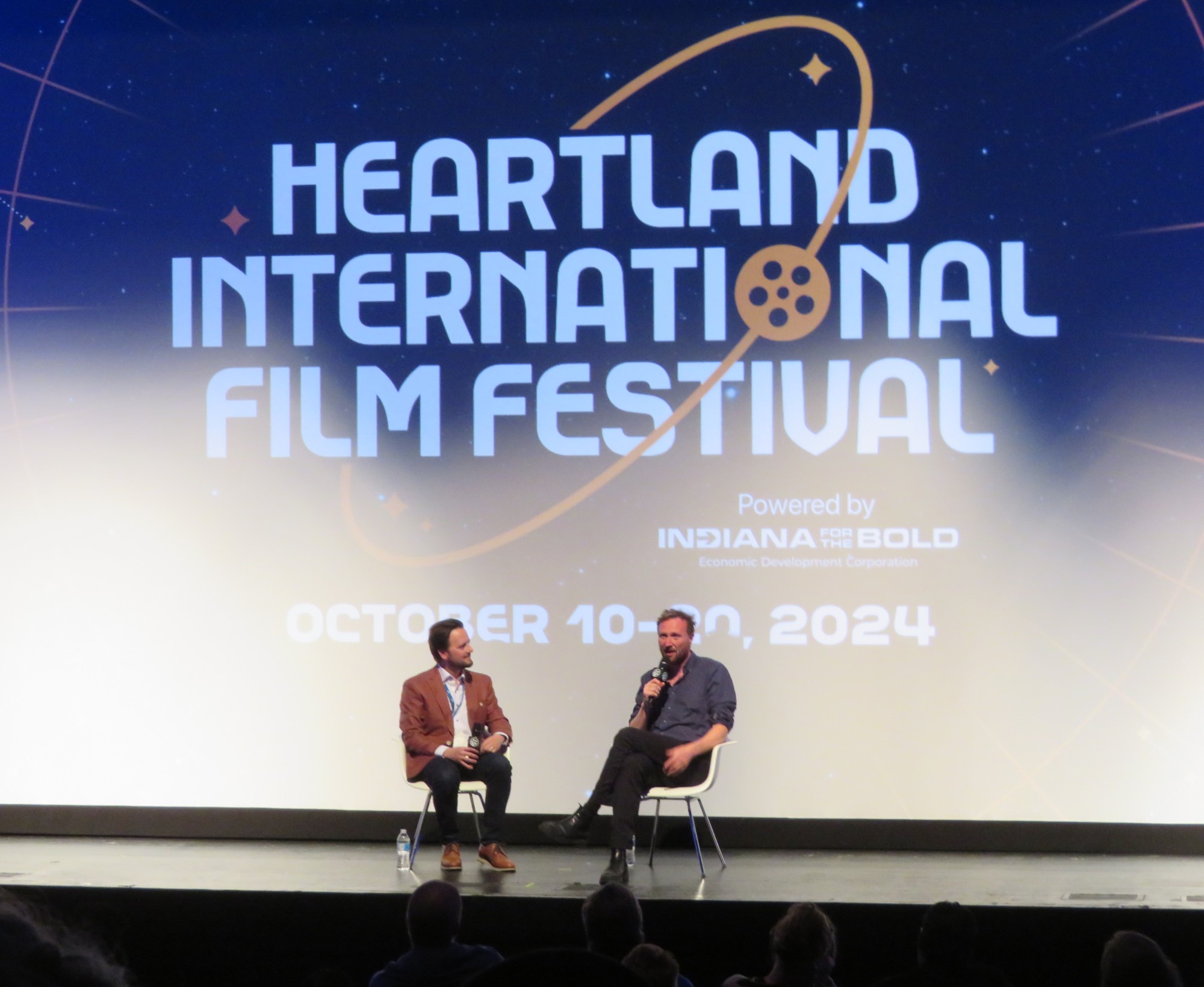
Unlike our last two Heartland Q&As, this time I brought a camera!
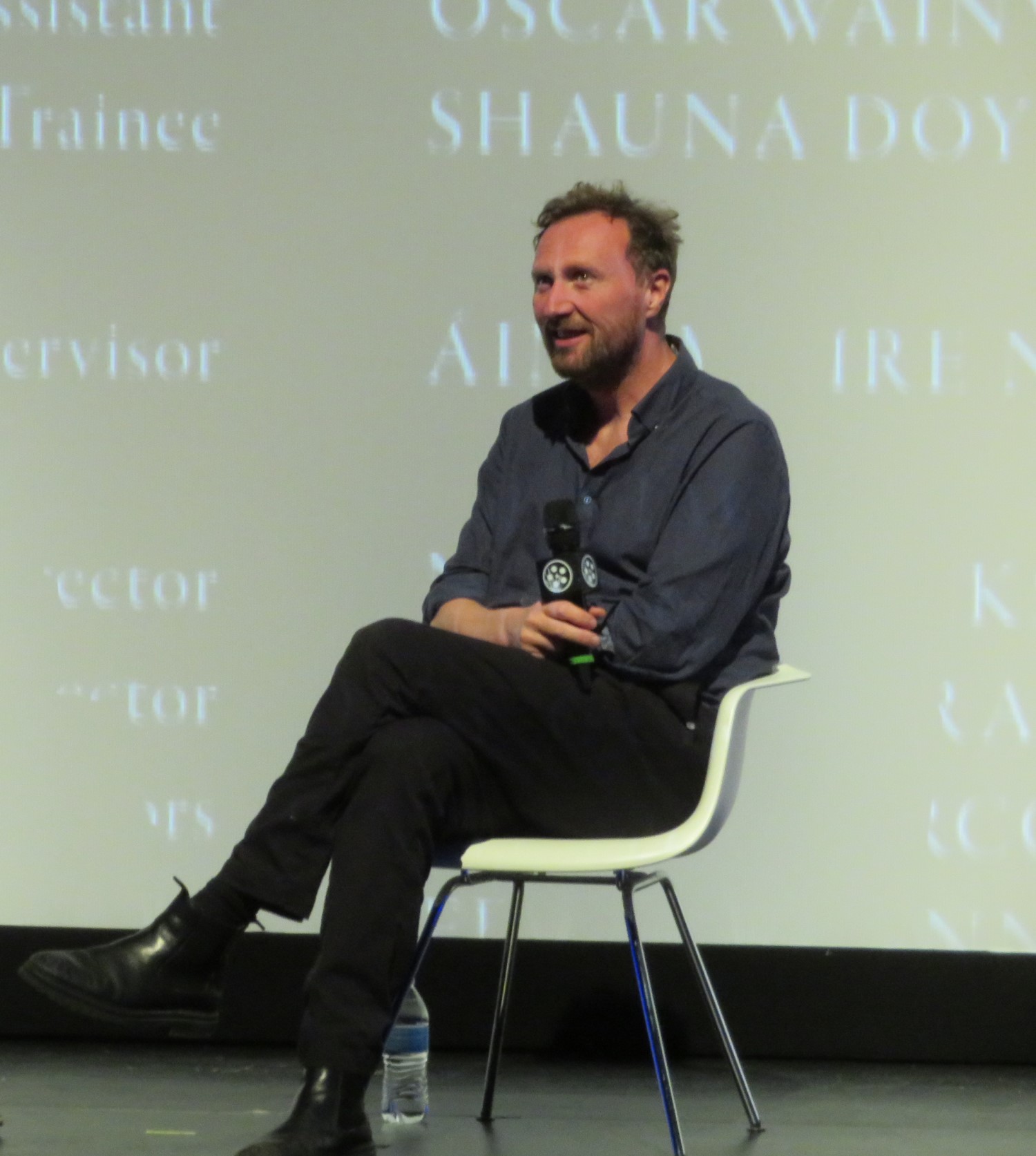
Director Tim Mielants.
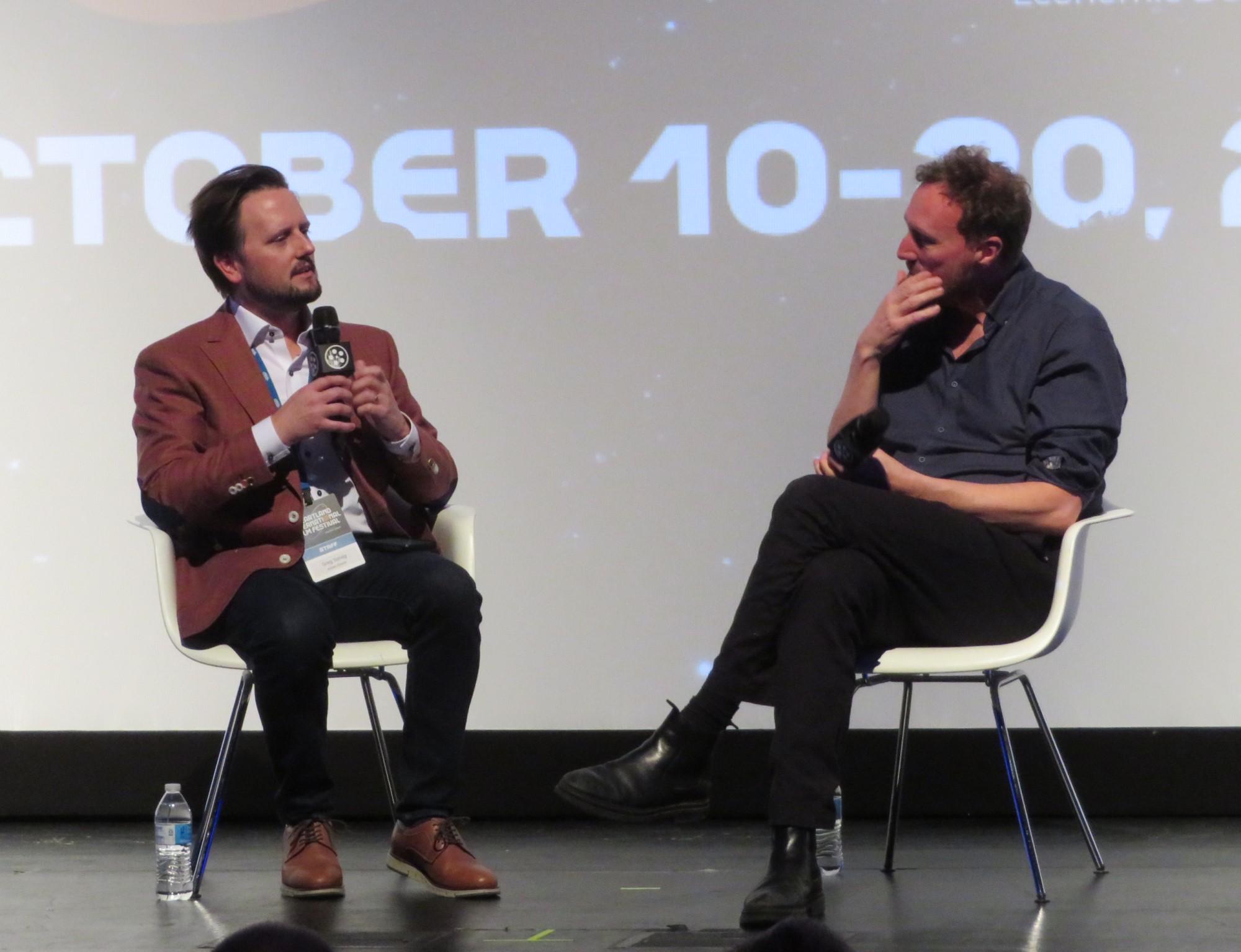
Mielants with our host Greg Sorvig, Artistic Director of the Heartland Film Festival.
Mielants entertained several questions from the audience about what he considers “a very religious movie”, the theme of grief that connects his works, and other related subjects. Tidbits:
- About two surprising names in the credits: while filming Oppenheimer, Murphy discussed the project with costar Matt Damon, who volunteered to sign on as a Producer and in turn brought aboard Executive Producer Ben Affleck.
- Mielants is Belgian and was ignorant of much of the Laundries’ history, so he relied on others to fill in his blanks so he could concentrate on other aspects. His career has precedent for challenging himself that way — he wasn’t a comic-book guy when he worked on Legion, either.
- He’s loved Emily Watson ever since he watched Breaking the Waves at far too young an age.
- Our audience’s little tension-breaking laughs during the office fireplace scene and a few other key moments were bits of intentional verisimilitude. That scene was also his favorite, a crucial turning point.
- Though he’d rather leave much of the film to viewer interpretation, he firmly believes “Silence is complicity.”
- Claire Keegan declined their invitation to active participation in the making of this film, same as she didn’t with The Quiet Girl.
- Should all pieces fall into place, his next project will be with Murphy again, which will be “bonkers” and involve a “caretaker for criminal youngsters” or something to that effect?
…and he casually dropped major spoilers for Peaky Blinders season three, for which he directed all six episodes ten years ago. I only just watched the very first episode and hope I can forget everything he said by the time I get there. I blame myself for letting too many small things fall through the cracks.
Discover more from Midlife Crisis Crossover!
Subscribe to get the latest posts sent to your email.
 Midlife Crisis Crossover!