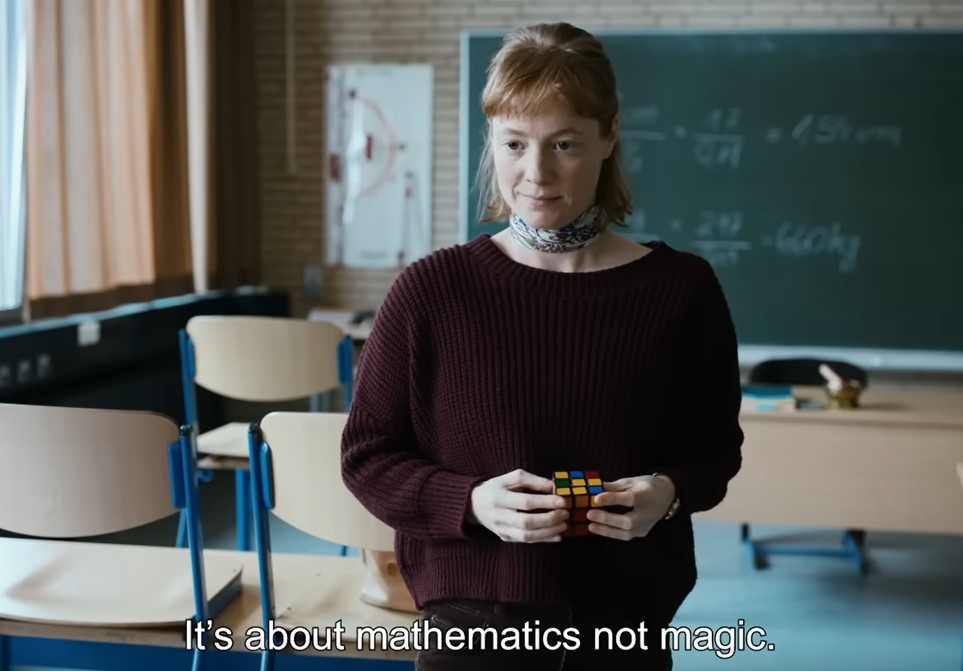
In my day, teachers could rest easy knowing Encyclopedia Brown would solve all their mysteries for them.
Previously on Midlife Crisis Crossover: our fourth annual Oscar Quest continues! We do our best to see how many freshly nominated works we can catch before ABC’s big, indulgent Academy Awards ceremony ends the viewing season. Every year the most challenging category for attaining a 5-for-5 viewing score is Best International Feature. Every single year, three-to-five out of five honored films haven’t even been released in the U.S. before their nominations are announced, so I have to contain myself as they slowly enter the national art-house circuit. Weeks can pass before they reach our Indianapolis theaters. Sometimes my patience pays off; sometimes a straggler or two misses the deadline.
Of this year’s lineup, I watched Society of the Snow on Netflix in early January, and The Zone of Interest arrived here a month ago. Whereas Society was a Spanish film about an Uruguayan ensemble and Zone was a U.K. film entirely about German characters, our next nominee The Teachers’ Lounge (oder “Das Lehrerzimmer” auf Deutsch) was Germany’s official submission for the category, but its main character is Polish and she’s fluent in German and English. ‘Tis truly a solid year for cosmopolitan cinema.
Director/co-writer Ilker Çatak embeds the audience with an already nerve-wracked secondary-school faculty, on edge as a series of thefts — money, pencils, anything not nailed down — have been going on for months and the 70+ adults on staff are at a collective loss. Kids snatching from each other would be an average American school day, but some of the pilfering has happened in the teachers’ lounge, wo die Studentin verboten sind. It’s an adult inside job. Enter Leonie Benesch (from Babylon Berlin, and who was Prince Philip’s sister Princess Cecilie in three episodes of The Crown) as Ms. Nowak, a young go-getter with a plan. One day she leaves her jacket on a chair in the lounge, tucks her wallet inside, leaves her laptop open on the table with the webcam on, steps out, and allows a few minutes for the trap to spring. Yep, surveillance is just that easy!
She returns to find money missing from her wallet. Thankfully they didn’t also steal her laptop, or else this film would’ve been shorter and funnier. The grainy webcam footage reveals the moment of the crime…but all it caught was a sleeve. No skin, no physical traits, just a somewhat distinctive sleeve. Ms. Nowak glances around the sparsely populated lounge and adjacent offices for suspects. She spots one woman nearby, a staffer named Mrs. Kühn (Eva Löbau, a short-lived nurse in the Liam Neeson flick Unknown), whose top kindasorta resembles the perp’s. Is the blouse truly unique? Is she the only person on site dressed that way? Could that particular pattern be all the rage among educators nowadays? Questions like this are why trained investigators prefer to spend more than ten minutes collecting more than two whole clues before making allegations.
Rather than widening the scope of her investigation and inspecting all 70+ adults on staff — or for that matter, bringing in a second set of eyes as backup — Ms. Nowak confronts Mrs. Kühn with all the tact of a Jerry Springer guest yelling “GOTCHA!”, and is stunned when her person of interest doesn’t immediately break down and confess. She escalates matters and goes straight to the principal, Dr. Bohm (Anne-Kathrin Gummich, one of the prison guards in The Reader). What could’ve been an opportunity for Dr. Bohm to activate and follow established protocols for such instances does not go well.
They manage to keep some details of the ensuing fiasco under wraps. The other teachers know something’s gone wrong, but they’re out of the tiny need-to-know loop and resent the info blackout. Making things worse, Mrs. Kühn’s son Oskar (Leonard Stettnisch, a remarkable find) is a student there. She chooses what she shares with him. He in turn shares what little he knows with his classmates. Soon they know even less. And soon their parents know, just in time for the annual parent-teacher night. Then the school newspaper gets involved, whose shrewd cub reporters know a little about questioning authority but have no adult oversight holding them back or vouching for their methods. Then everything circles back around to her own homeroom, who used to follow her every friendly instruction in lockstep. Every dissemination to a new social circle becomes a new level of Hell for Ms. Nowak.
She thought she was the good guy saving the day, and yet…she’s noticeably had incidents with students for other reasons. Her tactics beg ethical questions. Every peacemaking attempt is shakier than her detective work. Çatak’s camera stays in school and at her side for nearly the entire film, so the viewer is privy to no more intel than she is. She knows at least three languages, but soon her entire world is one big communication breakdown. Just how far off the rails can the situation fly? And can we handle her anxiety inflaming our own?
One fun part of seeing too many new movies in a short time frame (like, say, during Oscar Quest) is you start noticing unintentional connections among unrelated works, which can create an interesting portrait of where humankind’s collective heads are at, if not a zeitgeist made manifest. As I watched The Teachers’ Lounge, I was reminded of two other films I’ve seen in the past few months — Justine Triet’s Best Picture nominee Anatomy of a Fall, which I rented shortly before it was nominated; and Hirokazu Kore-eda’s Monster, which I caught at last October’s Heartland Film Festival. They’re three different films with three different goals hailing from three different countries — one of them half a world away — but in quite a few ways Teachers felt like a missing link between the other two.
Follow:
Teachers v. Anatomy: Our viewpoint characters are professional women who happen to be polyglots (or maybe that’s just de rigueur in Europe) living outside their homeland (though not far away). A plethora of clues and red herrings are teased, but we never learn what exactly happened. If the accused are innocent, there seems a lot of gaps in the unexplained true story. The lives of those central women are analyzed down to the bone and judged, because some onlookers have decided every little detail matters.
Teachers v. Monster: A ferocious mama-bear roars as her child bucks norms (one for family’s sake, one for friendship or more) while a teacher who means well makes bad judgment calls based on limited knowledge and ends up jeopardizing their own career and mental health. School officials form a united front, limit themselves to unhelpful canned responses for fear of legal backlash and throw the teacher under the bus.
Two key components are at the core of all three films: the inherent limitations of human consciousness and corporeality vis-à-vis shared knowledge, by which I mean none of us are mind-readers and we can never enter someone else’s mind to know truly what they’re thinking or have done; and a tested relationship between a mother and a son — whether tight, or taut, or both. More simply put: we want our families safe and in one piece, and we want to know everyone else’s truths. Sometimes those wants require us to put up a fight. We’re lucky if we can achieve one of those things, let alone have the right to expect both when all that’s at stake.
Of the three, Monster is perhaps the kindest to us, the only one that rises above our consciousness of insufficient dimensions and affords a view of humanity’s big picture from above — granting us the rare gifts of understanding and sympathy. Anatomy is a cagey, extremely detail-oriented, what-is-truth dissection that’ll leave the audience squabbling over its defendant’s guilt or innocence despite its conclusion. The Teachers’ Lounge isn’t concerned with probing every ensemble member so much as it’s pursuing the chain of events to its heartbreaking logical end: what happens when everyone thinks they’re right, someone has to be lying or just wrong, nobody will back down, and each side tests for themselves how far they’re willing to go and how many lines they’ll cross till they “win”. Çatak ends his inquiry not with closure, so much as he throws the brakes near the line between riveting human drama and over-the-top melodrama. As the credits roll over the final image, viewers can argue whether or not he threw the brakes in time.
…
Meanwhile in the customary MCC film breakdowns:
Hey, look, it’s that one actor!: Other teachers who’ve ever been visible in something shown in the U.S. include include Sarah Bauerett, who sold Lydia Tár an apartment near the end of Tár. Parents include Uygar Tamer, who had a bit part in Quantum of Solace; and Özgür Karadeniz, who was in one episode of Epix’ Berlin Station.
How about those end credits? No, there’s no scene after The Teachers’ Lounge end credits, but they’re your last chance to see how many more words you learned in German class that you haven’t thought about in years. I awarded myself a few brownie points for recognizing the filmmakers’ special thanks to their own parents and teachers.
Discover more from Midlife Crisis Crossover!
Subscribe to get the latest posts sent to your email.
 Midlife Crisis Crossover!