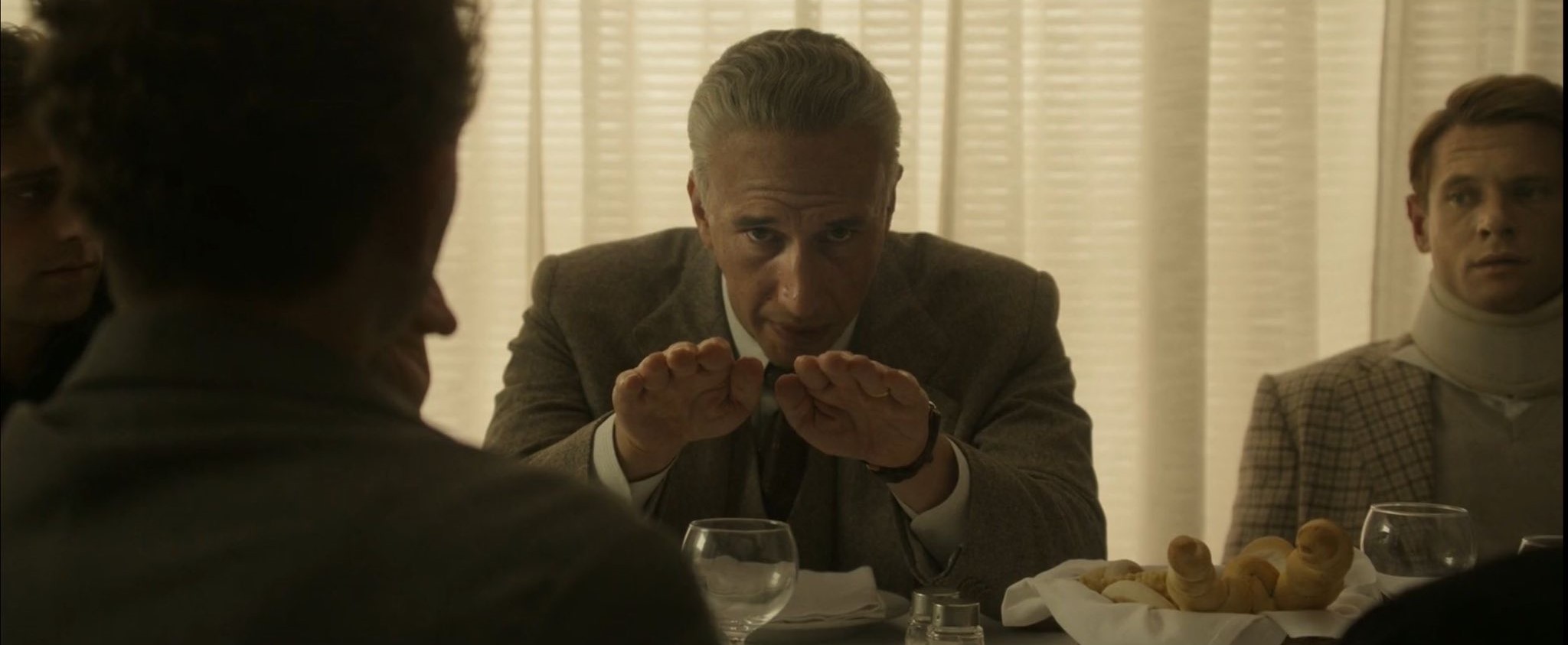
What this pic and movie really need are some Photoshopped 3-D Force-lightning.
Previously on Midlife Crisis Crossover: I tried starting my annual Oscar Quest three weeks early by catching several potential nominees before the Academy’s official announcement, in hopes of reducing my eventual legwork. Two of those screenings proved useless to my Quest in the end: Zack Snyder’s Rebel Moon (which was on the Best Visual Effects shortlist, but got justly bumped by Godzilla) and Ferrari, a vehicle for Adam Driver to explore a matured variation on his House of Gucci accent. Rendered irrelevant like that, this entry could’ve been procrastinated another week or two, but then I realized maybe it’d be a good idea to slot something between the entries for American Fiction and The Color Purple, which really would not work as a double feature.
Once upon a time, auto racing was the only sport I ever cared about for more than a day. My childhood home was two miles away from the Indianapolis Motor Speedway. Every May we could hear the sounds of those roaring, grinding, snarling engines from our front yard. On every Race Day — the Sunday before Memorial Day, unless bad weather pushed it back — I’d turn the radio to 1070 AM WIBC and listen to their live coverage of The Greatest Spectacle in Racing with my friends. I attended the race in person with a high school buddy in 1990 and in 1992, though I wouldn’t say I “saw” it live. Our seats inside Turn 1 afforded a view of a mere sliver of the racetrack, so we missed any and every great moment of both races except in ’92 when Roberto Guerrero crashed right in front of us on the parade lap. Yes, they weren’t even actually competing yet, just all 33 cars warming up in unison. It was literally Lap Zero.
But that’s why the fans watch, right? Those kinds of mishaps are what make auto racing such a surprising armchair thrill-ride as long as no one dies horribly right in front of you. Without the collisions and accidents, every league would be exactly as George Carlin described when he declared auto racing was not a sport: “Driving 500 miles in a circle does not impress me.”
Hence Michael Mann’s Ferrari. The creator of Miami Vice and occasional feature-filmmaker (I preferred The Insider and Manhunter; you might prefer Heat or Collateral) spent so many years on this expensive labor of love that its credited screenwriter Troy Kennedy Martin (Kelly’s Heroes, the original Italian Job) passed away in 2009. It isn’t a biopic meant to shill for a company’s product, like Air, BlackBerry, Tetris, or Flamin’ Hot, which was nominated for more Academy Awards than Ferrari was, for a final score of 1-0. (Thank that confounding Best Original Song category.) It’s a cross-section of Enzo Ferrari’s life that just so happens to contain the most wreckage, not all of it on the track.
Ironically, the man called Driver does not drive the most kilometers in the film. Enzo’s not behind the wheel anymore when the action picks up in 1957. At age 59 he contents himself with designing, building, supervising, promoting, and urging excellence and victory and so forth from his employees. The sports half of his life seems like a simple course down an unbending home stretch: that internationally renowned company of his can’t survive on selling only a few dozen lovingly crafted luxury sports cars per year, so he needs a promotional stunt and paycheck to save the company, which means putting together a team to win The Big Race and stick it to his chief rivals at Maserati. He hates them SO MUCH, but in a cool, distant way because he’s a Michael Mann character.
So the basics are all set. The first crash in the film is a jarring reminder that piloting high-speed machines has never been a safe hobby, though I giggled a little as the poor driver’s fate, true story though it might’ve been, was CG-illustrated in a way that reminded me too much of the death of Anthony Hopkins’ poor avatar in Transformers: The Last Knight. The racing scenes are of course where the most compelling action is, as our drivers navigate The Big Race winding through miles of Italian countryside roads, scenic highways, hillside hairpin curves, and dense city streets where walls of hay bales are the only barriers standing between adoring spectators and hot rubber death. (As I thought to myself, “How long till they swing by Rome and pass the Coliseum, its only building ever?” I had my answer within three minutes.) Mann’s ride-along cameras achieve the You Are There sensation essential to any solid racing flick, not to mention the aforementioned roaring, grinding, snarling engine sounds that separate a real racing film from a weightless contraption like Speed Racer, which was two hours of plastic Hot Wheels track sets.
Meanwhile behind the scenes, things were falling apart. The financial woes perplex Enzo and the company’s co-owner and business manager, his wife Laura. Previously on Midlife Crisis Crossover, Penélope Cruz starred in Almodóvar’s Parallel Mothers, which I couldn’t stop complimenting as the famed director’s camera enveloped her passionately in every frame. Here, Laura isn’t so lucky: she’s still grieving the death of their son Dino the year before from muscular dystrophy and adding it to a long list of reasons why her every gaze toward Enzo is like a barrage of cartoon daggers. Their loveless marriage has left her a harridan who dutifully shambles from one responsibility to the next, leaving clouds of fury in her wake, roaring and snarling at Enzo whenever they pass.
Laura knows he’s had women on the side, but she doesn’t know names, nor the full extent of his adultery. Cut to his other palatial home, where we meet Shailene Woodley (The Descendants, Divergent) as Lina, his mistress and baby-mama. Unlike Laura, he has a spare son lying around. Also unlike Laura, Lina doesn’t get to come alive or do much here, except make breakfast and yearn maybe one day not to live in fancy hiding. Driver is little more than a happy, ordinary family man around Lina, but whenever he and Cruz spar, that’s when he’s coaxed farthest outside his emotional bunker…which, to be fair, might at least be historically accurate. It’s hard to get a rise out of Enzo, partly because he’s an old manly-man and partly because he’s endured so many tragedies in his life — his first son as well as countless dead drivers throughout his career — that he’s had plenty of opportunities to practice repressive grief-swallowing. That’s a tough position to play without feeling monotonous on the outside, but eventually the man, the myth, the manufacturer comes to life with some tag-team effort between Driver and Mann. Now that I type that, they sound like a car-crash law firm with cheesy TV ads done by the same kids who make Saul Goodman’s spots.
Mann avoids the usual biopic sentimentality that’s a well-used part under the chassis of standard Oscar fare, including a couple of this year’s honorees. His staunch refusal to stick to their old dirt track is most drastically apparent in the final leg of the race, when all the preceding mileage — the moments of cars dashing around each other and losing precious seconds at pit stops and watching exotic panoramas turn into accident sites — leads to an unforgettable scene totally, abruptly, viscerally unlike any other moment in the entire film. Even if you’re a racing aficionado who knows the significance of the 1957 Mille Miglia, nothing will prepare you for a single, heart-stopping, slo-mo pivot of fate. My theater had maybe a dozen of us watching, but you could feel us all stop breathing at the same time. Once reality eventually snapped back into focus, I thought to myself, “Okay, so maybe that’s why Mann wouldn’t let this project go.”
Then again, maybe that crossroads is why the the film’s two halves never quite intersect. Once we’ve passed all the carnage along history’s roadside, it’s hard to bring our gaze back to the two-timer’s family drama that couldn’t possibly turn our heads with the same whiplash G-force as That One Scene. But for what it’s ultimately worth, Penelope Cruz comes closest of all to taking Ferrari‘s checkered flag, especially in the final hour when Laura fights most desperately for what’s hers, including a half-ownership stake in the film’s title.
…
Meanwhile in the customary MCC film breakdowns:
Hey, look, it’s that one actor!: America’s heartthrob Patrick Dempsey (Grey’s Anatomy, Transformers: Dark of the Moon) is real-life legend Piero Taruffi, the eldest driver on Enzo’s team for The Big Race. His all-white hair and natural-aged appearance were so off-brand for McDreamy that I never recognized him and was shocked to see his name in the end credits.
The drivers’ entourages include Sarah Gadon (11.22.63, Vampires vs. the Bronx) as Mexican actress Linda Christian, who was a girlfriend of another driver on Team Ferrari. Christian had her own stories to tell (such as how she holds the qualified title of Technically The First Bond Girl) but gets about as much screen time as Woodley — i.e., hardly any.
Otherwise, it’s all Italians I don’t know, though with higher-quality acting and production values than Italian cinema circa 1957 as Americans had seen it at the time — i.e., hardly any.
How about those end credits? No, there’s no scene after the Ferrari end credits, but they do confirm this decades-in-the-making biopic picked up nearly two dozen Executive Producers along the way from various countries, including Driver himself. Also acknowledged is the team of makeup artists who managed Driver’s prosthetics that transformed him into the elderly Italian with maybe one one-thousandth the press hubbub that Bradley Cooper’s Leonard Bernstein nose drew.
Discover more from Midlife Crisis Crossover!
Subscribe to get the latest posts sent to your email.
 Midlife Crisis Crossover!