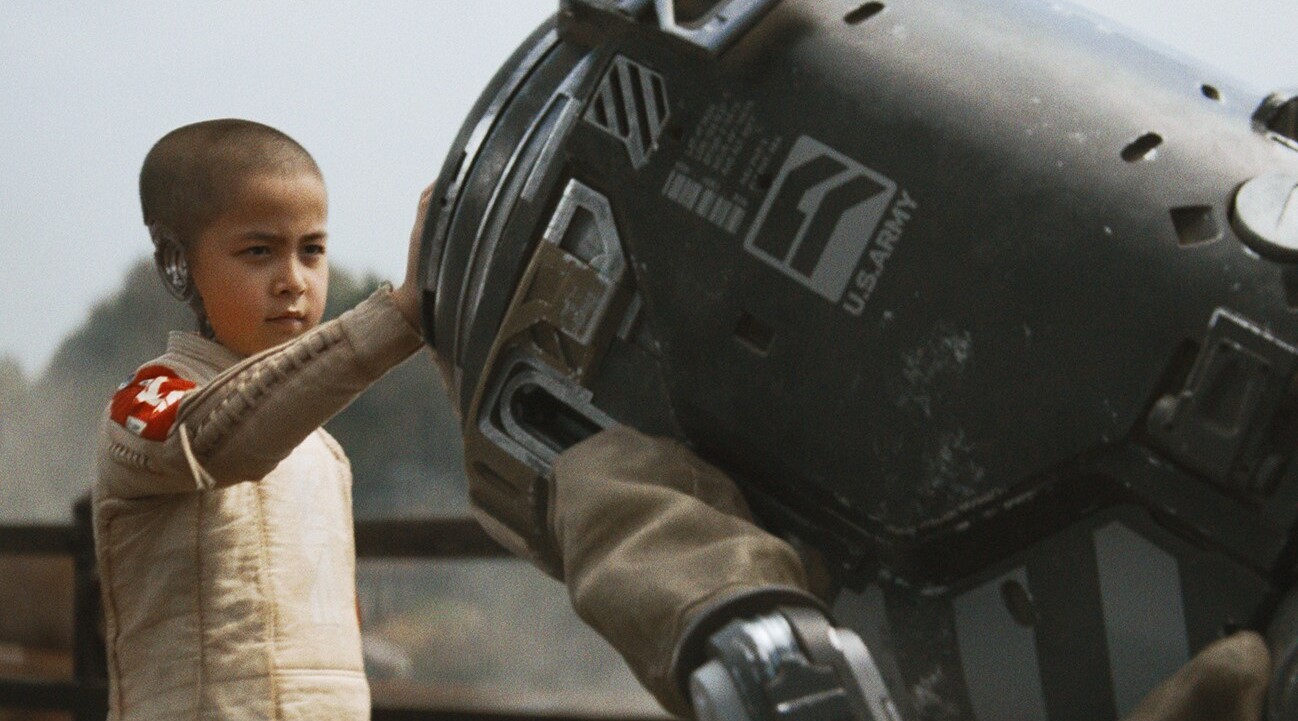
Whenever the teaser for this film came up between my rounds of Words With Friends, this was the exact image when the X would finally come up and I could exit the teaser and get back to my games.
“Robots are people too!” all the science fiction stories would plead with the ordinary citizens who dreaded a future where automatons immune both to Repetitive Strain Injury and to poverty might usurp our billions of factory jobs. Fantastical genre tales moved beyond Isaac Asimov’s Three Laws and into the pop culture firmament through the hard-luck journeys of Data, Short Circuit‘s Number Five, the Iron Giant, Chappie, the Westworld staff, the cast of Kubrick and Spielberg’s A.I., and legions of other eminently merchandisable microchipped personalities in between. If season 1 of Picard is to be believed, robots’ reputational status will remain a fragile thing even until the 24th century. All it takes is one malware-addled malefactor or one sinister organic-led false-flag operation, and robot rights can be tossed out the window as we revert to seeing them as our inventions and our property, rather than our friends, neighbors, or lovers.
Or, as we’re learning in A.D. 2023, all it takes is to redefine the parameters of the chat. Robots are out; A.I.s are in. Robots were willing to settle for our blue-collar jobs, but their non-corporeal cyber-brethren are coming for our white-collar and no-collar jobs. They aren’t even truly sentient yet, but limited-perception A.I.s on corporate leashes are being “hired” as journalists, writers and artists — utterly mediocre ones, to be sure, but just barely productive enough to please greedy employers and undiscerning audiences. Now the online citizenry are mobbing the networks with chants of “BURN THE A.I.!” as we’re ostensibly on the cusp of having literary discussions about the oeuvre of writer/director HAL 9000, auctioning off Skynet’s black-velvet paintings, or handing out Grammies and Newbery Awards to the dueling superprograms from Person of Interest.
Co-writer/director Gareth Edwards (2014’s Godzilla, most of Rogue One) doesn’t so much confront our current debates as he sidesteps them with The Creator, a quaint throwback to simpler times when robots, like immigrants, simply wanted to chase their personal ambitions freely in peace, and coexist with (and despite) the flesh-and-blood torch-and-pitchfork mobs at large. The film feigns relevance by referring to all its robots as “A.I.”, which is technically accurate yet may be confusing to anyone with a severe hangup about subgenre labels. To SF geeks, most of the cast are robots. ChatGPT and OpenArt do not in any way enter Edwards’ conversation here.
In a future where a spot of nuclear devastation leveled Los Angeles and was blamed on robots, our man John David Washington tries a new SF-blockbuster setting in the wake of Tenet by going deep undercover as he did in BlacKkKlansman. His dutiful Sergeant Joshua Taylor is embedded with the refugee robot community, who’ve fled to the future region of “New Asia”, which really feels like an American label. (If the locals have a better, less derivative name for it, they never mention it.) A vengeful America seeks the robot ringleader Nirmata through efforts on and below the table with an internationally televised hand-waving to New Asia’s sovereignty. Unfortunately Taylor makes the classic undercover-cop mistake of falling in love behind enemy lines; America, in turn, loses patience and switches to Plan B, which is wanton destruction in broad daylight. Their unstoppable killing machine of choice is called NOMAD (no relation to the much smaller, more talkative Star Trek killing machine), a colossal hovering cigar cutter equipped with a Giant Sky Beam™ that atomizes all matter it targets except whatever and whoever are needed to continue the plot later. Usually the part where an undercover crime drama turns tragic and no one wins comes at the end of a film, not in the prologue, so that part’s a moderate novelty.
Fast-forward five years: Taylor is on the outs with his superiors, but they reel him back in for one more special mission: now the robots allegedly have an Ultimate Weapon that could spell doom for all humanity if the robots are as evil as the U.S. government’s P.R. hacks totally swear they are. They reckon there’s only room for one Ultimate Weapon on this here planet, and that’s America’s elliptical travel-sized Death Star. They give Taylor added incentive to agree to this One Last Job — too much incentive, arguably. He makes the trip back to New Asia with a nominal team, but takes about five minutes to ditch his enemy-sabotaging assignment and find himself escorting a tiny child robot named Alphie (Madeleine Yuna Voyles), who has very special superpowers that could make her the savior of the robot race. It’s barely a spoiler to confirm they are not, in fact, blood-lusty warmongers.
Taylor and Alphie could enjoy a nice little Lone Wolf and Cub journey, except he’s made one of the worst possible mistakes for their health: he’s made Allison Janney mad. Her merciless field commander leads the American military charge with what could’ve been a one-note ferocity in other hands, but the always leveled-up Janney goes nearly orchestral with her colonel’s one-note Rite of Spring popcorn symphony. As the plot sends Our Heroes hopping away from her and toward the next set piece, we can admire the scenery and meet the other robots. The most humanoid ones (including Godzilla survivor and “LET THEM FIGHT” meme star Ken Watanabe as their kindly robot-herder) look distinctly cool with their cyborg parts and their CG’d hollow atlantoaxial joints that let us see cleanly through their necks. Very few of them come alive (so to speak) with any individual personalities or any sense of their assigned functions. Most robot stories compare their intended purpose to what they desire to do despite their programming. Most of The Creator‘s automatons presumably were supposed to “serve” and now they’re content simply to survive, little more. Or have these robots been building new robots simply out of procreative impulse?
Robots-begetting-robots tends to be more for conquering-army recruitment than for altruistic purposes (e.g., that time Ultron begat the Vision as more of a chief minion than a loving son), but Edwards overlooks that possibility because he’s much more vested in his world-building, which in a Dolby Cinema viewing was immersively dazzling, no complaints there. Sound, visuals, seamlessness of effects — if it snags a dark-horse slot in the next Visual Effects Oscar race, I’d lay a few bucks on it. The backdrops shift gears for value-added variety — seedy city nightfall, promise-filled ocean coasts, serene Asian forests suffering so much damage from man-vs.-mech melee. The lengthy climax, a barnstorming fetch-quest aboard NOMAD itself, revs up some gripping suspense (though at times it’s hard to get a spatial sense of NOMAD’s layout), but several earlier sequences rely more on throwing surprises at us than in building tension.
With the exception of a few interludes that goad Janney’s temper ever higher into the red zone, Edwards focuses almost too tightly on Washington and his wee charge, at the expense of the rest of the cast. Unlike with either Tenet or BlacKkKlansman, I found myself thinking “He’s not Denzel” a lot, whenever the film needed him to do the entire cast’s emotional weightlifting. His dad went through similar child-protector motions in Man on Fire, but Taylor isn’t played up as that sort of warrior. He’s a compromised family man with a law-enforcement resumé who maybe got Bs on his future-police-academy combat exams. He isn’t the Action Hero that this slick assembly of refurbished parts could’ve used to lift it above the baseline; he’s more of a wrong-place-wrong-time guy stuck in its gears and nearly ground up. In the closing moments his bond with Alphie finally feels real, but by then it’s hard to hear or feel any tears as they’re drowned out by so many proudly staged explosions.
After so much sound and fury, final fates are practically swept aside in the abrupt jump to The End, where The Creator barely nods toward the “Robot Lives Matter” sermon that was supposed to be the whole point. The robot characters outnumber Washington by a wide margin, but once we know what happens to him, you can almost hear the unison clicks of recording-equipment power-off buttons. It almost makes you wonder if their viewpoint would have been more authentically represented had an actual robot written and directed this.
…
Meanwhile in the customary MCC film breakdowns:
Hey, look, it’s that one actor!: Gemma Chan (Eternals, Captain Marvel) as Taylor’s wife, who nearly matters at first, until she doesn’t, except to the extent that the plot relies on her fridging. Ralph Ineson (The Witch) is the main military superior overseeing the robot genocide. Other soldiers include Marc Menchaca (Generation Kill), Robbie Tann (Black Mirror‘s “Mazey Day”), and Michael Esper (young Russell Crowe in A Beautiful Mind). Musician Sturgill Simpson (who composed the score for The Dead Don’t Die) is among the few people on Washington’s side. Veronica Ngô (The Old Guard, Star Wars: The Last Jedi) is the only other memorable humanoid robot.
How about those end credits? No, there’s no scene after The Creator end credits, but the crew, locations, and other hints throughout the film (e.g., “Nirmata” is Nepalese for “creator”) acknowledge “New Asia” contains far more that just China, Japan, Vietnam and the Koreas. There are other countries in that whole region, despite how rarely Hollywood centers on them except when cataloging 1970s American atrocities…or building faint robot allegories of them.
Discover more from Midlife Crisis Crossover!
Subscribe to get the latest posts sent to your email.
 Midlife Crisis Crossover!