 Remember that time when the world ended on December 21st? And before that on January 1, 2000, at the hands of the Y2K bugaboo? And before that in 1994 as Nostradamus predicted in The Man Who Saw Tomorrow? Neither do I. As the humble survivor of at least three documented ends of the world, I count my blessings and try not to take the failures of those premature endtimes for granted.
In honor of Earth living to rotate another day, I present this cursory clipfest of a few of the most memorable incidents in which someone or something threatened to end or merely ruin life on Earth as we know it. In some cases the day was saved thanks to some meddling kids; in other cases, Earth lost and the survivors pressed on because life had to find a new way. At the bottom are a few provisional inclusions — two stories I haven’t seen through to their conclusions, and two stories I could’ve lived without knowing.
(This list is clearly far from all-inclusive. Beyond what I’m forgetting or dismissing, I’m also setting aside the most famous of all, the one that will end with the Lord’s victory, because of obvious Hall of Fame status. Unfair competition, you see.)
On with the countdown, preferably timed with a red digital readout:
* Falling Skies — If the War of the Worlds Martians had better immune systems, even in victory they’d still have to reckon with the uppity spiritual descendants of America’s founding fathers. As led by the earnest but damaged Noah Wyle and Armageddon survivor Will Patton, the Second Mass is more organized and logical than Revolution, more hope-filled and less defeatist than The Walking Dead, and a lot less canceled than FlashForward.
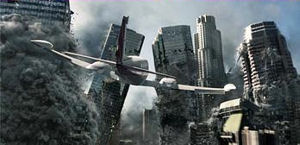
* 2012 — Not the year itself, but the arguably greatest film of Roland Emmerich’s career has better effects than Godzilla, less jingoism than Independence Day, and higher-quality schmaltz than The Day After Tomorrow. Add in a histrionic John Cusack, a self-parodying Woody Harrelson, and a mandatory impassionate speech at the end delivered by Serenity‘s amazing Chiwetel Ejiofor. With these key components, Emmerich finally nailed the formula he’d striven for years to perfect.
* Kraken — China Mieville’s lunatic horror/fantasy novel about a threatened end-of-days triggered by the locked-room theft of a museum squid reaches a fever pitch when the local paranormal constabulary sets a trap to lure in all the other characters by rush-facilitating two more simultaneous apocalypses, as written in the respective prophecies of raging Dharmapalite supremacists and another cult that worships a “wargod polecat ferret”. In a pluralistic world where all faiths are assumed to be absolute truth, it’s inevitable that theological wires would cross, deities would start tripping over each other, and reality would fracture under the strain of trying to reconcile them all. The novel’s resolution didn’t work for me, but that madcap sequence certainly did.
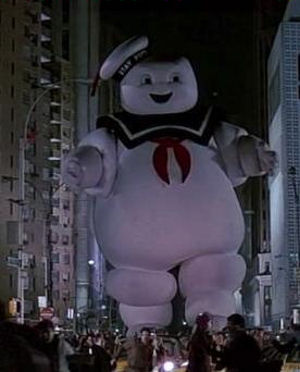 * Ghostbusters — Gozer, Zuul, and the Stay Puft Marshmallow Man were my #1 attempted world-killers for years. Now that the best horror-comedy of my childhood is one of the commonest go-to sources whenever Internet users want to impress others with random movie quotes, I’ve become a little less bedazzled. And Vigo is out of the running because Ghostbusters 2 was the first time in my life that my heart was broken by a bloated, inferior sequel. I’ve never quoted a line from the sequel, and never will.
* Zombieland — In my book, the best zombie ordeals aren’t afraid to confront their own absurdity and laugh once in a great while. Though only marginally less gross and profane than the differently inspired Shaun of the Dead, the sharp script offers the unforgettable zombie rules, four disparate characters who develop a solid chemistry, and Bill Murray mocking Garfield. It works.
* Buffy the Vampire Slayer / Angel — So many apocalypses nipped in the bud, it’s impossible to pick just one from their universe. (Note: I would not pick Buffy’s season 8.)
* “The Galactus Trilogy” — The saga that spanned Fantastic Four #48-50 saw Marvel Comics’ great super-hero family in their finest hour when a space giant in purple armor landed atop their headquarters and threatened to suck the lifeforce from our planet to satiate his incurable cosmic appetite. With a bombastic tale of pathos, fortitude, and Pyrrhic victory, Stan Lee and Jack Kirby were at the top of their game.
* The Book of Eli — Fans of the Bible disliked the over-the-top violence. Fans of over-the-top violence disliked the intrinsic inclusion of the Bible as a meaningful MacGuffin. Moviegoers on either side of the aisle disliked the methodical pacing and monotonous grey lens filters. I thought it was one of the most underrated performances of Denzel Washington’s career, as a gifted wanderer with a vital cross-country mission undertaken years after ecological burnout has turned society brutal. I found myself enthralled from start to finish, and can still hear pieces of Atticus Ross’ haunting score reverberating in my head.
* Crisis on Infinite Earths — The greatest company-wide event in the publishing history of DC Comics. The fate of not just one Earth, but all imaginable Earths was on the line as the multiverse shuddered under the doomsday designs of the Anti-Monitor. Fifty years’ worth of DC heroes teamed up in a twelve-issue maxiseries whose impact was so shattering and unprecedented, it spread forth into dozens of other DC titles in the form of “Crisis Crossovers” and spawned the phenomenon of “event comics” that rule/ruin the industry today. For all its flaws, inconsistencies, and poorly negotiated consequences, COIE was the Big One to end all Big Ones.

Apocalypse reviews pending:
* Fringe: I’m far enough into the show that I saw Peter Bishop save two Earths at once, but I haven’t started Season 4 yet. The sooner, the better — I already know too much about season 5.
* Battlestar Galactica: I watched the original Syfy miniseries, then was distracted by other TV shows and have yet to follow through. I hope to delve into this series someday, preferably before retirement.
Least favorite apocalypses:
* Stupid Mayans. We already covered their defeat yesterday.
* Armageddon. Michael Bay’s overlong eschatological vision is all about exploding, yelling, swerving, jittering, jump-cutting, swelling orchestras, showing off military hardware, and pulling off the impossible cinematic feat of making astronaut training camp dead boring. I watched it again Saturday to see if it had aged well over the past fourteen years. As it turns out, not really. Not even watching the Criterion Collection version redeemed it. All it did was ensure audio-visual clarity of the relentless explosion effects, and raise the still-unanswered question of how this merited a Criterion Collection release.
Discover more from Midlife Crisis Crossover!
Subscribe to get the latest posts sent to your email.


Each time I read “apocalyptic” or “post – apocalyptic”, my mind goes to the best cartoon ever made, “Fist of the North Star.” Some episodes, like the ones of the Warden of Cassandra, are engraved on my memory, I vividly remember them after years and I think I’ll never forget them.
LikeLike
I’ve heard great things about FotNS, but never had a chance to see it. I’ll have to add it to my to-do list. Thanks!
LikeLike
Thank you as well for your reply! : )
LikeLike
ah. prob’ly knot. (deeeturminayting yore fate, that izz).
whut with all the apocalyptic gwan gwanz… does anybody remember “world, flesh, and the devil”?
(moovy from the 1950’s (or verrrry early 1960’s) — it think Harry Belafonte was the ‘star’!)
i gotta check IMDB or … but there was an interesting GNU ZEELund moovy, one guy left, after whatever happens/happened. (then there were 3).
that didn’t help, did it?
the world as we know/knew it DID END, Dec. 5, 1970. whatever whoever we are think is going on, it isn’t.
LikeLike