Heartland Film Festival 2024 Screening #5: “Small Things Like These”

Cillian Murphy glowering from within the darkness of a coal shed.

What evil lurks within the coal shed?

Previously on Midlife Crisis Crossover:

It’s that time again! Since 1992 my hometown of Indianapolis has presented the Heartland International Film Festival, a multi-day, multi-theater celebration of cinema held every October. Local moviegoers have the opportunity see over a hundred new works in the realms of documentaries, narrative features, shorts, and animation made across multiple continents from myriad points of the human experience. Some participants stop in Indy on their grand tour of Hollywood’s festival circuit; some are local productions on shoestring budgets; and a wide spectrum of claims are staked in the innumerable niches between, projects with well-known actors screening alongside indies with enormous hearts.

Heartland’s 33rd edition runs October 10-20, for which I’ve made plans to catch at least eight films in all (Lord willing). Longtime MCC readers know the rule: every film I see in theaters gets its own entry…

Academy Award Winner Cillian Murphy is back! The Irish historical drama Small Things Like These, his first film since Oppenheimer, premiered at the Berlin International Film Festival back in February and will be rolled out to U.S. theaters in November. Its special exhibition as a Heartland “Centerpiece Screening” (read: highly promoted and tickets cost a tad more) represented its second-ever showing here in the States. Though it boasts a couple bigger names than some of the other festival films I’ve seen so far, its minimalist aesthetic and hushed ambiance make it feel smaller and more intimate than the rest — in many ways the opposite of Murphy’s last gig. It’s also a Christmas movie!

Continue reading

“Oppenheimer”: In the Shadow of Manhattan

Cillian Murphy with hair slicked back, sitting with a lit cigarette and staring wide-eyed into the distance as an offscreen General Matt Damon asks important questions that annoy him.

J. Robert Oppenheimer lit up more cigarettes than nuclear bombs. Believe it or not!

It’s 1986. DC Comics has begun publishing Alan Moore and Dave Gibbons’ Watchmen in monthly installments. It is one of several contemporaneous works that change the medium, for better or worse. Its most powerful character is Jonathan Osterman, a nuclear physicist turned by a freak laboratory accident into the nigh-omniscient, nigh-omnipotent Dr. Manhattan fourteen years after the end of World War II. Although the word “quantum” is never used in-story, his origin and intimidating powers are directly tied to the Atomic Age and the emergence of quantum mechanics. The American government employs him as an ultimate weapon, wins the Vietnam War, and changes the world and its timeline, for better or worse. As extrapolated by Moore as a sort of offshoot from quantum superposition, Dr. Manhattan perceives everything that has ever happened, is happening, or will happen to him all at once, rather than in chronological order, within/outside of each and every second that ticks by for us mortals (up to a pivotal event in the concluding chapters):

“There is no future. There is no past. Do you see? Time is simultaneous, an intricately structured jewel that humans insist on viewing one edge at a time, when the whole design is visible in every facet.”

It’s 2023. Oppenheimer is the new film from Christopher Nolan, the celebrated writer/director whose works often play with time-shifting and experiment with our perceptions in their storytelling construction, for better or worse. Tenuous connections stretch between the leapfrogging reminiscence of the fictional Dr. Manhattan and Nolan’s narrative of the real-life Mr. Manhattan Project himself, theoretical physicist Dr. J. Robert Oppenheimer. Much as Dr. Manhattan’s life is portrayed as a series of flashbacks that are out-of-order to us mortals yet interlock conceptually by the end, Nolan likewise eschews the standard Hollywood biopic formula (this happened, then this happened, then this happened, then The End), with a slightly modified form of the other standard Hollywood biopic formula (ordinate flashbacks within an end-of-timeline story frame) to chronicle the lives of the masters of the atom from interwoven character arcs. Certain images recur from one era to the next for foreshadowing and epiphanies and so forth. Ultimately the audience needs to experience the whole tapestry before they can truly see each component for what it is.

Continue reading

“A Quiet Place Part II”: Prolonging the Silence

A Quiet Place Part II

Sometimes it’s just nice to get out of the house.

If you and your loved ones are still debating whether or not it’s time to return to theaters and leave the safety zone where you’ve been harbored for the past year, might I suggest starting with the simplest of creature comforts? Emphasis on the “creature”.

Continue reading

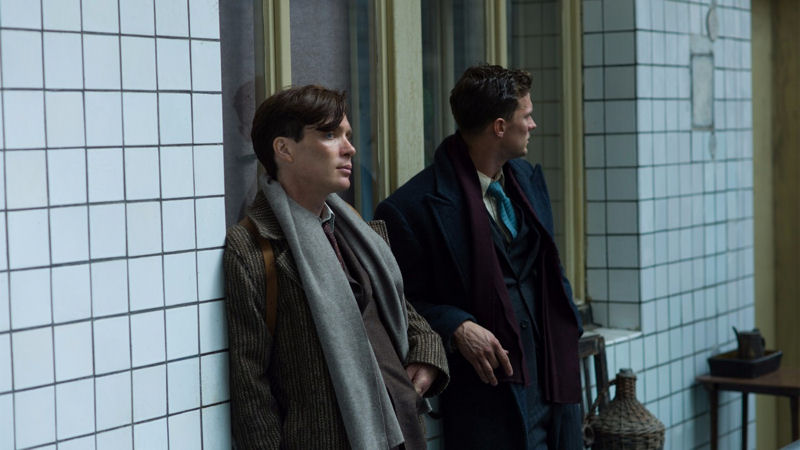
Scarecrow and Mr. Grey in “Anthropoid”

Anthropoid!

Just hanging out in Prague, trying to look cool and impress Czech chicks and maybe not get executed.

In this age of wall-to-wall summer action blockbusters and the multiple temptations to entertain ourselves at home for cheap, we have a hard time getting out there to see and support the obscure, scrappy little films whenever they air in the precious few local theaters that bother to screen them. On rare occasion my wife and I will find spare moments to make the long trek to the one art-house theater on the opposite side of Indianapolis if something tempts us on a not-so-busy weekend. Nine out of every ten experiences have ranged from pleasant to surprising to thrilling.

It’s been a while since we’ve run up against that tenth out of ten films. As soon as it opened here in town, we made an appointment with Anthropoid because films about World War II are usually her cup of tea. This time, not so much.

Continue reading