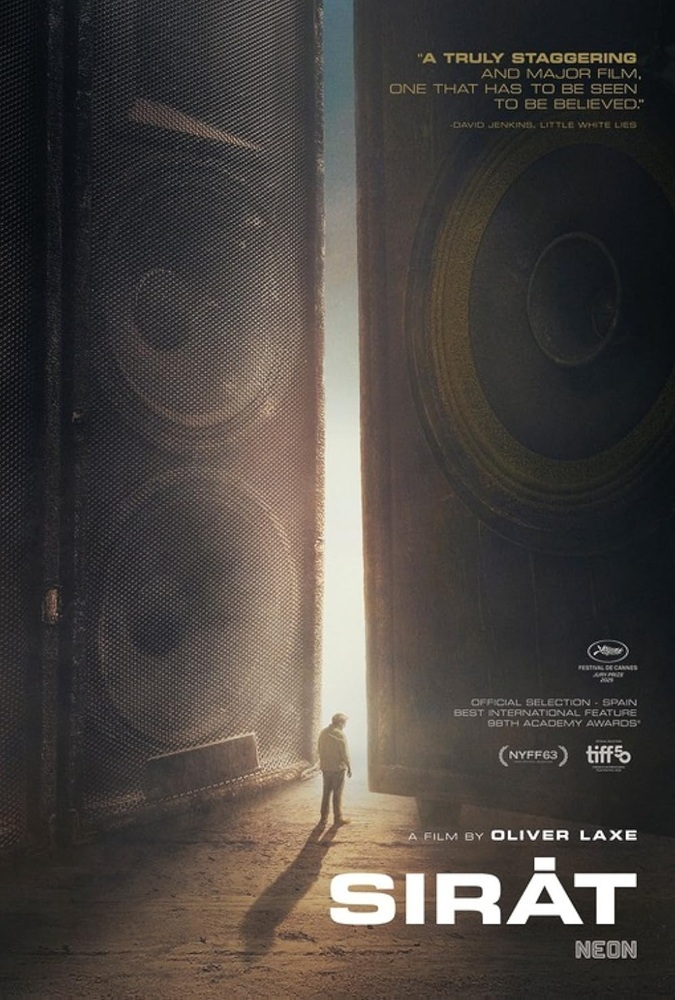
These speakers go to one hundred eleven!
Previously on Midlife Crisis Crossover: Oscars Quest ’26 continues! Once again we see how many among the latest wave of Academy Award nominees I can catch before the big ABC ceremony. Pretty much every single time, at least one of the last films on my to-do list is whichever nominee for Best International Feature is the last to open here in Indianapolis.
I wish I could’ve gotten to the Spanish drama Sirat when it screened at last year’s Heartland Film Festival, which was on my shortlist but got cut because their lineup was too impressive for me to get to everything I wanted to in a single week. (Other regretted cuts included Arco and The Secret Agent.) Fortunately its limited-release rollout reached the Midwest just in time for its two big showdowns for Best International Feature and Best Sound. Fans of the latter category are encouraged to see it somewhere with the strongest speakers possible.
The Gist: The third collaboration between director Oliver Laxe and co-writer Santiago Fillol, Sirat (more accurately Sirāt, but my attempts at ASCII reverence have caused some annoying blog side effects) stars Sergi Lopez, who terrified U.S. audiences twenty years ago as the evil Spanish Civil War captain in Pan’s Labyrinth. He’s older and less harmful now as a concerned father name Luis towing along his young son (Bruno Nunez Arjona) in search of the adult daughter he hasn’t seen in five months, who’s reportedly at a rave somewhere in the middle of the Moroccan desert. The duo sticks out like sore thumbs as they weave through a crowd of entranced daytime dancers in various stages of chemical alteration and tonsorial dishevelment.
Everyone’s pretty chill with these two squares, but apparently no one’s seen her. They’re kind enough to let Luis know there’s another rave happening in the not-too-distant future, where maybe his estranged, missing, or enslaved daughter could show up. Luis doesn’t seem to have much of a game plan or any discernible detective skills, so he decides to follow this thin lead and the motley quintet who gave it to him. He refuses to be shooed away and tags along behind their tiny caravan, which has to head south toward Mauritania, through the Atlas Mountains. The ravers drive an RV and what looks like a military surplus truck; Luis has a suburban van, which reached this far into Morocco through the power of movie magic. The assembled party sets out to navigate a harrowing road trip from Rave A to Rave B across deceptively flat stretches of sand, precariously crumbling mountain paths, and other obstacles not labeled on their old-school paper maps. Considering the tribulations ahead, Google Maps wi-fi access might not have made much of a difference.
Oh, and meanwhile, intermittent news reports are warning everyone about war breaking out within the vicinity. But really, what’s the worst that could happen?
The familiar faces: Lopez is the only cast member with more than four acting credits to his name. Behind the camera, though, the producers include Academy Award Winner Pedro Almodovar (along with his brother Agustin).
The Impressions: Laxe lulls us into the groove after some gradual sound-system setup demonstrates how much physical effort goes into putting on these shindigs. For a good 10-15 minutes we’re just watching folks dancing and mellowing out while our theater walls purr and throb with mesmerizing electronica harmonies, nary a singing voice or nattering DJ heard through the entire film. Luis’ plaintive surveying and HAVE YOU SEEN THIS GIRL handouts are a mood breaker straight out of an ordinary missing-child drama, almost leaning into a civilian pursuit-procedural that slightly morphs into an encouraging found-family travelogue, complete with bonding moments in between mild Oregon Trail hardships. His sparse arrangements rely on minimal dialogue and virtually no backstory exposition. We aren’t here to learn anyone’s life stories: we know these characters only as they exist within a single shared moment, as notes jamming within the same measure till the stinger cuts them off.
With a single, heart-stopping stab from Laxe’s jagged conducting wand, the guardrails are kicked over and the convoy is plunged straight into thriller territory. The award-nominated sound design balances the grinding and growling of their vehicles, the reverberations of the harsh natural surroundings they’re trudging through, and the shimmering techno-flourishes that eventually become one of the few sources of reassurance as circumstances go from bad to worst, then back to merely worse. Not until it’s too late will Our Heroes realize the final half-hour in particular is a nerve-shredding nightmare.
The ravers, largely played by non-actors, each have their easygoing charms within their comfy unit that’s used to most of these surroundings, while Lopez’ uneasiness escalates into a fusion of fright and anguish. Together this band of travelers is squeezed through the universe’s wringer, shell-shocked beyond words as vicissitudes fluctuate and reality destabilizes before their eyes. Some might or might not have belief systems to fall back on (the title, explained up front, comes from Islamic tradition), but rather than seeking comfort or help from above, their immediate, encroaching despair threatens to overwhelm them as larger questions plague them about the unfairness of this broken world, and why some people live on against the odds while the lives of others are cut grievously shorter. (More than once my thoughts drifted back to my own ruminations upon the untimely death of Chadwick Boseman at 43.)
Past a certain mile marker, Luis’ daughterly MacGuffin is almost beside the point. Some viewers yearning for comfort in a pat conflict-and-resolution plot may find the closing scene frustrating, despite the Pyrrhic antivenom it offers after what we’ve just suffered. Sirat also reminded me of a quote that’s long been stuck in my head, from a comic I read and loved 35 years ago: “Sometimes a direction is a destination.” Our goals (long- or short-term) may not always be achievable and our plans may not even have definable endpoints, but when life spins us out of control and our internal compasses are left adrift, the only response that won’t drive us mad is to just keep moving until or unless the path swallows us whole. When life feels like a dance marathon episode of some old TV show and everyone’s tied for last place and ready to collapse, the least worst thing you can do is keep moving, keep flowing with the rhythms around you, and keep dancing like nobody’s watching, while you still can.
The end credits? No, there’s no scene after the Sirat end credits, which are entirely in Spanish and include uncommon job titles such as “Meteorologia” and “Gasolinas”. The music section of course confirms I don’t know any of the performer-programmers involved, other than noting at least one is attributed to the film’s credited composer, Kangding Ray. I haven’t been much into electronica’s various sub-sub-subgenres since Fatboy Slim’s heyday, but his is a name I’ll need to remember.
Discover more from Midlife Crisis Crossover!
Subscribe to get the latest posts sent to your email.

