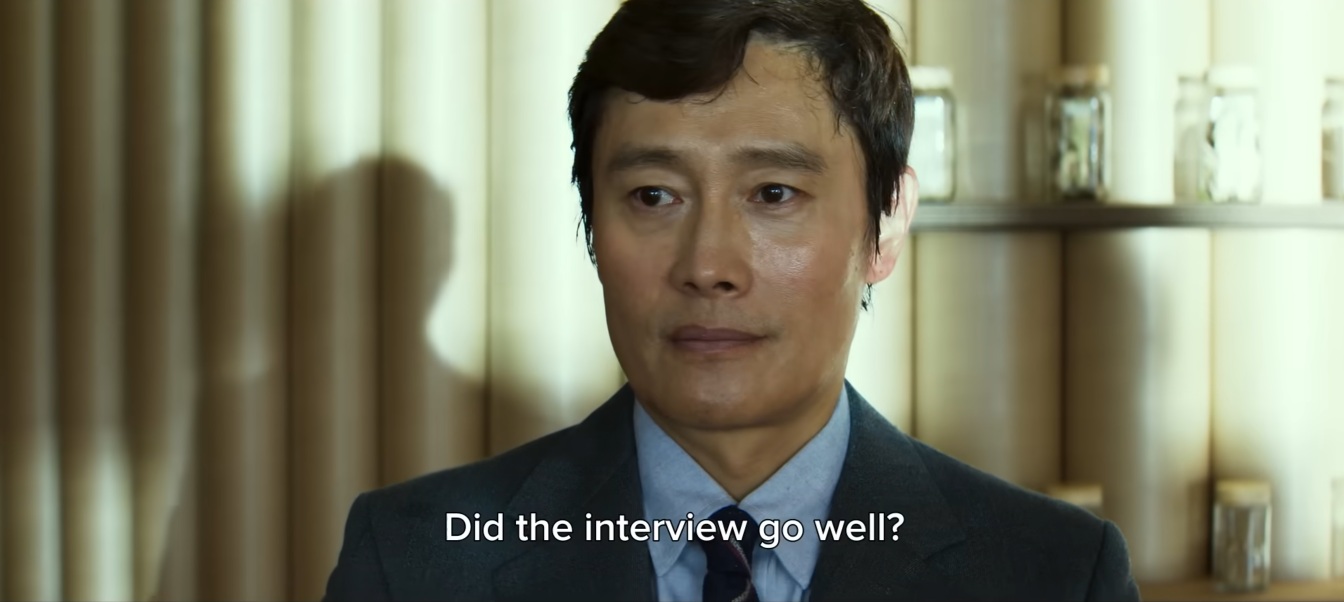
To any head-of-household having a hard time out there: keep in mind your spouse will not consider your flop-sweat a turn-on.
Previously on Midlife Crisis Crossover: It’s Lee Byung-hun’s time to shine! Zillions of Netflix subscribers tuned in for the South Korean actor’s machinations as Squid Game‘s nefarious Front Man, but that wasn’t his first villainous turn for American moviegoers. He was a T-1000 in the wisely forgotten Terminator Genisys, the worst in the series. As the murkily motivated ninja Storm Shadow, he was among the few highlights of the two G.I. Joe movies. And discerning youngsters out there caught him voicing the demon king in last year’s animated sensation KPop Demon Hunters. (I’ve yet to convince myself to check him out in the most recent Magnificent Seven alongside Denzel Washington. Maybe someday, but it wouldn’t fit this paragraph anyway, unless there’s a shocking twist in which he betrays them and shoots Chris Pratt in the face.)
The Gist: Lee is front and center — yet representing no less for the Dark Side — in the anti-corporate satire No Other Choice. It’s the latest from director Park Chan-wook, whose dramatic library ranges from the traumatically brutal Oldboy (though it did pioneer the one-take hallway fight!) to 2022’s more subdued, nearly bloodless Decision to Leave, not to mention other stops in between that I haven’t seen yet. In this adaptation of Donald Westlake’s 1997 novel The Ax, Lee is initially congenial as Yoo Man-su, longtime middle-manager at a paper company who finds himself downsized after a buyout by American interlopers. Having failed to take Dave Ramsey’s advice about saving up an emergency fund in case any financial emergencies exactly like this happen to him, he panics at how his family’s cushy lifestyle is now in jeopardy, from their beautiful house’s mortgage to their two dogs who I presume are pedigreed and have overpriced appetites.
As his wife Mi-ri (Son Ye-jin) begins enforcing household austerity measures, Yoo freaks out, does some research and realizes only one other Korean paper company is doing well in the biz. They already have a guy doing his equivalent job, but Mi-ri unwittingly inspires him: what if he were to eliminate his competition…with extreme prejudice? And not just the one guy: in a shrewd bit of proactive HR math, Yoo commits to going one step farther by identifying any other potential candidates with better resumes who could beat him out for the job — fellow castoffs who’d also need the work — and dispatching them as well…with even more extreme prejudice. One tiny problem: he doesn’t know what he’s doing. Plotting is easy; actually murdering is hard. But is it the kind of job you can learn on-the-go?
The familiar faces: Oh Dal-su, Squid Game‘s fishing-boat captain with a dark secret, is one of the police detectives. A few veterans of Park’s The Handmaiden show up, including Lee Yong-nyeo as Mi-ri’s mom and Kim Hae-sook as a grandma who keeps lots of potted plants on her roof. When Mi-ri returns to her old job as a dental hygienist, her family dentist/new boss is played by Yoo Yeon-seok. who as a teen was in Oldboy as its protagonist’s younger flashback self. Other costars are possibly major names in the South Korean entertainment industry, for all I know.
The Impressions: No Other Choice is not quite as savage as its trailer or Chan-wook’s track record suggest (the split-second shot of Lee with a chainsaw is kindasorta bait-and-switch for epic-kill junkies), but there is a body count and messes happen. (Like Oldboy, a scene of major tooth damage implies Park really fears dentistry.) It also isn’t the first modern tale of How to Succeed in Business by Murdering Your Peers. (My memory’s peculiar go-to is always Michael Caine in 1990’s A Shock to the System. There’re more out there.) Chan-wook has his own design and rhythms, allowing Yoo’s scheme to unfold at a measured pace as he multi-tasks his family’s daily routine, a fake job search for cover, and his secret stalking of the other paper-guys one by one. Once the hero of his employees and friend to the working man, Yoo tries not to think too hard about how his quarry are/were on his same economic stratum and might have their own sob stories and innocent families to feed. Alas, common decency and mercy won’t pay for his autistic daughter’s violin lessons.
As the camera nods toward upward and downward mobility with subtle crane shots that rise or fall from one building’s story to another with each new location, our ostensible family man doesn’t merely waltz through the gauntlet. Mi-ri is sometimes a sharp observer whenever she can belay the impulse for wifely rationalization, and the police are often competent at adding two plus two, albeit avoiding the basic question of “Who benefits?” as the missing persons add up. Comedic fumbling ensues with each encounter, most amusingly in a three-way scramble for a pistol that’s slid under furniture. An awkward body disposal isn’t given nearly enough time for Yoo to follow Walter White’s learning curve, but he has his own skill sets to deploy in perverse fashion. Yoo is not a mastermind like the Front Man, a martial artist like Storm Shadow, or a fiery cartoon demon mouth: Lee exudes palpable desperation as an ordinary suit more affluent than many of us, who isn’t even fighting for a promotion or to get even richer. He’s trying his worst to fail upward past his deficiencies just to maintain his comfy status quo.
Yoo shares one tic with the other businessmen around him: whenever their methods are questioned, their excuses often include the phrase “no other choice”, as if they’re helpless robots with singular routines to achieve their primary objectives, programmed to dismiss anyone who suggests they find a Plan B. (Change careers? What, and possibly make slightly less? In THIS economy?) Far as they can tell through their corporate culture’s collective tunnel-vision, life is a single-take hallway fight with no doors or turnoffs to other perfectly livable paths.
The end credits? No, there’s no scene after the No Other Choice end credits, which are almost entirely in Korean. Among the readable parts are a dedication to noted director Costa-Gavras (who adapted the same novel into his own French film back in ’05; two producers here share his last name), a credit for a 1707 Stradivarius that was incorporated in some manner, and, near the very end, dozens of logos for various contributing corporations and/or products, which may or may not include paper companies.
Discover more from Midlife Crisis Crossover!
Subscribe to get the latest posts sent to your email.
 Midlife Crisis Crossover!