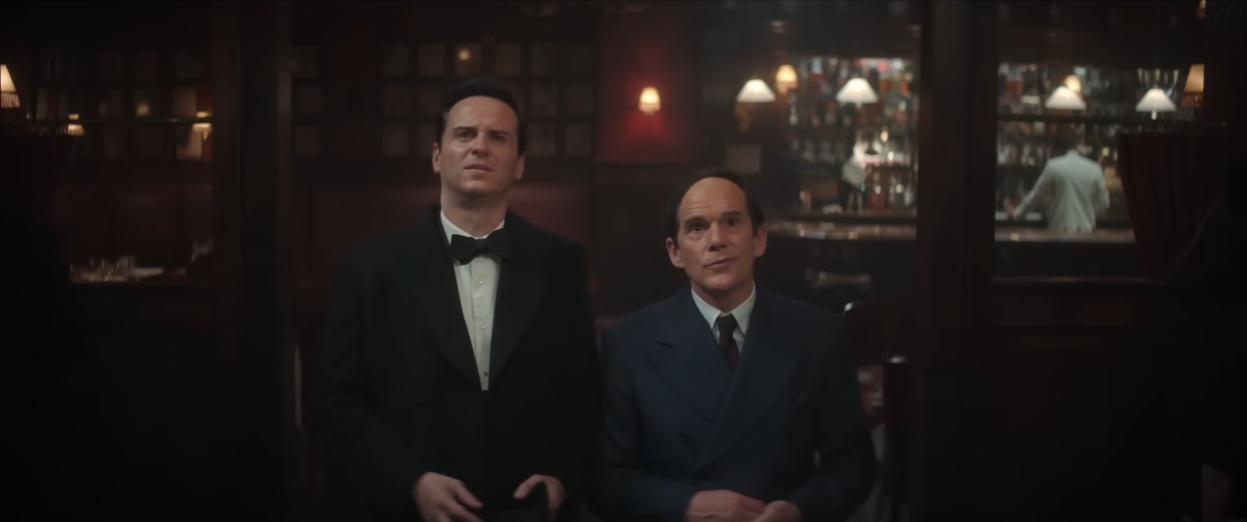
Super-Villain Team-Up presents Moriarty and The Grabber!
Previously on Midlife Crisis Crossover:
It’s that time again! Since 1992 my hometown of Indianapolis has presented the Heartland International Film Festival, a multi-day, multi-theater celebration of cinema held every October. Local moviegoers have the opportunity to see over a hundred new works in the realms of documentaries, narrative features, shorts, and animation made across multiple continents from myriad points of the human experience. Some participants stop in Indy on their grand tour of Hollywood’s festival circuit; some are local productions on shoestring budgets; and a wide spectrum of claims are staked in the innumerable niches between, projects with well-known actors screening alongside indies with enormous hearts.
This’ll be my third year diving in and seeing more than just a single entrant. Heartland’s 34th edition runs October 9-19, for which I’ve made plans to catch at least six films in all (Lord willing) — maybe more if time permits…
Next up is Blue Moon, the twelfth film I’ve seen by prolific director Richard Linklater. His last joint, the true-story dramedy Hit Man, was among my favorites last year. Though his subjects vary wildly from one to the next, his films and their ensembles always have their laid-back charms, so invitingly that you don’t feel time passing because you’re enjoying the conversations so much…even when the loudest guy in the room is blissfully unaware that everyone else is aware of his problems.
One of two entertainment-history films that Linklater has coming out this year (Netflix will drop Nouvelle Vague on November 14th), Blue Moon reunites him with screenwriter Robert Kaplow, a New Jersey professor who also wrote Me and Orson Welles. Both films aren’t all-encompassing biopics trapped within the formula, but rather short stories within a limited time frame — each a concise yet emotionally comprehensive portrait of the essence of a given artist, and not always at their best.
Blue Moon stars Ethan Hawke as Lorenz Hart, one-half of the renowned songwriting team Rodgers and Hart, known for such hits as “Isn’t It Romantic?”, “The Lady Is a Tramp”, “My Funny Valentine”, and other “standards”, as well as such musicals as A Connecticut Yankee, Pal Joey, and a couple dozen others that haven’t been revived since 1950 and none of us talk about anymore, not even our own grandparents. As Hart’s alcoholism and other problems got in the way, Richard Rodgers parted ways with him and found a new creative partner in Oscar Hammerstein II, whose preceding collaborations had included Show Boat and a few lesser others. (I’ve seen the 1936 version, though no one warned me about the group Blackface number.) The team of Rodgers and Hammerstein would achieve legendary status with such hits as The Sound of Music, The King and I, South Pacific, Carousel, and their first team-up, Oklahoma!
The latter is most germane here, as Blue Moon takes place on its opening night of March 31, 1943, and unfolds almost entirely at the legendary Sardi’s, that storied bar down the street with all its walls covered in famous caricatures. After leaving the theater early in contempt, the disenfranchised Hart retreats to the bar while it’s still mostly empty and tries to entertain a captive audience and maybe sneak the occasional drink, over the objections of Bobby Cannavale (Stepdad Cop from the Ant-Man trilogy) as Eddie the bartender, who knows him all too well and has surely seen Hart at his worst, possibly more than a few times. After the show they’re joined by the duo and their entourage: Andrew Scott (Sherlock, Ripley) is the gentlemanly Rodgers, who’s accepting kudos from all comers while Hart’s insistent on bending his ear; Simon Delaney (The Conjuring 2, The Woman in the Wall) is Hammerstein, humbled by this great success and maybe a little curious what’s going on across the room between Rodgers and Hart.
As Hart thinks himself the center of his own universe (digressing into a fun exchange with Eddie about how we’re all just extras in each other’s main-character lives), so is Hawke’s flamboyant performance the film’s centerpiece. Now in his 50s (only a year older than me!), he’s developed a fascinating specialty of playing unreliable protagonists who love the sound of their own voice more than anyone else around them does. See also: late-stage Jesse in Before Midnight, his serial killer in The Black Phone, his Moon Knight super-villain, muckraking gadfly Lee Raybon in FX’s great Sooner-noir series The Lowdown, et al. Hawke also has to deal with some technical challenges as Linklater pulls some Lord of the Rings trickery to depict Hart’s five-foot stature. It can be distracting at times, and some five-foot viewers could feel a tad demeaned, but Hawke’s eloquent swagger recaptures our gaze and reminds us that Hart had bigger issues than undertallness.
Linklater and his crew have a ball reenacting the 1940s visually and sonically, as Sardi’s pianist (Jonah Lees, a LuthorCorp minion in the new Superman) treats us to some of Hart’s greatest hits as well as a few other big names. (Cohan! Berlin! Kern! Gershwin!) Like a lounge lizard in his element, Hart holds court on his ex-coworker’s “cornpone” new show (he hates hates HATES the exclamation point), the best and worst lines in Casablanca, and his prediction that the new duo’s reliance on sentimentality and sincerity will go on to tremendous success, though he refuses to be happy about it (sometimes he’ll fake it, as one does). He bloviates on pop culture of the day like an internet blowhard six decades ahead of his time, flexing his vocabulary and wit to anyone who’ll pay attention, whether they get the joke or not (e.g., some self-amusing cringe inverting “indefatigable” as its punchline).
Unlike the last film about Rodgers and Hart, 1948’s Words and Music, Blue Moon doesn’t tiptoe around Hart’s open-secret sexuality. They avoid most cliches and acknowledge — or at least, Hart himself proclaims with a Jack Harkness impishness — that his desires weren’t always easy for ordinary onlookers to pin down. That’s especially evident when a special friend drops by: Margaret Qualley (The Substance, Poor Things) plays his 20-year-old protege Elizabeth Weiland, who comports herself as the sort of looker who’d stop any 1940s movie dead in its tracks while all the other characters fawn wide-eyed over her. (Kaplow based his screenplay, which was years in the making, on actual letters between the two.) As if his breakup with Rodgers weren’t enough to cope with, he becomes far more aware of his own fragility as their chats reveal he might be overestimating the state of his relationship with her.
Hart’s charisma notwithstanding, it isn’t long before Hawke and Linklater start revealing the flaws in his erudite armor, including but not limited to the irony of him decrying plays with old-fashioned boy-gets-girl endings while floundering in his own love triangle. As an increasingly desperate Hart chokes on flop-sweat while pitching new projects to Rodgers, it’s telling that his favorite idea for their next big collab is a scathing satire of Broadway musicals, the very medium in which Rodgers has just achieved a huge success. As the straight-man foil, Scott excels with a necessarily more responsive performance: Rodgers maintains his composure and resists the urge to blow up in public on his big night, to smack Hart down with a Moriarty-esque “I WILL BURN YOU” tirade to chase him off, but you can practically feel him screaming on the inside.
Then again, Rodgers’ inner scream will soon fade as his big night of nonstop acclaim goes on. Hart, on the other hand, has but the patronizing camaraderie of those few still around him, drowned out by the inarticulate gasps of dawning irrelevance on the inside. Thus Blue Moon sets, an engaging tragedy about a has-been who’s trying to keep his own party going for as long as he can while his Broadway spotlight dims away.
…
Meanwhile in the customary MCC film breakdowns:
Hey, look, it’s that one actor!: Patrick Kennedy (Downton Abbey, Dept. Q) is the essayist E.B. White, a fellow bar patron who’s stuck on a children’s book he has vaguely in mind.
While not a familiar actor as we usually cover in this section, the famous personalities who cameo among the characters include a youngster named Cillian Sullivan playing Hammerstein’s neighbor’s kid Stevie, who sure has his opinions about Broadway, before he’s nudged away and merrily rolls along.
How about those end credits? No, there’s no scene after the Blue Moon end credits, but they note the small VFX crew in charge of chopping ten inches off Hawke’s height to match Hart’s. The team includes a Hobbit-method stand-in and folks with such job titles as “Floor SFX” and “Height Wizard”.
Discover more from Midlife Crisis Crossover!
Subscribe to get the latest posts sent to your email.
 Midlife Crisis Crossover!