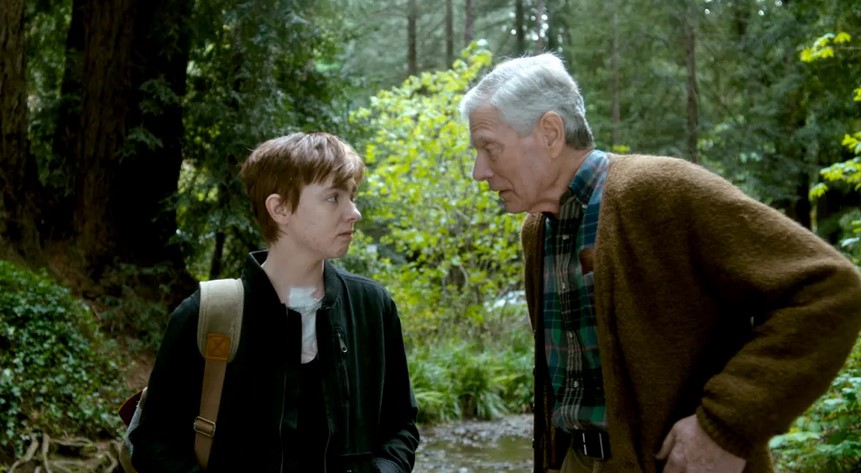
With no official site and no trailer online, this is the only image available for this film on any entertainment hub that’s covered its film-festival tour.
Previously on Midlife Crisis Crossover:
Since 1992 Indianapolis has held its own celebration of cinema with the Heartland International Film Festival, a multi-day, multi-theater marathon every October of documentaries, shorts, narrative features, and animated works made across multiple continents from myriad points of the human experience, usually with an emphasis on uplift and positivity. Ever since the “International” modifier was added in recent years, their acquisition team steadily escalated their game as they’ve recruited higher-profile projects into their lineups. For years my wife Anne and I have talked about getting into the spirit of the festivities. This year we will do better. The festival’s 32nd edition will run October 5-15. I’ve committed to at least five different Heartland showings — one of them virtual in-home, while the others will screen at four different theaters throughout central Indiana…
We’ve now gone beyond “at least five” into festival overtime. Due to unfortunate circumstances beyond our control at our fifth feature presentation, we wound up with a free pass for one more film. I’d already driven 150 miles this week around central Indiana for cinema’s sake — in the midst of a normal 40-hour work week, mind you — and was burned out on driving, but Heartland also had dozens of new films available for virtual rental at home (our first film was among those). After digging through the entire list, I found a drama in Anne’s historical-aficionado wheelhouse of World War II in general and the European theater in particular.
Avenue of the Giants, from writer/director Finn Taylor (The Darwin Awards, Pontiac Moon), is based on the true story of Herbert Heller, a Czech Holocaust survivor who emigrated to America afterward and lived a long, fulfilling life as a children’s-store owner in northern California until his death in 2021. Like another concentration camp survivor we met years ago, Heller was open to sharing his arduous life story with others in hopes of passing on the lessons learned and putting their own tribulations into a broader context. Taylor’s most daring trick is in the casting: Heller is portrayed by Stephen Lang, widely known as Colonel Miles Quaritch from James Cameron’s Avatar series, a fierce military commander whose muscles have muscles which also have muscles and who could snap Rocky Balboa in two. Lang accepts the challenge of playing the polar opposite — a far kinder, gentler, older, peaceful Jewish man who’s slightly hunched and beloved by all the townspeople — but his voice can’t help remain unwavering and steely despite that benevolent persona. (One scene implies his reflexes are enviably sharp, too.)
At the behest of a rehab supervisor named Ruth (Robin Weigert from Deadwood and Jessica Jones), Heller is paired with an awkward teen named Abbey (Elsie Fisher from Eighth Grade and Barry) who could use some company and/or distractions after her recent suicide attempt. Abbey isn’t getting much out of her mandatory group therapy and is instead ostensibly tasked with interviewing him about his WWII experiences and what happened to his family. She’d rather not talk about herself, so Heller tends to lead their conversations. He doesn’t lack for material.
Flashbacks reveal the Heller family’s good ol’ days before incoming Nazis ordered him, his brother and his parents out of their loving home to report to Terezin, a former noblemen’s resort that was converted into a “model camp” of sorts, where the prisoners were 10% less oppressed to fool International Red Cross inspectors into believing all the camps were humane and totally not genocidal or anything, because of course war had certain rules and courtesies to be extended regarding POWs. The Hellers kept each other’s spirits up, and li’l hard-working Herbert (Luke David Blumm from The King of Staten Island and Netflix’s The Watcher) was their most ebullient boy in striped pajamas since Benigni’s Life Is Beautiful. Then they were herded into a boxcar and transferred to Auschwitz.
What happened next has been covered elsewhere in history texts and the grimmer corners of pop culture, but Taylor nails little details here and there for value-added verisimilitude as the imagery skirts the thin line between PG-13 and R. (e.g. the part where the eldest and youngest tended to be slaughtered first, so if you were really young, you told them you were older. If you were old, you told them you were younger.) Heller’s hard time in Auschwitz is a series of horrible tragedies leading up to the January 1945 death march to Birkenau. Compared to the Auschwitz sequences, the march feels like a two-minute trifle, but that’s the real-life point where Heller made his escape through means that fate/luck made possible for him, without the aid of Steve McQueen or an entire British officers’ club. Outside the camp’s relentlessly monitored walls, that harsh journey presented a child-sized window of opportunity.
His somber storytimes lose a lot of emotional impact as they’re rendered by some utterly distracting camera work that keeps shifting gears on a dime, as if someone behind the scenes turned a film-school glossary into a checklist of Things We’d Like to Try for Fun — caffeine-withdrawal shaky-cam, an unseemly number of worm’s-eye-view shots, Instagram Vaseline filters, closeups using lenses drawn out of a hat, a few random cranes whenever they could rent one from Home Depot, and so on. Anne paid no heed as we watched, but it drove me buggy, like a graphic novel with every page drawn by a different artist and no editor around to coax them into lining up. Every survivor’s story is important in itself and really shouldn’t require superfluous tricksy visuals to liven them up.
As Heller’s narrative reaches its happy ending with a few surprising lights at the end of his long tunnel, Abbey slowly begins to open up about her own pain. Snippets of memories foreshadow her revelations as we go. We’ve no clues as to whether Abbey’s tale is as based-on-a-true-story as Heller’s is. Much of her story can be inferred ahead of time, but at least one “twist” is guaranteed to blindside viewers and possibly jar some out of the film altogether. It’s outlandish upon its shock discovery, and yet…in our 21st-century broken world where depravity is a spectator sport for many and a career track for still others, I can’t call it unbelievable. Borderline soap opera, but not impossible, either.
Avenue of the Giants‘ eponym is a California highway that runs through Humboldt Redwoods State Park and provides the central metaphor for our conversational pair, likened to nigh-invulnerable trees that outgrow their wounds and continue rising up. Heller’s Holocaust-survivor biography and Abbey’s intensely modern-teen turmoil aren’t exactly parallel gauntlets, but Taylor tries his best to intertwine their slim commonalities. Together the disparate duo generate just enough elder/younger chemistry as they explore the act of storytelling as a healing mechanism in itself, learn to bear the crushing weight of survivor’s guilt, and let go of the secrets that gnaw at them from within.
…
Meanwhile in the customary MCC film breakdowns:
Hey, look, it’s that one actor!: Other actors in widely seen works include Ben Geurens (The CW’s Reign), Leah Pipes (The CW’s The Originals, the Charmed reboot), and Lyndsy Kail (a voice actor in BioShock Infinite‘s DLC finale “Burial at Sea”).
How about those end credits? No, there’s no scene after the Avenue of the Giants end credits. Anne and I started our usual post-film discussion a few minutes early and my attention wandered from the screen, but a quick rewind while writing this confirmed we didn’t miss anything. (Virtual screenings may not have the cachet of a big-screen setting, but it’s nice to have the film at hand for double-checks while the rental lasts.)
Fun trivia update added 3/10/2026 that no one may ever read: This past weekend, nearly 2½ years later, I caught a trailer for this in front of Sirat, implying it’s finally coming soon to theaters, but with at least one major change: it’s been renamed The Optimist. It’s a tad blander, but probably less confusing for non-California residents. Whatever works!
…
Other chapters in this very special miniseries:
Discover more from Midlife Crisis Crossover!
Subscribe to get the latest posts sent to your email.

