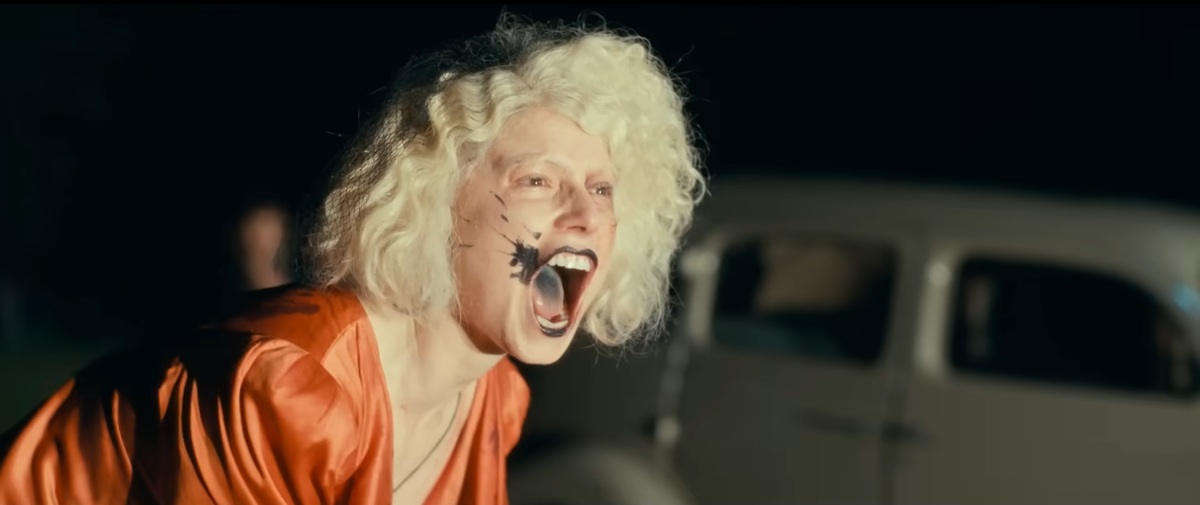
Not one of Madonna’s better phases.
Previously on Midlife Crisis Crossover: After nearly thirty years of acting, back in 2021 Maggie Gyllenhaal stepped behind the camera to write and direct her first feature — a heartbreaking novel adaptation called The Lost Daughter, in which Jessie Buckley and Olivia Colman each played the same character at different ages, whose personal issues complicated her unenthusiastic young-adult attempts at motherhood and continued haunting her as life grew increasingly lonelier with age. Both actresses were nominated for Academy Awards, as was Gyllenhaal for Best Adapted Screenplay with such a complicated portrait of a woman in no position to deal with the expectations of everyone around her and The Viewers at Home.
Viewers may feel even more confounded by the writer/director’s sophomore follow-up, a big-budget IP-romp called The Bride! that isn’t a novel adaptation and isn’t quite a remake of James Whale’s iconic Bride of Frankenstein…at least, not all of it. Remember the scene where Elsa Lanchester awakens and screaming at Boris Karloff? Imagine that screaming stretched out to a two-hour runtime, except now she’s screaming at everyone except Frankenstein’s Monster, and somehow the screaming and posturing make her a feminist icon. Or something?
The Gist: Gyllenhaal reunites with Buckley, whose latest Oscar nomination for Hamnet is pending this very weekend. In the meta prologue, Buckley plays Mary Shelley’s ghost (bear with me here), who’s upset that 19th-century mores forbade her from writing the Frankenstein sequel that she totally wanted to, so she’s decided to grant herself that unrealized wish by manifesting in some 1930s pocket universe where her book is the reality and not a fiction, Frankenstein is still alive a century after his creation, and actually goes by the name “Frankenstein”. Academy Award Winner Christian Bale’s version of The Creature is just kinda there (“Frank” to his friends, natch), but he’s not really center stage. Bale coming slightly alive whenever he opines on his one hundred years of solitude, but gets easier to overlook as we go.
Mary’s spirit possesses a Chicago call girl (also Buckley, so she’s a perfect fit) right before she’s killed, whose body is then dug up by Frank and an American doctor (Academy Award Winner Annette Bening, dialed down to about 40% of her natural gusto) who’s helping create a companion for him using methods as mad as the late Doctor Frankenstein’s. The lady-of-the-evening is brought back to life, but comes off schizophrenic because Mary keeps taking her over every so often and randomly shouting a lot in her own British accent. Her stream-of-consciousness outbursts fluctuate — sometimes just thesaurus entries read aloud, sometimes the prattle of a Dadaist Grant Morrison villain, and sometimes she’s tacking new verses onto INXS’ “Mediate”.
Her fragmented, spook-addled, post-resurrection memory makes her easily gaslightable, and before long she’s going steady with Frank and road-tripping from the Windy City to NYC and back again because he’s a superfan of a dancing movie star named Ronnie Reed (Gyllenhaal’s brother, Academy Award Nominee Jake) and wants to watch his movies in different theaters, like a hippie following the Grateful Dead. When they eventually meet in person, things go far more parasocially cringey than any short-circuiting fan I’ve ever witnessed at a comic-con guest’s autograph table. It’s during a lengthy party sequence that also includes a fully premeditated homage to Young Frankenstein, with Bale going full Peter Boyle to the exact same tune. I must stress this is not me joking. At least he doesn’t sing, but still.
Inevitably there’s anti-monster discrimination and outbreaks of violence, and Our Monsters end up fugitives on the run. Amid all this, The Bride decides to make “I would prefer not to” her big catchphrase, which inspires an entire movement of poseurs copying her complexion and distinctive splotch because they’ve mistaken flamboyance for intellectual rebellion. And so it goes.
The familiar faces: Meanwhile in a completely different movie, Academy Award Winner Penelope Cruz (Ferrari, Parallel Mothers) and the director’s husband Peter Sarsgaard (September 5, The Batman) are a soft-boiled detective duo likewise confronting 1930s sexism, but with a lower body count and all the chemistry of pairing Nora Charles from The Thin Man with Chuck Charles from Bob’s Burgers.
Ronnie Reed’s frequent screen partner is famous TV dancer Julianne Hough. The dependably eccentric Zlatko Buric (Superman, Marvel’s Wonder Man) can only do so much with two scenes as cheap knockoff gangster boss Alexei Caponovich. His lackeys include John Magaro (September 5, Past Lives) and Matthew Maher (Our Flag Means Death). Jeannie Berlin (Succession, The Fabelmans) is Bening’s Igorette. Louis Cancelmi (The Penguin‘s childhood crime idol) is a traffic cop.
The Impressions: I’m unsure why this is set in the ’30s, unless maybe they found lots of leftover Sinners costumes stashed in a Warner Brothers steamer trunk tagged “too white”. Apart from CG establishing shots, Chicago is one big hazy alley, NYC is a single block of Broadway, and Indiana is one deciduous forest and one cornfield (which, okay, for the 1930s that’s dead-on). More than a few sequences trip from gaudy horror into wacky fantasy-land, like Golden Age of Cinema tributes except instead of indulging the artifice of musicals, it’s as if the monsters are exuding psychotropic pheromones and warping everyone’s brain functions. Anything with outlandish dance numbers that pirouette on the thick line between audacity and obnoxiousness will risk unfair comparisons to Moulin Rouge‘s gold standard, but what’s the fun in channeling Baz Luhrmann without singing and half the spotlights burned out?
The trailers gave me such high hopes that The Bride! would find her own voice, but she can call very little of this her own. Other aspects of the Frankenstein multiverse are whirred into one absurdist smoothie bloated with chunks of Bonnie and Clyde, Natural Born Killers, and both Jokers. Worse still, Our Antiheroine wields Bartleby the Scrivener’s “I would prefer not to” as a cudgel, with all the dignity of a toddler answering “NO!” to everything till they get spanked. No one tells her Melville’s grown-up Moral of the Story was, “But often we gotta anyway.” What might make an interesting examination of contrarianism as a mental health issue is instead treated like empowerment. Her parroted petulance comes off as a parody of social activism in general, let alone any specific feminism wave. In an undead-girl-power fable it’s to be expected that all the male characters are either evil or stupid, but her female followers don’t shine much brighter.
I knew Gyllenhaal obviously wasn’t aiming for the gothic poetry of del Toro’s Frankenstein, where the thought of female companionship was a fleeting fancy ultimately dismissed because he felt unworthy and events went awry too quickly. I hate to say it’s simply “too soon” after del Toro’s vision, but it also suffers in comparison to Whale’s finely aged oldie. Even taken on its own terms, mostly The Bride! just plain suffers. If any of this is truly what Mary Shelley envisioned happening next in the Franken-verse, her ghost would do well to go ask Harper Lee’s ghost how things went with Go Set a Watchman.
The end credits? No, there’s no scene after The Bride! end credits, but they confirm Jake sang at least two songs himself, and end with a dedication “For My Daughters”.
Discover more from Midlife Crisis Crossover!
Subscribe to get the latest posts sent to your email.
 Midlife Crisis Crossover!