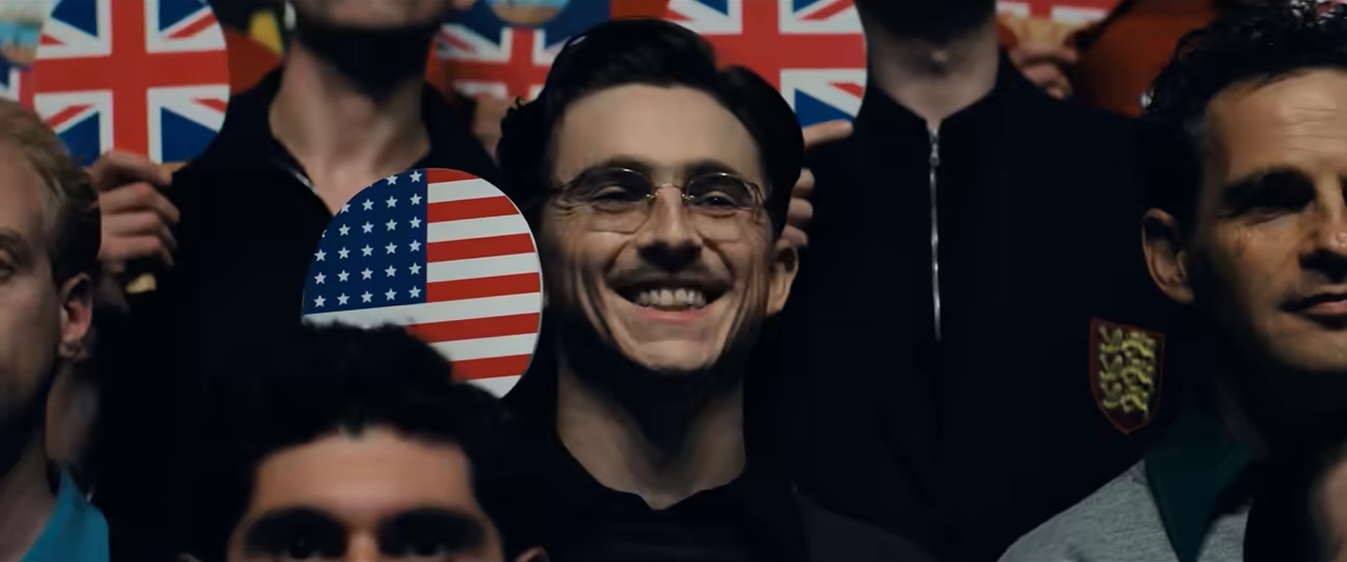
Preening Putz Proud of Patriotic Paddle.
Everybody loves narcissists! They’re everywhere today! They’re an evergreen industry and a dominant species and we can’t stop throwing money and attention at them! They rule our reality shows, win our sports, determine our politics, influence our social media, hoard our headlines and flood our feeds! We’re posting about them nonstop and letting them live rent-free in our heads, comping them on head-utilities and buying them head-groceries! We just can’t stop talking, thinking, mocking, or mentioning and mentioning and mentioning and mentioning one of the most self-aggrandized narcissists of them all! We never seem to shut up about him in particular! And by “we” and “our”, I mean you ‘n’ yours — constantly feeding the troll, day-in day-out, exactly what Usenet newsgroups taught us never to do way back in the 20th century. I sure can’t wait for this century’s students to catch up.
Now’s the perfect era for a story like Marty Supreme — a slick all-American anti-fairy tale about an entitled motormouth who almost always gets his way thanks to his unspoken magical self-help affirmation, “Because I said so!” and tries to steamroll over every “NO” like the nice-guy twin to Ben Kingsley’s Sexy Beast human monster. It doesn’t hurt that he’s played by Academy Award Nominee Timothee Chalamet, that beloved Manic Pixie Dream Boy idol of millions who just turned 30 last month. Who wants to be mad at that face, as long as we viewers aren’t the ones suffering in his character’s self-absorbed path of destruction?
The second-weirdest thing about the film is its choice of subject: a period-piece biopic-shaped drama whose unreliable protagonist only faintly resembles a real-life 1950s table-tennis champion. Here’s a summary of everything I know about the sport better known as ping-pong among us commoners who don’t play it for money:
“All of my heroes are table tennis players: Zoran Primorac, Jan-Ove Waldner, Wang Tao, Jörg Roßkopf, and of course Ashraf Helmy. I even have a life-size poster of Hugo Hoyama on my wall. And the first time I left Pennsylvania, was to go to the Hall of Fame induction ceremony of Andrzej Grubba.”
— Dwight Schrute (Rainn Wilson) from THE OFFICE season-4 episode “The Deposition”.
…and that’s pretty much it. We never played it in gym class. I’ve never seen Balls of Fury, which might or might not have helped. I honestly thought Dwight was rattling off made-up names till I looked up every single one of them. Point is, I generally don’t watch sports, and I’ve definitely never watched this sport.
Director Josh Safdie and his frequent screenwriting pal Ronald Bronstein, whose last collab was Uncut Gems (with brother Benny Safdie, who went off and made his own sports biopic, The Smashing Machine) apparently bought a copy of that “Famous Jewish Sports Legends” leaflet from Airplane! and came up with the fictionalized cautionary tale of Marty Mauser, a youngish NYC shoe salesman who insists he’s kind of a big deal in all the local table-tennis halls. He grew up a poor spoiled-rotten brat who sucks at customer service, rules, and other basic job requirements. He aims to take his ping-ponging to national and maybe even international levels. All he has to do is cajole, manipulate, connive, rip off or rob anyone standing between him and the riches he imagines he deserves.
Safdie surrounds Marty in a dingy, busy, jittery world of nostalgia prompts and thoughtful callbacks (shoe salesmen! rotary phones! corporal punishment! postwar Japan’s need for a feel-good victory in any kind of contest!) where he barely keeps his head above water using his bottomless chutzpah as a skeevy kind of life jacket. Chalamet is alternately wired, wiry, worrying and wearying as Marty juggles multiple cons and contingency plans at once, and comes off like an amalgam of characters past — emulating Young Wonka’s showmanship, laughably appropriating Paul Atreides’ Chosen One destiny, recycling Bob Dylan’s NYC-fed aspirations, and zealously overdoing Lee the cannibal’s penchant for consuming everyone in his path. It took about an hour into the 2½-hour runtime before I stopped wishing for everyone to take turns punching his block off. Slowly I developed a tolerance for his malignant exuberance and extended some patience while waiting to see whether Safdie would deliver unto him a comeuppance or an ironic victory at everyone else’s expense, apropos of today’s pro narcissists.
Sooner or later Marty burns nearly every bridge around him, but ordinary folks can be rather trusting to a fault when confronting a smooth-talking chatterbox with a suspiciously winning smile and the boundless enthusiasm of a toddler asking “ARE WE THERE YET? ARE WE THERE YET? ARE WE THERE YET?” every six blocks during an 813-mile car trip. He’d thrive on Instagram today if he’d been born later, but he keeps adding names to the long list of suckers and/or enemies he makes along the way. Temporary allies among them include Odessa A’zion (HBO’s I Love L.A., the Hellraiser remake) as Rachel, a married friend-turned-baby-mama (not that Marty cares); Academy Award Winner and Marvel survivor Gwyneth Paltrow as a retired Golden Age actress named Kay who’s improbably intrigued and maybe sees in him what Jan Levinson saw in Michael Scott; the pliable boss’ son (internetter Luke Manley); a random dog-owning stranger (longtime NYC film director Abel Ferrara) who’s not so feeble in his advanced age; and so on and so on. What’s interesting to note is how Marty’s ill-gotten winning-streak ways become contagious as other characters see what he pulls off through brazen willpower and feel the urge to push their own luck in the same way, usually with drastically different results.
All the best parts involve Marty’s most formidable opponents who present major threats to his adamantium ego. As he insinuates himself into pro competitions, he plows through all comers until a mid-film face-off with Japanese rival Koto Endo (real-life player Koto Kawaguchi), whose deafness filters out distractions and accentuates his Zen-like powers of concentration that shield him from Marty’s showboating stunts. But Marty Supreme‘s true MVP is first-time actor Kevin O’Leary as Kay’s husband Milton, the millionaire owner of a pen company who’s open to unorthodox marketing ideas, clearly has experience negotiating with stubborn mules, and will only brook so much tomfoolery before he flexes his status and his decades of experience. Milton indulges Marty when it suits him, nips some of his flightier escapade attempts in the bud, and never lets his Charisma score fall below 17 even when he’s bellowing.
That name might be more familiar to you than it was to me. I don’t watch reality TV and, until it was explained to me at the comic shop last Wednesday, I had absolutely no idea O’Leary is one of the original multimillionaire stars of ABC’s Shark Tank. Throughout his every scene I couldn’t shake that “Where have I seen him before?” character-actor vibe; this past week now I’m noticing him in occasional TV commercials, which I realize to my amused horror may have been bombarding me for years. Regardless, far as this film is concerned, he’s Marty’s worst nightmare and he’s my hero.
The table tennis matches are technically thrilling, ostentatious, at times seemingly ludicrous as the players keep getting farther and farther from the table yet keep up the volleying with the sort of wild swinging and gazelle-leaping I expect more from tableless tennis. Maybe that is how it goes (again, I wouldn’t know!), but I was initially indifferent to all those duels after the opening credits prominently listed a Visual Effects Supervisor, implying some matches may have been redrawn and calling into question how much of the gameplay is real and how much is augmented. To be fair, if any of it is fake, that’d still require some intense choreography on the players’ parts. Bonus points either way for the fancy footwork, then.
Chalamet’s charm can only carry us so far, though. Marty Supreme is overstuffed with long-con subplots that come and go. The weirdest thing about all this is the wildly disproportionate amount of non-ping-pong-related violence. I haven’t seen this much bloody gunfire in a sports drama since The Last Boy Scout, to say nothing of the lengthy sequence that culminates in Marty and a pal driving away from an exploding building (!!). Marty the film winds up extenuating itself as much as Marty the athletic libertine scoundrel does with his patsies and marks, most noticeably in the hour-long stretch or more in the middle containing zero table tennis.
When the frenetic furor eventually dies down and Marty leaps without segue from a decisively Pyrrhic victory to one last, looming threat to his vainglorious independence at the end, it doesn’t read like any kind of satisfying ending. You can all but imagine some William Dozier wrap-up narration over the final image: “How will Marty weasel his way out of this one? Tune in next time!” I’ve known too many folks like him — unrepentant users who treat other people like stepping stones — to buy into its weak, last-ditch shot of ambiguity. We already know Marty’s next play.
…
Meanwhile in the customary MCC film breakdowns:
Hey, look, it’s that one actor!: Tyler the Creator is one of the few friends Marty doesn’t screw over, a cabbie who assists with the occasional swindle. TV’s The Nanny herself, Fran Drescher is Marty’s Concerned Mom — hard to recognize now that she’s older and not nearly as made-up, but as soon as she speaks, you know. Comedienne Sandra Bernhard (last spotted on Severance) is a friend of hers.
Other unlucky guys left in Marty’s wake include Emory Cohen (Brooklyn, The Bikeriders) as Rachel’s abusive husband, and Maya Hawke’s brother Levon Hawke (Blink Twice, Apple’s The Crowded Room) as a ping-pong hotshot down at the bowling alley. The crew and hangers-on around Kay’s latest Broadway comeback attempt include writer/director David Mamet, Kraven the Hunter survivor Fred Hechinger, and fashion designer Isaac Mizrahi.
How about those end credits? No, there’s no scene after the Marty Supreme end credits, but the music section helpfully divides its catalog into three labeled sections: one for the ’50s hits, one for the ’80s anachronisms (including two Tears for Fears needle-drops, though at least they aren’t from the same album), and one for “Others” (classical, some Japanese tunes from the final act, etc.) It’s quite compartmentalized, kinda like Marty’s brain.
Discover more from Midlife Crisis Crossover!
Subscribe to get the latest posts sent to your email.
 Midlife Crisis Crossover!
Great review! I’ve only seen fawning reviews over this movie, so this is a refresher.
LikeLike
Thanks! I liked some elements, but so much of it felt like…well, I don’t think “screwball drama” is a thing, but that seemed to be the goal. It hit pro critics’ sweet spots, but for me it got caught in the net.
LikeLike