
The Globe Theatre used to be pretty cool about letting audiences interact with actors on stage, long before trying to tear famous people’s clothes off became a thing.
Oscars season is coming! On January 22nd the Academy of Motion Picture Arts and Sciences will announce the next round of Academy Awards nominations. Fans have a month to go before we learn which multi-million-dollar blockbusters will be validated in the secondary categories and which Best Picture nominees were only released in a single Times Square theater that would’ve made more money if they’d just shown porn instead. The more potential Oscar winners we watch now, the less we’ll have to cram into our annual Oscar Quest before the March 15th ceremony. Or, y’know, I could just take the old-fashioned approach: go see films I want to see for my own reasons and hope they get recognized later.
The latter applied for me in regard to Hamnet, the latest from Academy Award Winner Chloe Zhao. Her contemplative road-trip drama Nomadland took Best Picture during the pandemic, and I was among the six viewers who enjoyed Marvel’s disavowed Eternals, in which super-team punch-’em-up veneer cloaked a thoughtful exploration of religious disillusionment, immoral sacrifice in the name of The Greater Good, the soul’s search for purpose and sometimes repurpose, and what the treasured canard of With Great Power Comes Great Responsibility means on a cosmic scale. With Hamnet four years later, she’s retracted her reach from planetary destruction to merely the foundation of classic Western Literature, with a story set in the sixteenth century rather than traveling all the way back to the Dawn of Time. Yet another survivor of the Marvel Machine finds deeper artistic fulfillment on a smaller stage.
Based on a novel by Maggie O’Farrell (who co-wrote the screenplay with Zhao) that presumably drew from the surprisingly scant historical texts on the subject, Hamnet stars Jessie Buckley (I last saw her in Fingernails and Women Talking) as Agnes Hathaway (pronounced “Ahn-yes” here, which feels odd for a bit), the future Concerned Wife of ye olde legend William Shakespeare (Gladiator II star Paul Mescal). Agnes was born and raised in Deep Woods England, where komorebi highlights the beauty of her verdant surroundings and her interests include herbalist lore, luxuriating in forests to impress the cinematographer, and spending quality time with her expertly trained pet hawk. The film speculates on her meet-cute and short courtship with the local teacher who isn’t exactly living out his dreams. After a bit of class-clash among their in-laws, the falconer and the aspiring writer marry, have three kids, and they all live happily ever after.
Then years later, “ever after” ends. Tragedy strikes and a child is lost, a casualty of one of the million ways to die in the Elizabethan era. The grief of each parent is searing, uniquely expressed and denied and wracked with rage. Agnes in particular seems unused to having bliss torn from her hands by events beyond her control. The entire point of mastering the uses and effects of every plant around her was to remedy every possible affliction, to rely on what Earth provides unto us under heaven, to be always ready to save the day. In a small yet meaningful part as Shakespeare’s judgmental mother Mary, Emily Watson (last sighted in Dune: Prophecy and Small Things Like These) softens in sympathy with her daughter-in-law, for she knows well the sorrow of losing a child and how commonplace it was in those days. For Agnes, this unconscionable event doesn’t feel “common”.
She’d already been stressed before all this. Her husband had been frequently far from home for long stretches as he oft hied to London in pursuit of a writing career. That same absenteeism would haunt each of them — he was present neither to prevent the calamity (not that he could’ve anyway) nor to stand at the deathbed and make the most of those final moments. Afterward he retreats still farther, emotionally as well as geographically. Agnes fears he’s drifting away from the family and trying too hard to forget. On the contrary, his plans will ensure everyone remembers, as he toils to create a new form of “ever after”. Life expectancy may have seemed like a single-digit gauntlet back then, but not every dead child leaves behind a parent with the talent and the willpower to immortalize them.
Hamnet dwells among the Shakespeare family at a measured pace — idyllic at first, joyous amid their happier days, and crescendoing in emotional charge as they come to know suffering. Not that avoiding a spoiler minefield is a concern here — the film’s first frames relay the fun trivia that the names “Hamnet” and “Hamlet” were basically interchangeable ’round those parts. Jacobi Jupe (Disney’s live-action Peter Pan & Wendy) is impressive as wee Hamnet Shakespeare, a rambunctious and precocious lad who’d surely have followed in his father’s ambitious footsteps had destiny not shorted him so bluntly. Zhao and O’Farrell briefly entertain a red herring before Death’s scythe swings, but it’s not about fooling the audience with a Shocking Plot Twist; it’s more a capricious game played by cruel Fate, of the sort that would become a narrative staple of our man’s future plays.
For anyone like me with tin ears when it comes to strong accents, I was fortunate enough to find a theater offering open-captioned screenings — i.e., the subtitles that I turn on for everything I watch at home. They’re uncommon in theaters but not unheard of, if you dig deeply enough into a given theater’s showtimes on their app or site. (The same theater let me enjoy Bill Nighy in Living the same way two years ago.) Among other benefits, they’re how I came to notice that by and large, Shakespeare is virtually never referred to by name. Whenever he’s speaking offscreen, the captions refer to him as “[Father]” or other labels. It’s a clever conceit that aids in signaling to us Hamnet isn’t all about him.
Also in my favor: as someone who’ll never be a Bard scholar, it was self-validating to relish a film based on the one play of his that I’ve encountered more than any other. After reading it all the way through in high school, Kenneth Branagh’s four-hour epic adaptation was the first film I ever saw with an intermission, long concession-stand line and all. I’ve seen Olivier’s Best Picture-winning version, the German version mocked in MST3K‘s final season, I’m absolutely counting The Lion King, and of course portions have been referenced or reenacted across various media — the classic Star Trek episode “The Conscience of the King” (a Hamlet troupe in space!), Kyle Baker’s uproarious graphic novel The Cowboy Wally Show (a Hamlet troupe in prison!), and so on and so on. I had to share the theater with quite a few folks, so I only shouted “I understood that reference!” several times on the inside.
Naturally Zhao can’t avoid “To be or not to be”, which comes up twice but in different contexts. She doesn’t just play the hits, though — newcomers may be stunned to realize the play contains other scenes and soliloquies. Such surprises resonate most powerfully in the play’s climactic Globe Theatre premiere, where a still-anguished Agnes lurches toward the front row, reluctant yet indignant to see just what was so absolutely important about this blasted production that her husband felt he absolutely had to devote his fullest energies to it rather than be present for her. Some of her interactions beg the question of whether this is actually her first time attending live theater; either way, she’s never experienced theater quite like this before.
In Aftersun Mescal quietly devastated me as a young father who wants to give his daughter one really great day, which ultimately ends up overshadowed in her otherwise painful memories in adulthood. Here, his painstaking playwright is a father who doted well on his son during their too-brief time, possibly to the point of absentee guilt that he aims to absolve by celebrating his child — and the man he might’ve become — as the star of his own memories and those of anyone else who might bear witness to his masterpiece. But it’s Buckley’s performance that stuns the hardest and cuts the deepest through her initial, understandable confusion at the intersection of art and sorrow, which leads to an epiphany of empathy and the discovery of catharsis in tragedy — not just for her, but for the rest of the audience who’re just as riven by personal loss.
The climax in particular works wondrously thanks to another surprising player: among the canniest of Hamnet‘s casting choices, the youngster headlining Hamlet‘s world premiere is li’l Jacobi’s big brother Noah Jupe, whom we’ve seen grow up in A Quiet Place and its sequel. He’s now 20 and definitely not going back to playing a tween again unless that series’ producers want to endure endless Stranger Things comparisons. Jupe the Elder has to work on two levels: as Prince Hamlet the bereaved son of a murdered king, and as a young thespian pioneering an untested role who, in the show’s closing moments, realizes he holds the heartstrings of an entire crowd in his hands, especially one lady who eventually stops heckling and becomes supernaturally transfixed by his every line.
Granted, critics and awards-voting bodies frequently brake for films about the making of art, with a sometimes hilarious emphasis on movies-about-the-magic-of-movies. Hamnet isn’t exactly that, though it’s fairly adjacent, as a film about a play that’s been turned into a lot of films. And meta-Shakespeare tales aren’t a new idea — cf. the comedic vantages of Shakespeare in Love and Rosencrantz and Guildenstern Are Dead (among others that don’t share the sharpened quill pen of the late Tom Stoppard). Surely the execs behind Hamnet may hold ambitions For Your Oscar Consideration; even if it’s left wanting for such stamps of approval in the months ahead, it’s nonetheless a stirring tribute to what dreams may come to us, and sublimate or transform for us, through a poet’s pained yet assured hand.
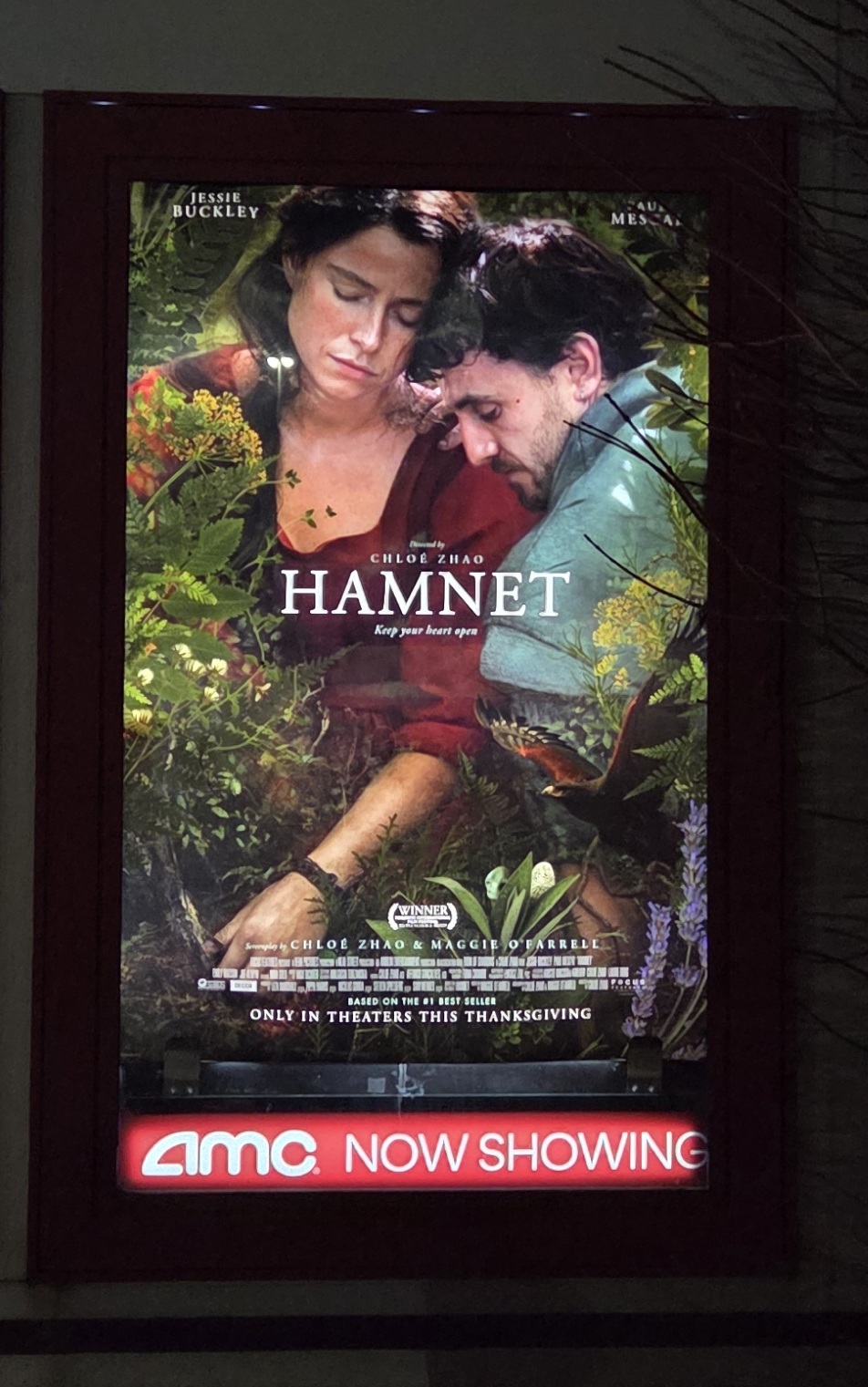
The poster as I left the theater, hanging outside and perfectly framed by night and nature.
Meanwhile in the customary MCC film breakdowns:
Hey, look, it’s that one actor!: Joe Alwyn (The Brutalist, The Favourite) is Agnes’ brother Bartholomew. Other actors onstage at the Globe include Sam Woolf, who played The Crown‘s final version of Prince Edward.
How about those end credits? No, there’s no scene after the Hamnet end credits, but the very last sound before they fade out is the faraway cry of Agnes’ hawk.
Discover more from Midlife Crisis Crossover!
Subscribe to get the latest posts sent to your email.
 Midlife Crisis Crossover!