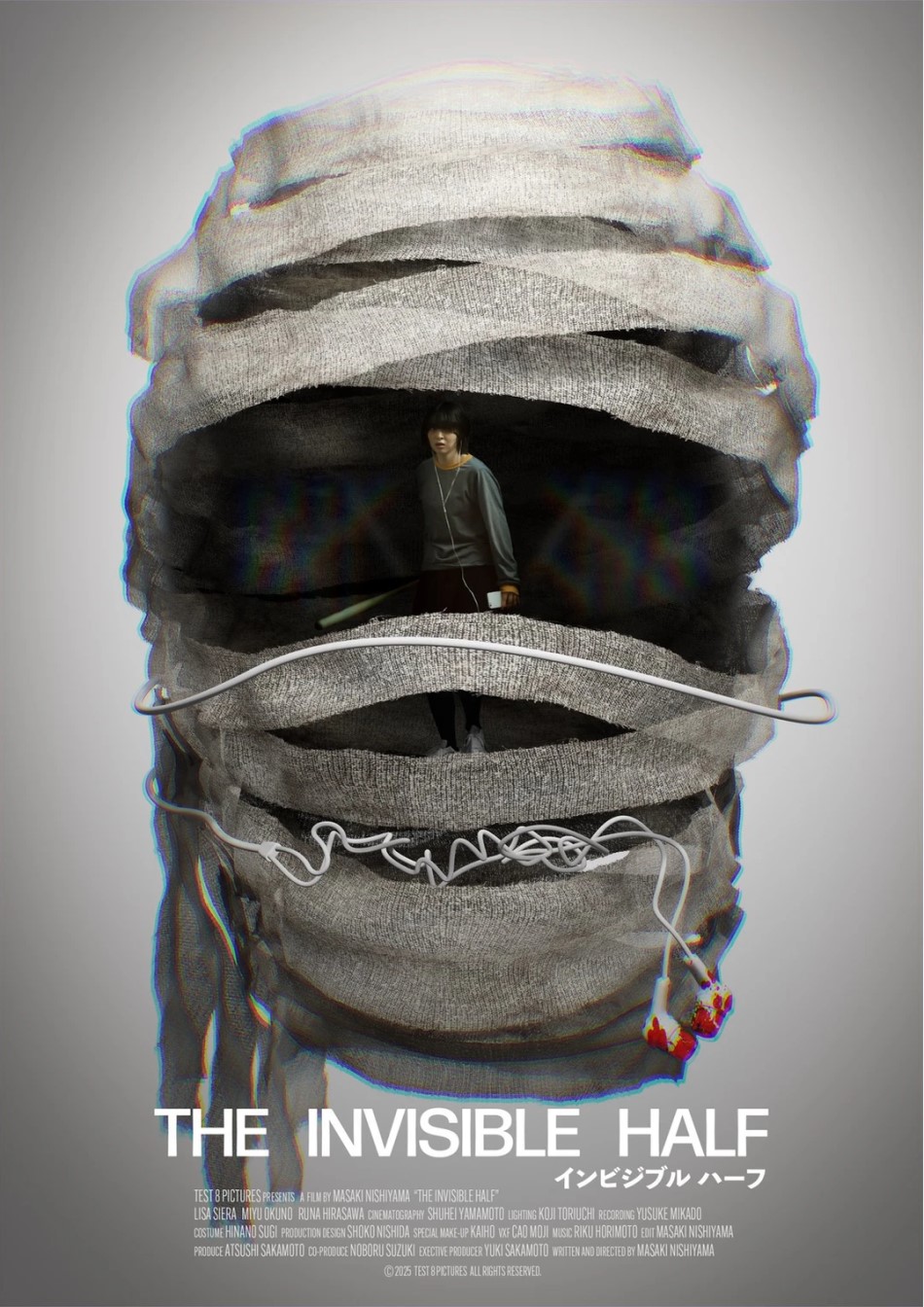
Funny how wearing lots of bandages always means “scary monster” and not “victim receiving the care they sorely needed”.
It’s that time again! Previously on Midlife Crisis Crossover: since 1992 my hometown of Indianapolis has presented the Heartland International Film Festival, a multi-day, multi-theater celebration of cinema held every October. Local moviegoers have the opportunity to see over a hundred new works in the realms of documentaries, narrative features, shorts, and animation made across multiple continents from myriad points of the human experience. Some participants stop in Indy on their grand tour of Hollywood’s festival circuit; some are local productions on shoestring budgets; and a wide spectrum of claims are staked in the innumerable niches between, projects with well-known actors screening alongside indies with enormous hearts.
This’ll be my third year diving in and seeing more than just a single entrant. I enjoyed much of what I saw in 2024, though some of my picks have yet to find distribution to this day. Those few that did kinda came and went without much fanfare. The most “prestigious” film I saw, Small Things Like These, at least went well enough for its makers that star Cillian Murphy and director Tim Mielants reunited for Steve, which just hit Netflix earlier this month. (Highly recommended, by the way.) Numerous other Heartland entries showed up on Oscar ballots, but I failed to catch them at the festival proper. (Eventually I saw Heartland veterans Flow and The Seed of the Sacred Fig, to name a couple.) I’ll be curious to see what happens to this year’s alumni in the months ahead.
Heartland’s 34th edition runs October 9-19, for which I’ve made plans to catch at least six films in all (Lord willing) — maybe more if time permits. Longtime MCC readers know the rule: every film I see in theaters gets its own entry, no matter how big or little. We kick things off with one of the only three horror films in the lineup (a genre HIFF has only opened up to within the past few years), and among this year’s few Asian ones: The Invisible Half, in which we learn Japanese teenagers are no more well-adjusted than ours are.
The first full-length feature from writer/director/editor Masaki Nishiyama is largely set in an all-girls’ school where nearly all the students are racist bullies, which is bad news for half-Japanese transfer student Elena (Lisa Siera). She’s lived in Japan for a decade, ever since her mom parted ways with her British dad (Sir Not Appearing in This Film), but she’s just moved into town and takes about three seconds to invite the wrath of the Mean Girl supermajority. Only two others fall out of lockstep as well: her kindly new BFF-by-default Akari (Miyu Okuno) and furiously inscrutable quasi-goth Nyan (Runa Hirasawa), who rarely emerges from the protective curtain of her bangs and clutches her phone and earbuds at all times like they’re a service animal. Although two other classmates sneer more loudly than the rest, pretty much everyone treats Nyan like trash because Different Is Bad and Groupthink Is Awesome. I trust this is an accurately searing indictment of Japanese Kids These Days?
Despite Nyan’s below-zero social standings, new girl Elena becomes the runt of the litter and eventually comes to realize the deal with Nyan’s phone obsession: there’s a monster on the loose! After a bizarre encounter under a bridge, Elena figures out she can only see or hear its bandaged visage or its oddly old-timey jacket when she clutches her phone and earbuds at all times. She doesn’t actually have to look through its camera, download a special app or subject it to a rite: its talismanic power comes through easy instant-contact…if she keeps the battery charged, of course, that notorious Achilles heel of every smartphone ever used in a film as a plot device.
Elena has her own fatal flaw to overcome: she’s intensely introverted to such a claustrophobic extreme that she won’t let any of the other characters into her head, which means no arguments, no warnings whenever the monster is coming, and almost no moments to open up and reveal anything inside. Sometimes not even the audience is privy to her thoughts, or any feelings beyond “locked up more brokenly than a McDonald’s ice cream machine”. The mood she sets for all her scenes is realistically stifled and alienated, which is sort of an unusual achievement, but it’s also among the film’s liabilities. Our inner voices end up shouting “LET US IN! SAY SOMETHING! DO ANYTHING!” at top mental volume because she is so frustrating to watch at times. I’m sure folks who’ve been around me at my quietest have thought much the same, but I don’t present my mood swings as two-hour performance-art installations for them to sit through and critique.
When anyone is exchanging noises, among the film’s best aspects is Yusuke Mikado’s creatively detailed sound design, in which the ambient audio quality varies depending on whether or not Elena has both earbuds in; when they’re both out, the nuances are striking if your theater’s speakers are as well equipped as ours were. (We never hear her listen to anything through them, but that’s for the best: cranked up at the wrong moment, iTunes could get her killed.) And with everyone’s silence anti-communicating at cross-purposes, Nishiyama does manage one particularly sharp epiphany: how sometimes one of the most painful sensations for an intense loner is to be scorned by another intense loner.
That implication stands out more than the “duality of man” metaphor promised by The Invisible Half‘s title, which gets lost amid other ambiguities. The monster gets no secret origin, no soliloquy explicating its motive, and…well, it doesn’t talk much more than poor Elena. I’m okay with leaving some questions for the audience to debate later, but I’d be less irritated if Nishiyama didn’t let everything crawl so slowly. Elena’s glacial pauses aren’t the sole cause: some takes linger uncut for interminable lengths, as if waiting for the slowest viewers to feel Emotional Weight before the whole class can move on. If you’re a cineaste intrigued by the notion of “What if Tarkovsky made a Mummy sequel”, here’s a credible simulation.
I was also surprised that, in terms of content, the film was virtually YA-level except for a pile of bloodiness at the end. I’ll admit I jumped in my seat once, and some of Mini-Darkman’s extended approaches were effectively creepy. My son, who’s much more immersed in this area than I am, tagged along for the screening and, while he didn’t mind the languorous pacing as much as I did, he called it “the least disturbing Japanese horror film I’ve ever seen.”
…
Meanwhile in the customary MCC film breakdowns:
Hey, look, it’s that one actor!: It isn’t uncommon for indie or international releases to leave me empty-handed for this section, though I’ve been surprised before. In this case the three young ladies and their characters are the only cast info available online as of tonight. If any of the adults or other teens intersect with my viewing history, I may never know until and unless this earns an official release on either side of the Pacific and prompts IMDb to highlight the crew beyond its poster’s surface. Most of the involved folks who are clickable have uniformly short resumes, though some have worked with Nishiyama on his previous short films, implying a loyal team at hand. We’ll see if any of them go on to future works that’ll have me referring back to this one someday.
(One relative standout: the aforementioned Yusuke Mikado has also been a boom operator on the upcoming Marty Supreme and Apple’s planned Neuromancer series that’s currently in production. Yes, sometimes I’ll drill down to subterranean level on this stuff if the mood strikes.)
How about those end credits? No, there’s no scene after The Invisible Half end credits, which are mostly Japanese and curiously printed white-on-grey till they reach the Special Thanks section and switch to black-on-grey. The full cast list names seven or eight other actors, so it’s not just the same three teens swapping in different wigs and prosthetic noses to play all the roles.
Discover more from Midlife Crisis Crossover!
Subscribe to get the latest posts sent to your email.
 Midlife Crisis Crossover!