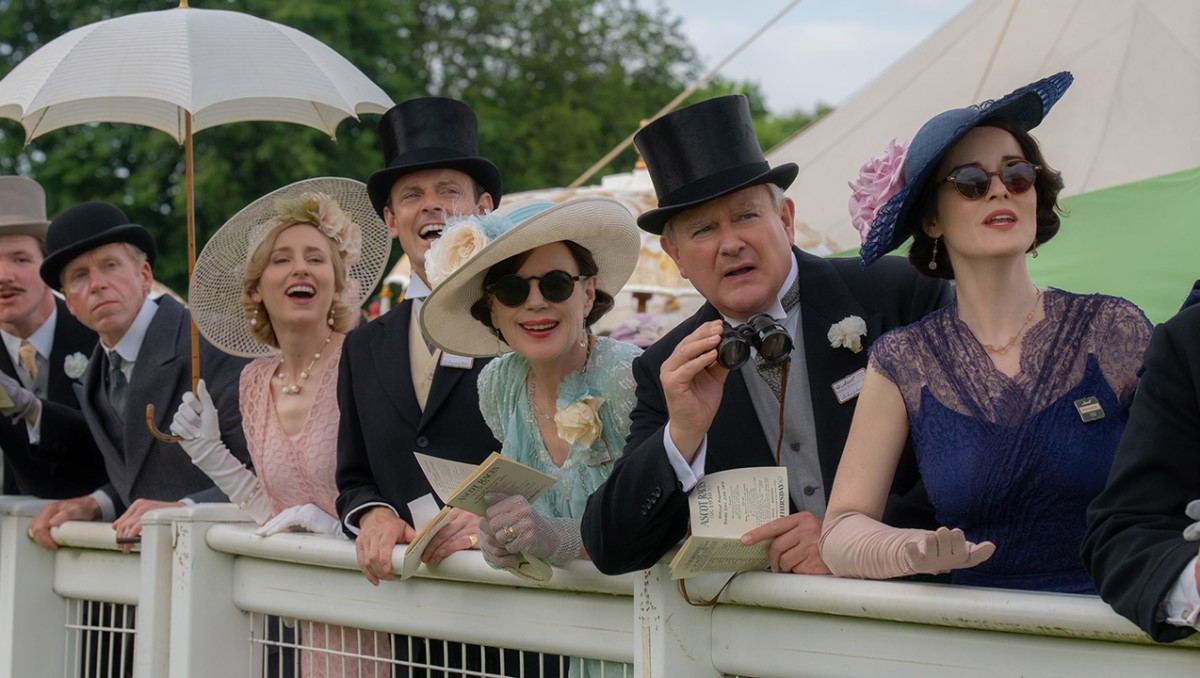
Our Heroes stunned by an unladylike voice in the next section screaming, “COME ON, DOVER! MOVE YER BLOOMIN’ ARSE!”
Previously on Midlife Crisis Crossover: my wife Anne and I are Downton Abbey fans! We’ve seen all six seasons and three movies, most of which she had to annotate for me at length because, as longtime MCC readers know, she’s a history aficionado who can speak on such matters for hours uninterrupted, while I’m a chronic history-deficiency sufferer who needs to be fed very large Vitamin H supplements during and after every period-piece viewing. In exchange, she doesn’t yawn in my face whenever I natter on after every Marvel or DC production about what they changed from the comics.
After the first few seasons wrecked the original cast with the Titanic, World War I, the Spanish flu pandemic, road hazards, and the systematic torture of Anna and Mr. Bates, I presumed the series would only keep getting more depressing as it went, possibly devolving into Walking Dead survival-horror attrition but with nicer parties, culminating with Highclere Castle being bombed into driveway gravel during the Blitz and the Crawleys’ Thatcher-era descendants forming the first punk bands. Then a funny thing happened on creator Julian Fellowes’ way to teaching the upper class a lesson: at some point his creations became too precious to permit any further harm to any of them, unless they were really gracious about it, like Dame Maggie Smith.
Their self-titled cinematic debut was mostly one long royal dinner party, while Downton Abbey: A New Era was one-half Singin’ in the Rain remake and one-half “The Dowager Countess: The Last Stand”. Both were such pure fan-tea-service for their PBS constituency (not that any of us were complaining) that by this stretch the Crawleys had effectively fixed all their problems and gotten happy endings. The only characters still in any real danger were any males foolhardy enough to court Lady Mary. (Granted, at least three of her past suitors have gone on to their own healthy acting careers, so there’s a tradeoff.)
Nevertheless, Fellowes and returning director Simon Curtis were compelled to conclude the trilogy with Downton Abbey: The Grand Finale and brought back nearly the entire crew for yet another victory lap. Nearly everyone who lived to see 1930 is here: the Earl and Countess of Grantham! The Marquess and Marchioness of Hexham! Lord and Lady Merton! Mr. and Mrs. Carson! Mr. and Mrs. Bates! Mr. and Mrs. Parker! Mr. and Mrs. Mason! Mr. and Mrs. Molesley! Thomas and his new “employer” Dominic West from The Wire! The kids, I think, though they’re never near enough to the camera for a head count! Tom Branson, without his wife or his downtrodden Irish skepticism! And yes, Michelle Dockery (last on the big screen in Mel Gibson’s Flight Risk) is back as Lady Mary Talbot, the Crawleys’ eldest daughter, literally the last remaining original cast member who’s not happily married, and basically CEO of all things Downton, who has to face as many as three (3) whole surmountable kerfuffles!
First and foremost: it’s past time for Robert (Paddington’s pal Hugh Bonneville) to step all the way down officially; to leave all the decision-making to Mary, which was the whole point of her taking over in the first place; and for him and Cora (Elizabeth McGovern) to hie themselves away to cozy retirement living so he isn’t still hanging around Downton and breathing down Mary’s neck every day. One problem: he doesn’t wanna go. She might do, say, or think something differently from him and the world will end and England will be overrun by unchecked soccer hooligans and it’ll all be because he wasn’t there to do everything right and proper. Sometimes it’s alarming when he has a tantrum about his encroaching oldness; sometimes it’s amusing, as when he’s introduced to the concept of “flats” (or “apartments” in Americanese), which he finds most curious and describes as “a layer cake of strangers”.
In a parallel subplot, it’s also time for Lesley Nicol’s erstwhile Mrs. Patmore to retire officially; to leave the kitchen in the capable hands of Sophie McShera’s Daisy; ride off into the sunset with her new husband, Daisy’s former father-in-law Mr. Mason (Paul Copley); and enjoy every aspect of matrimony with him…as in, EVERY aspect, some of which they haven’t gotten around to yet. (Oh, how the elderly ladies in our audience got a kick out of those discussions.) To everyone’s surprise, the new Mrs. Mason can barely muster a single qualm and is so ready to get on.
In slightly more serious matters, the 1929 stock market crash reverberates across the Atlantic, same as it did for Downton‘s Upside-Down counterpart Peaky Blinders in its fifth season. Cora’s brother Harold (returning Academy Award Winner Paul Giamatti) visits again from America to confess that with their mother passed away (R.I.P. Shirley MacLaine) and no longer managing their family’s wealth, he squandered much of it and would’ve lost it all if not for his financial advisor Gus (Alessandro Nivola, last seen screeching in Kraven the Hunter). Harold and Gus now want to (a) ask Cora to entrust any remaining balances unto them, (b) reinvest them differently and nebulously, (c) ???, (d) profit! And they might even pull it off if Gus didn’t keep turning into a drooling cartoon wolf around Mary, not to mention the peculiar vibe we viewers get from watching a team-up of Rhinos from two different Marvel films.
The most formidable challenge to Downton’s fate is coming from within the Abbey itself: despite everyone’s valorous discretion, word eventually leaks to society at large that Lady Mary is now officially — dare I even type it uncensored on a modern device? — divorced. (Gasp! Horrors! My word! Oh, dear! Heavens to Murgatroyd! Our pearls, we clutch them for strength!) In reality this was indeed a Big Deal at the time; today we laugh, especially at Curtis’ staging of the shocking public revelation with a dramatic tsunami of silence that envelops an entire party, stunning even the band on stage into an aghast stillness, as if this were any of their business, let alone the rest of high society’s. Nevertheless, the collapse or her second marriage renders Lady Mary’s reputation like unto damaged goods amongst her peers with whom she must continue conducting business and comparing fashion statements. If she’s socially doomed by the cruelty of rich-mean-girl shunning, then the fate of Downton itself might well hang in the balance!
Or it might not! Hardcore fans aren’t here to be shocked and saddened: we’re here to mingle vicariously in one last family gathering before they’re gently escorted away into pop-culture history. The jeopardy is slight, the debates are slighter, and everyone who was ever charming is as charming as ever. Most characters get in a good scene here and there, especially Edith and her husband Bertie (The Crown‘s Harry Hadden-Paton, mattering more than he ever has before!) once she, the show’s former answer to Jan Brady, points out that in terms of peerage, the two of them are now the highest-ranking cast members. And my old favorite, Mr. Molesley (Kevin Doyle), remains the comic-relief MVP as the footman-turned-teacher-turned-screenwriter reverts to an excitable bumbler upon hearing some rather mind-blowing news. (In bragging about his new vocation, he looks directly into the camera and proclaims, “In many ways writers are the real stars!” and you can almost see Fellowes’ knuckles gripping the marionette controller above his head.
With an ensemble as large as theirs, someone had to lose out. Among those given short shrift: Isobel’s new husband Lord Merton (Douglas Reith) hardly gets a word in, and the kids are still accessories with less screen presence than Robert’s latest hound Teo or Daisy’s kitchenware. Fifi Hart, who’s been playing Sybbie since season 5, is now old enough for lines and as a parting gift is permitted two (2) complete sentences. Either the wee bairns of the next generation are tabulae rasae intentionally for the sake of future reboots authorized by Fellowes’ estate, or UK child-labor laws were too daunting for him to bother with them.)
The TV ads for The Grand Finale insisted, “See it on the biggest screen possible!” One local theater took it so seriously that they scheduled a few Dolby Cinema showings. It isn’t quite that kind of sensory experience (if only they’d taken my suggestion of an explosion-filled Downton vs. Nazis!), but there’s a sort of museum-browsing joy in browsing the castle’s enormous inner walls writ large, covered in well-kept antiques and stoic paintings, especially one prominent piece bearing an unmistakable, sorely missed visage. I trust she approves of her inheritors holding one last soiree without her.
…
Meanwhile in the customary MCC film breakdowns:
Hey, look, it’s that one actor!: One man might be Mary’s saving grace: Arty Froushan, the Kingpin’s chief minion in Daredevil: Born Again, here embodies an exactly opposite well-dressed fellow as the legendary Noël Coward. Uncultured swine that I am, I knew next to nothing about him going into it, which meant the Crawleys were much more wowed than I was at his name-drop, but I’ve since gathered he was kind of a big deal at the time. (Of his works I believe I’ve only experienced the 1933 Best Picture winner Cavalcade, which was based on one of his plays. I don’t remember a frame of it.) Anyone hoping to enrich their Downton 3 viewing experience might want to brush up on his considerable multimedia oeuvres first.
For lack of the Dowager Countess as her sparring partner, Cousin Isobel finds a new opponent in Simon Russell Beale (Operation Finale, Thor: Love & Thunder‘s Dionysus) as the chairman of the county fair’s planning board, which she’s just joined and of course has very specific ideas for improvement over the last time the show had a county fair.
Joely Richardson (Event Horizon, Netflix’s The Sandman) is a party hostess who gets the vapors around divorcees, but surely has plenty of fainting couches at her disposal.
How about those end credits? No, there’s no scene after the Downton Abbey: The Grand Finale end credits, but they confirm nearly every song in the film came from Noël Coward’s prodigious pen. Now if only they could’ve convinced him to stick around for the county fair scenes, maybe croon another number or two, then they could’ve subtitled this film Coward of the County.
(…I’ll just have a footman show me out.)
Discover more from Midlife Crisis Crossover!
Subscribe to get the latest posts sent to your email.
 Midlife Crisis Crossover!