Special thanks to Gem City Books out of Dayton, OH, for showing up at comic-cons and selling such oversized collections at enticing discounts.
Previously on Midlife Crisis Crossover:
Welcome once again to our recurring MCC feature in which I scribble capsule reviews of everything I’ve read lately that was published in a physical format over a certain page count with a squarebound spine on it — novels, original graphic novels, trade paperbacks, infrequent nonfiction dalliances, and so on…
…and so on goes the usual intro. Last year’s stacks are cluttering the living-room space next to our PC but can’t be put away till this delayed annual tradition is finished. Onward, then, for feng shui‘s sake! Starting with the heaviest! Keep in mind, all these numbers aren’t rankings, just random tallying, not even listed in actual reading order.
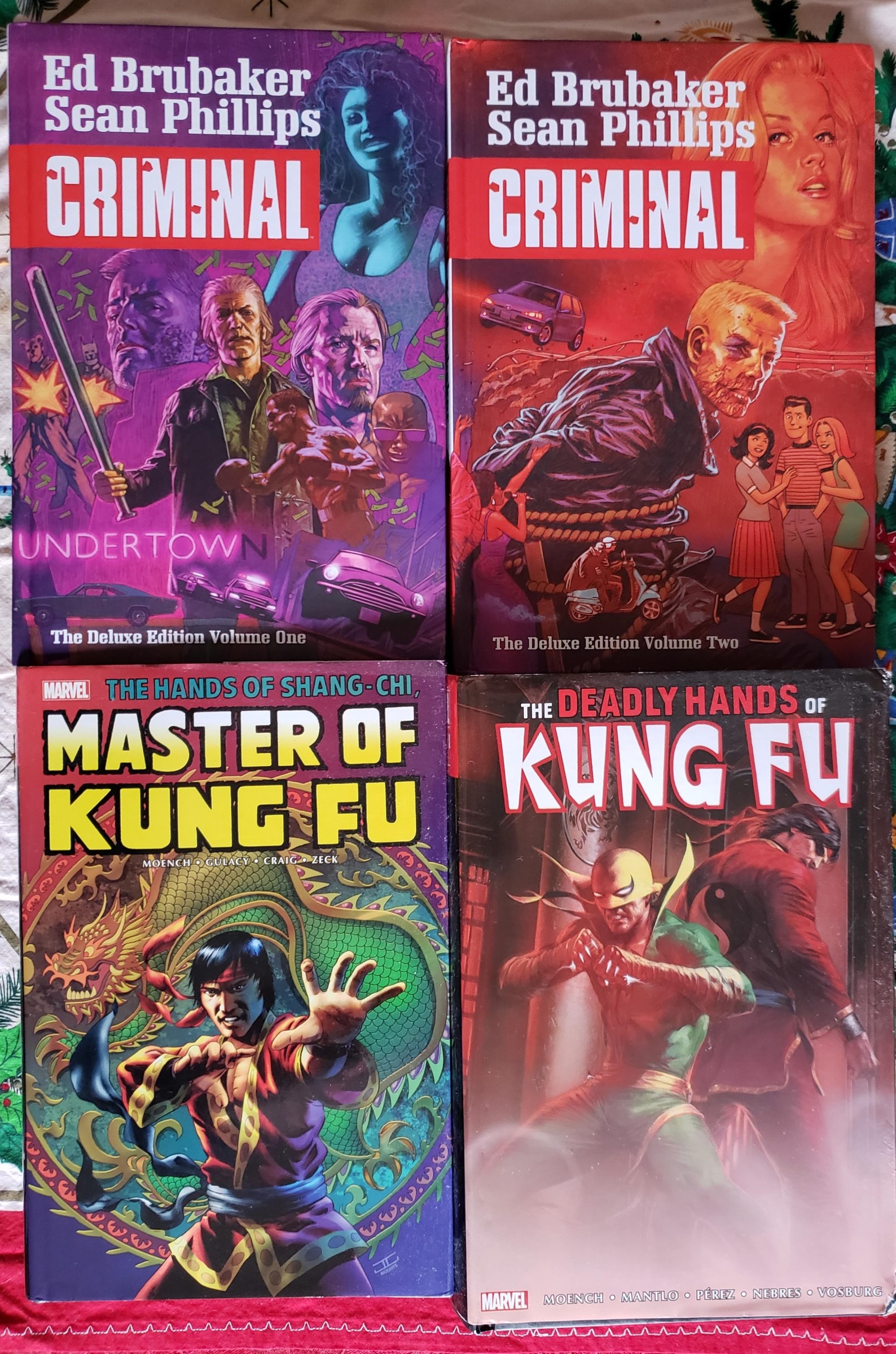
14/15. Ed Brubaker and Sean Phillips, Criminal: The Deluxe Edition Vols. 1-2 (both 2021). Soon to be a Prime Video series! Comics’ best modern noir, the original “bad guys vs. worse guys” trope that’s among my faves, collected in two volumes heavy enough to kill a man with a single blow.
16. Doug Moench, Paul Gulacy, Jim Craig, Mike Zeck, et al., Shang-Chi, Master of Kung Fu Omnibus, Vol. 2 (2016). I’m told Simu Liu doesn’t sign old Shang-Chi comics at cons, but I wouldn’t know for sure because he hasn’t attended one within 200 miles of us yet. Nevertheless I was curious to check out the originals for myself and, thanks to Marvel’s exposition mandates back in the day, the cumbersome recaps were more than enough that my FOMO for the first volume is negligible. An awful lot of Our Hero’s storylines had him tagging along on spy missions with white James Bond knockoffs ordering him around, which isn’t quite what I was expecting, but when they aren’t in charge, Moench and Gulacy’s issues in particular were ahead of the curve in the medium’s maturation and darkening years before the ’86 convergence.
17. Doug Moench, Bill Mantlo, George Perez, Mike Vosburg, Rudy Nebres, et al., The Deadly Hands of Kung Fu Omnibus, Vol. 1 (2016). Marvel’s line of black-and-white magazines offering edgier content for wider audiences included a ’70s martial-arts craze cash-grab that wasn’t just comics. Shang-Chi was a regular, but shared pages with other heroes such as Iron First and the forgotten Sons of the Tiger (drawn by a young Perez, RIP), whose magical power amulets would later be passed on to the White Tiger, who failed to mention them in Daredevil: Born Again. And the zine wasn’t just comics! Other content is reprinted here — interviews with actors, kung-fu movie news, film reviews written by future luminaries such as X-Men legend Chris Claremont, and three introductions from the original writers, most notably Gerry Conway apologizing for pretty much all of it.
All the books in this entry with the fewest pictures!
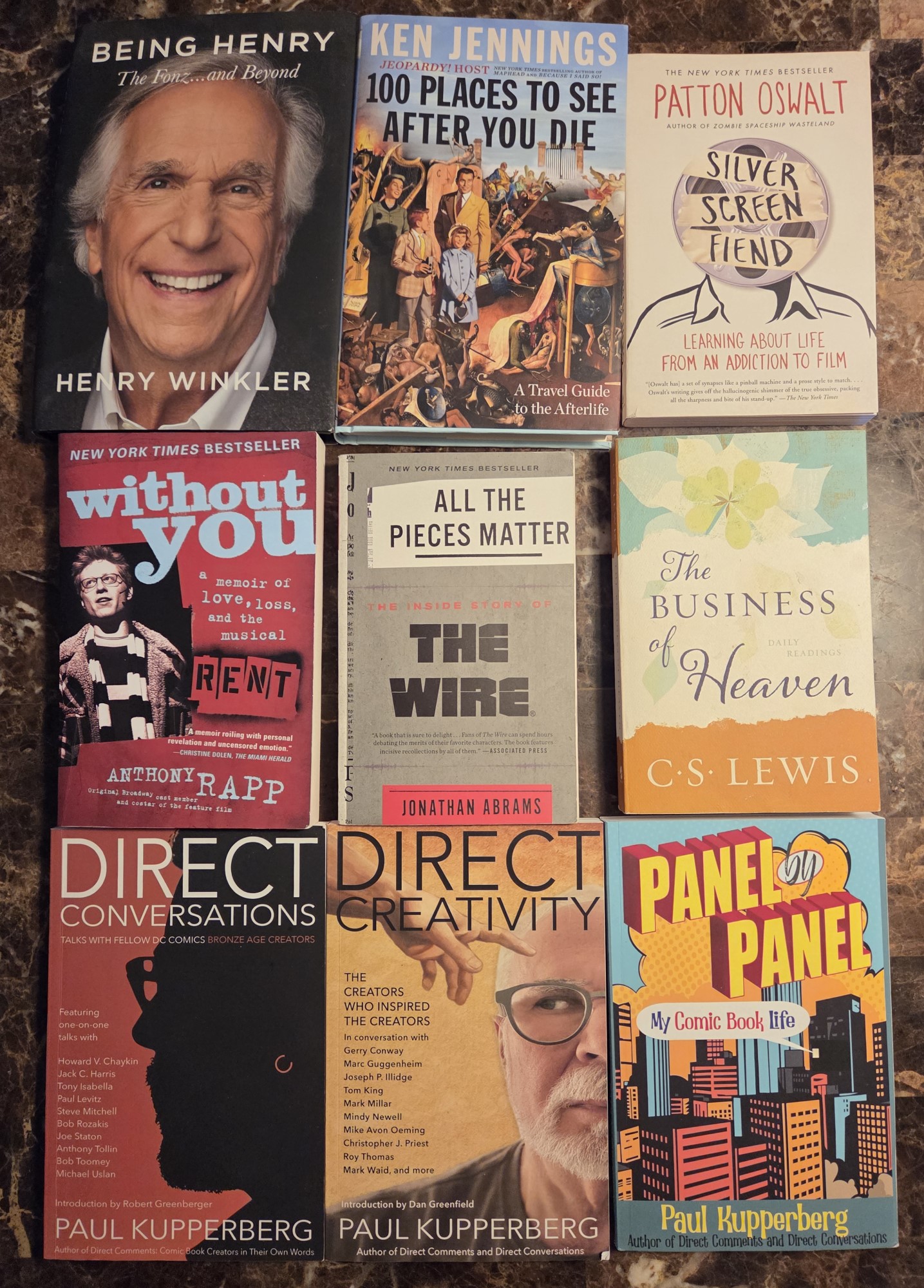
18. Jonathan Abrams, All the Pieces Matter: The Inside Story of ‘The Wire’ (2018). Please enjoy this site’s 199th mention of my all-time favorite show. I’d assumed years ago Rafael Alvarez’s much thicker The Wire: Truth Be Told would be the only behind-the-scenes book I’d need, but Abrams (the journalist, not the Jonathan Abrams who wrote the also-excellent Juror #2) found different facets to explore, conducted new interviews, and barely overlapped with Alvarez’ work, if at all. I do love an excuse to return to Baltimore years after my binge. I can still remember much of the show more vividly than 80% of the streaming series I’ve gorged on in the last six months.
19. Henry Winkler with James Kaplan, Being Henry: The Fonz…and Beyond (2023). The third memoir (following 2011’s I’ve Never Met an Idiot on the River) from one of the nicest actors we’ve ever met at a comic-con is less focused on fishing this time and more on broader subjects — the effects of undiagnosed dyslexia on his childhood, his career from The Lords of Flatbush to Happy Days to finally (justly) winning an Emmy for Barry, and numerous anecdotes in between. At turns he’s as funny and honest in print as he is in person, even when some of his memories aren’t so flattering, but he shares with humility and a witty hindsight.
20. Anthony Rapp, Without You: A Memoir of Love, Loss, and the Musical ‘Rent’ (2006). Count me among the sheltered Midwesterners who’d never heard of the former child star turned Broadway performer till Star Trek: Discovery and the headlines about his Kevin Spacey experience. Now I’ve watched Rent, finally gotten around to Adventures in Babysitting, and through this book-shaped time machine traveled to his distant past when he wasn’t a TV presence and was comfortable writing candidly about the death of his mother, his sexuality, and the anger-control issues that came to the fore when Rent‘s prolonged success and his own family issues collided. Among other insights, he finally convinced me to watch Dazed and Confused, which I can appreciate now and lament the “hur-hurrr, it’s a stoner flick!” marketing campaign that kept me at bay for decades and which director Richard Linklater likewise laments in the Criterion extras.
21. Patton Oswalt, Silver Screen Fiend (2015). Yes, another memoir about fame and success, this one centering on addiction, but not the usual variety. The comedian/actor recounts the four years he committed to seeing at least one movie in a theater every day — no matter if he’d already seen them and no matter what he was canceling or sacrificing to keep worshiping at the altar of cinema. Humorous, revelatory, and definitely not bragging about it as a glowing “accomplishment”, file it on the fandom-run-amuck shelf alongside other post-geek cautionary tales like Fever Pitch, High Fidelity, and Eltingville Club. For anyone who doubts his claims, he encloses the entire list, because of course he wrote it all down. I can relate.
22. Ken Jennings, 100 Places to See After You Die (2023). Before he transitioned from Jeopardy! champion to regular host, the trivia master assembled a cute yet educational travel-guide parody using his vast knowledge of the subject of death in various religions, mythologies and geek canons, all of which I’m sure he boned up on in case of death-related categories. He may also have researched a few new pop-culture areas for this book’s sake, but it’s all too easy to imagine him writing all this over a single weekend with his internet turned off, just for kicks.
23. C.S. Lewis, The Business of Heaven: Daily Readings (1984.) 365 excerpts from the Narnia creator’s nonfiction works and letters reframed into a daily devotional format, which I found useful, instructive and challenging over the course of that many mornings. Mere Christianity is an old favorite, but the rest were new to me.
24-26. Paul Kupperberg, Direct Conversations: Talks with Fellow DC Comics Bronze Age Creators (2023); Direct Creativity: The Creators Who Inspired the Creators (2024); Panel by Panel: My Comic Book Life (2024). The longtime writer/editor has had a long and storied career that’s touched on Supergirl, Archie, Arion, Checkmate, and so on at length, to say nothing of the numerous titles he edited. The answer to the trivia question “Who was the regular writer on Doom Patrol before Grant Morrison took over?”, Kupperberg hasn’t been in comics for a good while, but he’s plied his talents in other worthy places, such as these Kickstarter’d books. The first collects interviews with friends and peers from DC’s pre-Crisis heyday (though sometimes repeating the same memories and talking points from one chat to the next); the second probes a different set of comics writers from various eras about their influences (Tom King! Mark Millar! Priest!); and the third is his own memoir, ranging from his comics-loving youth spent with Paul Levitz as a best friend to his professional credits, including what might be the first behind-the-printing-press tales I’ve ever read about what it was like working at the Weekly World News.
The best things I read last year that I haven’t previously covered, graphic storytelling division.
Now we begin GRAPHIC NOVEL LIGHTNING ROUND! ALL FINISHED BOOKS MUST GO!
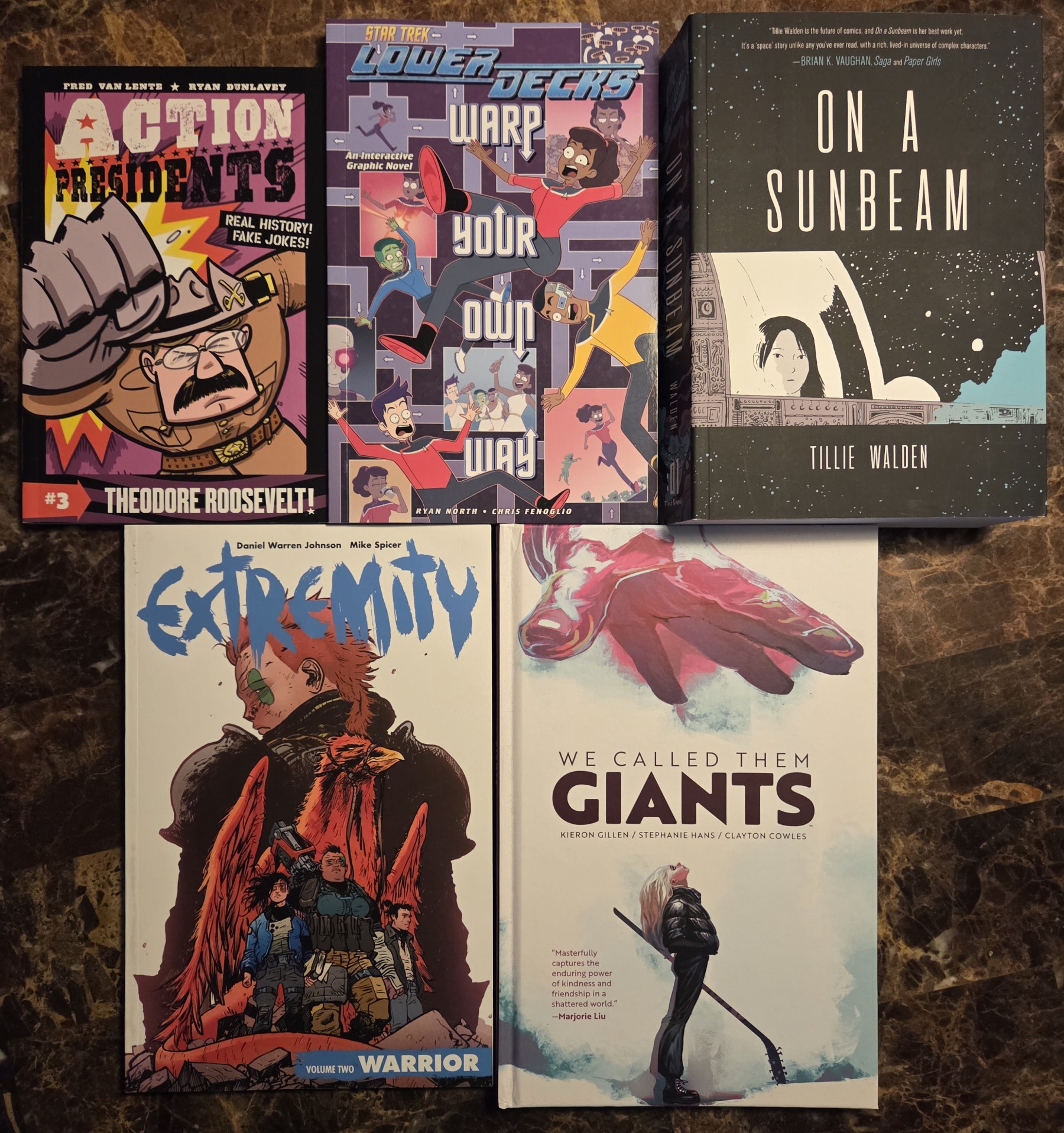
27. Ryan North and Chris Fenoglio, Star Trek: Lower Decks: Warp Your Own Way (2024). The greatest Trek cartoon in world history now has its own Choose Your Own Adventure! From the same winning team who brought you some of the issues of the ongoing IDW series, the crew of the Cerritos runs afoul of various anomalies they can only navigate with the help of YOU, The Viewers at Home! CAUTION: Light math required to win. Also, if you cheat by flipping straight through every page, effectively charging through the walls of each timeline like a rhino in a temporal china shop, there’re contingency pages to catch that, and your uncooperative choice would condemn the cast to a terrible fate. Do not do this! Also, here’s the usual gratuitous mention of North’s glorious work on Unbeatable Squirrel Girl!
28. Kieron Gillen, Stephanie Hans and Clayton Cowles, We Called Them Giants (2024). The latest project from the creators of DIE is a shimmering, haunting fable about life after an apocalypse and how humanity relates to aliens who arrive later. I don’t want to spoil too much or undercut it by delving into how it’s such an evocative realization of that one Porno for Pyros song, blessedly without Perry Farrell’s shrillness.
29. Daniel Warren Johnson and Mike Spicer, Extremity, Vol. 2: Warrior (2018). The conclusion of the uncompromising war-is-hell space operetta from one of the more recent additions to my ever-changing mental list of must-buy-now-now-now comics writers. Johnson is equally adept at breakneck pacing and heartbreaking stillness, striking a contentious balance between the thrill-ride visuals and the pricking of our conscience as we wish in vain that the sort of suffering endured here could never happen in our real world.
30. Fred van Lente and Ryan Dunlavey, Action Presidents #3: Theodore Roosevelt! (2020). From the funnybook historians who brought you Action Philosophers! and The Comic Book History of Comics comes the rather hilarious Cliffs Notes version of everything my schoolteachers failed to mention in class about good ol’ rough-ridin’ Teddy. As longtime MCC readers know, the schools I attended literally never taught me anything about history (American or world) that happened after 1870, so I have to rely on my wife, roadside attractions, movies, comics, and Wikipedia to fill in my educational gaps, usually in that order. God bless the too-few gift shops that carry this series.
31. Tillie Walden, On a Sunbeam (2018). Brief testimony to the power of Free Comic Book Day samples: after first encountering her work in a 2022 preview of her Clementine trilogy, I’ve slowly been tracking down her works ever since. A recent Walden reissue (part of my 2025 Reading Pile) included an enlightening intro that points out such influences as Hayao Miyazaki and Winsor McCay (whom I once wrote about in a college seminar), which unlocked some thoughts as to why I’ve been enamored of the delicate linework, intimate interiority, and expressionist settings. Her longest work that I’ve gotten so far is a space drama with faint echoes of Castle in the Sky traveling through dreamlike worlds, but with a main cast borne of a more personal, earthbound perspective.
Honorable mentions!
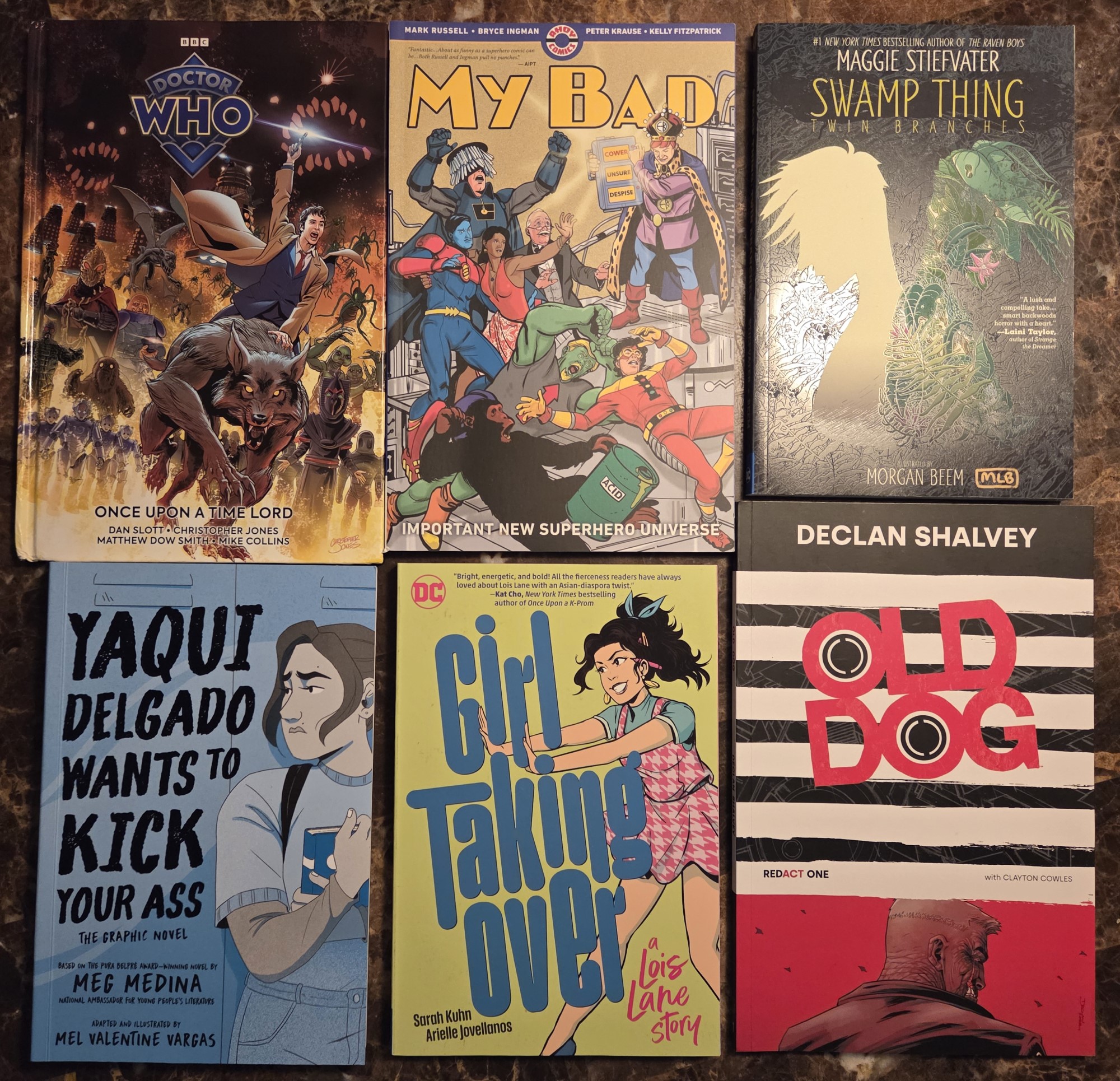
32. Dan Slott, Christopher Jones, Matthew Dow Smith and Mike Collins, Doctor Who: Once Upon a Time Lord (2023). Slott’s Silver Surfer run with the Allreds was a blinking-neon love letter to The Doctor, but years ago at C2E2 I reconfirmed even harder that he’s definitely one of the biggest Whovians I’ve ever met on the opposite side of a comic-con table when he noticed my wife’s “You Never Forget Your First Doctor” T-shirt and immediately focused all his attention on showing her phone-pics of cool Who-related sights he’d seen in his recent travels. So it’s tremendous fun to see him cross “write a Who comic” off his bucket list — and with the Tenth Doctor in the lead story, at that.
33. Maggie Stiefvater and Morgan Beem, Swamp Thing: Twin Branches (2020). DC’s sprawling YA line has existed largely out of my line of sight because my buying habits focus too myopically on my weekly singles fix from our local comic shop and not so much on bookshops. Thanks to the magic of Artists Alley outreach I’m glad I ran across this one, a reimagining of Alec Holland as an awkward teen with a twin brother who still loves botanical experiments and discovers a new level of reality after a greenery-based accident gone awry. Swampy has endured so many “takes” of wildly varying quality after Alan Moore’s legendary run that I’m no longer emotionally grafted to any of them and therefore not feeling the least bit territorial about how he “should” be done. This version discards the paper-thin B-movie of earlier pre-Moore works, eschews Gothic pretension and implements a clever device for conveying the emotions Alec senses from nearby plants — cute, but I like it.
34. Sarah Kuhn and Arielle Jovellanos, Girl Taking Over: A Lois Lane Story (2023). DC YA strikes again! In another reality Superman’s future coworker and SO still has her indefatigable drive for truth-seeking in her pre-Daily Planet days, but now she’s Asian-American and her overbearing dad General Sam Lane has been supplanted by an equally oppressive dragon-mom. Other strife comes from a sexist boss, everyday racism, and hypercompetitive peers with their own issues (“I am not your ORIENTALIST CONSTRUCT!” shouts a rival girl to an imagined offender during performance-art rehearsal). It’s not necessarily “my” Lois through-and-through, but the important genomes are in there.
35. Meg Medina and Mel Valentine Vargas, Yaqui Delgado Wants to Kick Your Ass (2023). YA strikes again, but without DC’s help! A compelling graphics adaptation of Medina’s 2013 prose novel (which was banned in at least one Florida school system) about a teenage girl who endures capricious school bullying from some angry girl she doesn’t even know. It’s a testament to how hard a book is hitting when you find yourself getting actively furious at the antagonists and start reading faster just to get to the light at the end of Our Hero’s tunnel so they can feel better.
36. Declan Shalvey with Clayton Cowles, Old Dog: redAct One (2023). After years of making the Big Two look cooler (Thunderbolts, Moon Knight) and solid creator-owned collaborations (Injection, Time Before Time), the writer/artist’s first truly solo project (plus letterer) concerns father/daughter tensions in a vivid action-spy world. I bought the first issue upon release but for some reason, despite Shalvey’s strokes as assured as ever, it didn’t grab me, but in a collected trade it was more captivating, especially after the jaw-dropping Everything You Know Is Wrong twist in #4. It’d be unfair to evoke those sagging streaming TV shows whose fans apologize for them with “But it gets really good starting with episode 6!”, but credit is due whenever one’s patience is rewarded.
37. Mark Russell, Bryce Ingman, Peter Krause and Kelly Fitzpatrick, My Bad, Vol. 1: Important New Superhero Universe (2022) Russell is another must-buy-now-now-now writer whose humanist philosophizing and sharp-tongued mockery of billionaires, mega-corporations, and class-war exploitation have been a fun challenge to track down as he’s been getting projects published by multiple publishers of all sizes. This one from Ahoy Comics isn’t his only superhero satire, but it’s among the funnier ones so far.
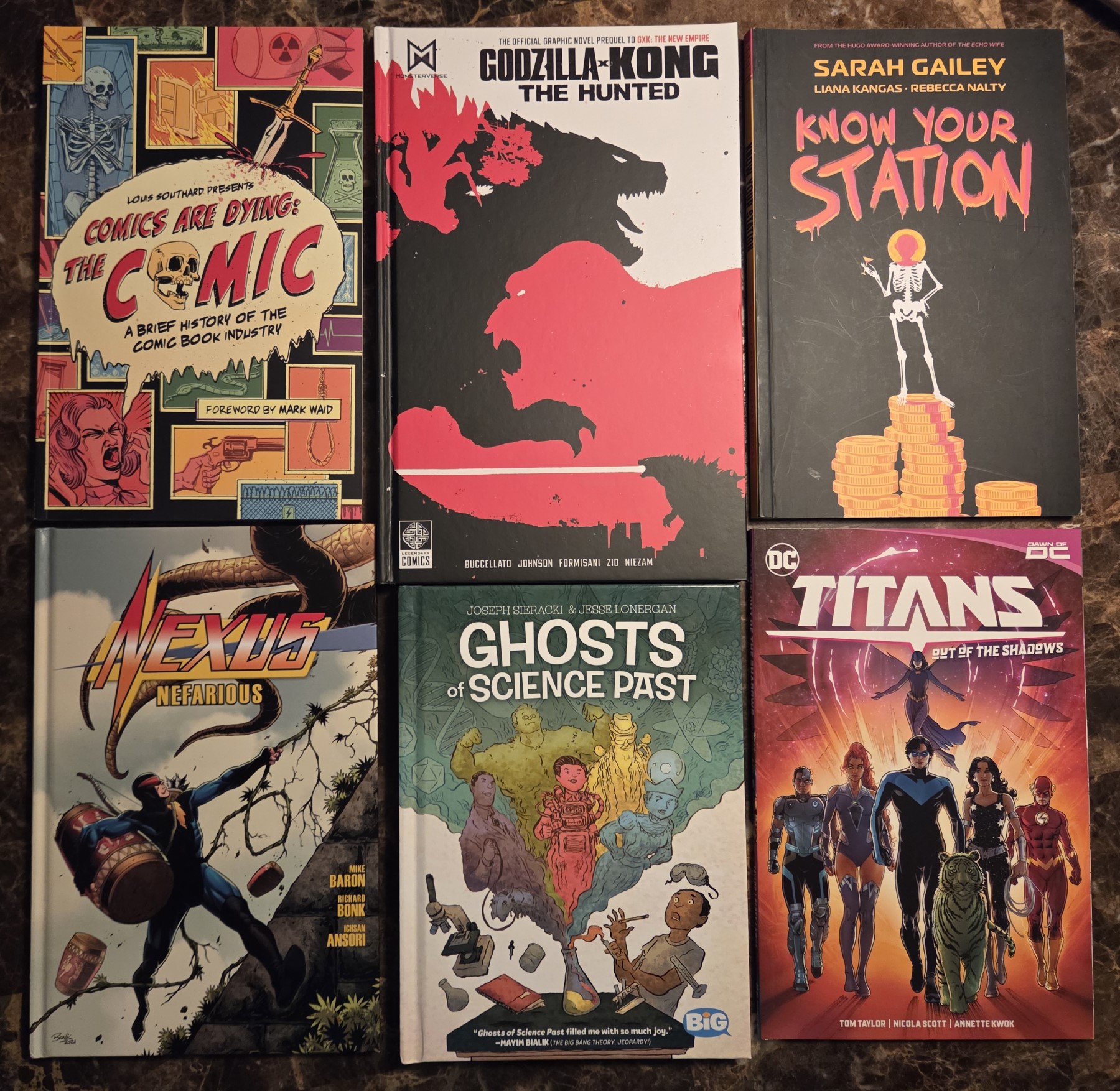
And the rest!
38. Tom Taylor, Nicola Scott and Annette Kwok, Titans: Out of the Shadows (2023) I was 8 when the original Wolfman/Perez New Teen Titans changed DC’s business fortunes and became my favorite super-team book for years, up until the 1984 title split broke my heart because I didn’t live near a direct-market comic shop yet. I’ve only followed them intermittently since, and it’s never been the same (though the first animated series was keen). Their umpteenth relaunch, part of DC line-wide initiative #7,006 umbrella-titled “Dawn of DC”, brought back the early-’90s lineup (i.e., with Donna Troy in Troia costume) was friendlier to prodigal readers than I expected, but packed with too many guest stars and it isn’t a complete story — it’s just five consecutive issues, because the industry-wide five-issues-per-trade marketing compromise remains Holy Writ. Nicola Scott does make these young geezers look fantastic, though.
39. Joseph Sieracki and Jesse Lonergan, Ghosts of Science Past (2022). Lonergan’s BOOM! Studios miniseries Man’s Best (with writer Pornsak Pichetshote) was among 2024’s best comics, so I was itching to see more of his work. A bit earlier and less innovative, this education-minded tale uses A Christmas Carol‘s structure to invite a series of scientists’ spirits (some more famous than others) to come inspire a failing student to fall in love with learning, somehow, in spite of their penchant for turgid textbook speeches that don’t exactly roll out the Reading Rainbow welcome mat. Mostly it’s preaching to the erudite child-prodigy choir.
40. Louis Southard, et al, Comics Are Dying: The Comic: A Brief History of the Comic Book Industry (2024). Ye olde “Comics Are Dying” news-site headlines will apparently never die and the jokes about their immortality still ring true for us irony lovers, but its use here doesn’t reach far beyond the title. Anyone with fond memories of Jules Feiffer’s The Great Comic Book Heroes or Ron Goulart’s ’80s reference books can appreciate the need to preserve the medium’s history for new generations, which Southard’s text upholds in this crowdfunded anthology, with each page drawn by a different artist, many of them unfamiliar to me because I don’t read webcomics or explore Instagram much. But to avoid copyright and trademark infringement, all the tales involving existing IPs — i,e, the majority of total pages here, even the ones about public-domain works — replace those household names with the author’s own characters, which I thought were all jokey throwaways till the appendices revealed they were largely reused from his own preexisting nostalgic works. The artifice of that novelty thought experiment makes matters more confusing and less constructive for newcomers, which I guess aren’t the target audience after all.
41. Brian Buccellato, Drew Johnson, Dario Formisani, Zio and Niezam, Godzilla x Kong: The Hunted (2024). The official prequel to last year’s big-screen sequel Godzilla x Kong: The New Empire, though it wasn’t exactly essential. My edition pictured above (with exclusive David Aja cover!) was published through a Kickstarter campaign that ran into logistical problems, so it didn’t ship to us backers till months after the basic edition had already hit store shelves and well after the film had come and gone. It’s just-okay creature-fights, with Kong getting way more page space than the King of Monsters does, though some of the inconsistent artwork is painted prettily and now we know what Atlanta‘s Brian Tyree Henry looks like in comics form!
42. Sarah Gailey, Liana Kangas and Rebecca Nalty, Know Your Station (2023). Ostensibly a murder mystery set aboard a space station populated chiefly by billionaires, it’s not a true whodunit — just class-war SF that shakes up the formula a little, doesn’t quite stick the landing, and comes with an afterword about billionaires’ inhumanity toward humanity that loses its grasp on some of the latter.
43. Mike Baron, Richard Bonk and Ichsan Ansoir, Nexus: Nefarious (2023). Gen-X comics fans revered Mike Baron and Steve Rude’s SF-superhero saga about an intergalactic executioner-of-mass-murderers as a longform classic as it hopped publishers from Capital to First to Dark Horse, where it withered away over time. The team has since parted ways but agreed to let each other continue his world in their own respective, separate stories. Last time I checked in with fellow fans on Facebook, we’re largely in consensus that the most recent results from each gentleman have really, truly, deeply, disappointingly, alarmingly amateurishly not been the same. Baron’s whimsies seem stiffer and awkwarder than they used to, Rude writes about as well as Baron draws, any sense of forward-moving continuity is gone, and at this point I’m not convinced reuniting the duo would make a difference. Far as I’m concerned, Horatio Hellpop has sailed into the West and I am done.
…
…and I guess that’s it! I’m out of 2024 stacks, and the 2025 stack is already looking precarious. I should probably carefully move it off the top shelf of our PC desk.
Till next time, then!
Discover more from Midlife Crisis Crossover!
Subscribe to get the latest posts sent to your email.
 Midlife Crisis Crossover!