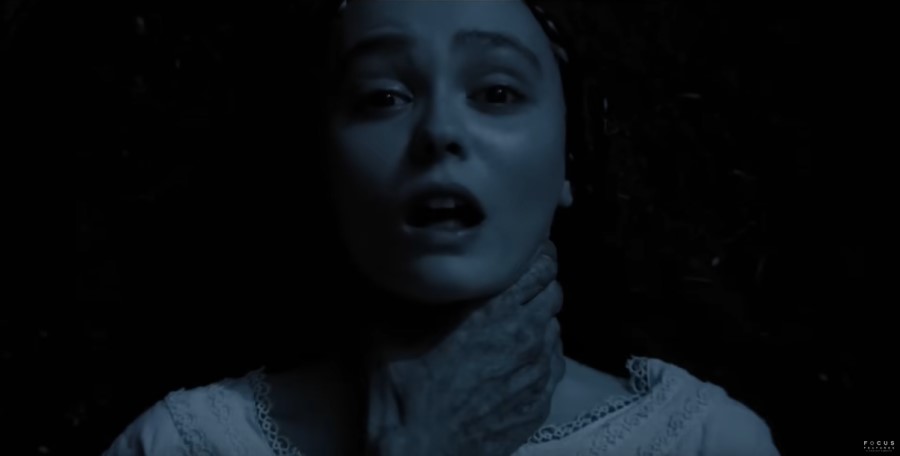
PROTECT YA NECK, KID!
Previously on Midlife Crisis Crossover: with three films writer/director Robert Eggers claimed a neglected niche as an artisanal horror scenographer, creating unique environments with an obsessive fastidiousness that surely frightens and confuses any execs used to funding facsimiles of other films. At first The Witch disoriented the unsuspecting viewer with stylized Puritanical dialect before plunging them into a malevolent maelstrom of what Salem might’ve looked like if the witch-hunters hadn’t been making it all up. The Lighthouse was an intensely claustrophobic, black-and-white duel over Mellvillian obsession and 19th-century on-the-job training. As if those weren’t harrowing enough, The Northman retold the tale of the turn-of-the-ninth-century Jutland prince Amleth (you may recall Shakespeare’s watered-down adaptation called Hamlet) as a visceral, deafening Dolby Cinema experience in which its antihero, a doubt-free rage-monster, waged relentless revenge atop a sonic tsunami of pummeling war drums. Such are the hypperrealities that Eggers, diviner of realms unseen, has dared us to watch.
Whereas The Northman was less a do-over of existing material than a savage interpretation of the historical record, Eggers’ latest is his first total remake — a full-throated cover of the 1922 silent classic Nosferatu: A Symphony of Horror, F.W. Murnau’s unauthorized adaptation of Bram Stoker’s Dracula that took on a life of its own despite the ensuing lawsuit. Eggers’ Nosferatu has no subtitle and is twice the runtime, and follows in the footsteps of other movie-monster aficionados-turned-pros such as Guillermo del Toro and Leigh Whannell, but as one might expect, it’s no ordinary Dracula flick to throw on the ever-mounting pile.
Surprisingly, Eggers hews pretty faithfully to the original by Murnau and the original screenwriter Henrik Galeen. Once again we’re transported to 19th-century Germany, except Eggers cunningly lulls us into a complacent non-Eggers state with the tediously BBC version, where not a single word of German is spoken, everyone has British accents, and everyday rhythms feel awfully ponderous behind all those starched collars and corsets, not to mention stretched-out arcs for the other characters who mattered not at all to Murnau.
Nepo-baby Lily-Rose Depp (Yoga Hosers, HBO’s The Idol) is Ellen Hutter, a Concerned Wife who’s still reeling from a bizarre psychic encounter she had years ago as a teen, which has sparked unsettling random dreams ever since. The ubiquitous yet always welcome Nicholas Hoult (whom I’ve seen most recently in Juror #2 and The Menu) is her husband Thomas, a realtor tasked with journeying to faraway Transylvania to close a deal in person with a rich recluse who has designs on moving into their own li’l fictional town of Wisborg. Sure, Thomas will be gone for weeks, but she has friends of equal social standing who’ll look after her, and, as with most period pieces, money seems no object even in his absence. What’s the worst that could happen?
Thomas is soon countries away, surrounded by angry Romani and seemingly superstitious inn employees all shaming him for his business dealings with…with that man. He shrugs off their bug-eyed warnings and arrives at the current residence of the client…whereupon we meet Bill Skarsgård, the biggest monster in such films as Stephen King’s It and John Wick: Chapter 4, as Eggers’ revamp of the notorious Count Orlok. Not merely the bald, spindly, stiff-backed, black-suited demon of pop culture and its countless homages from Salem’s Lot to Spongebob Squarepants and back again, Skarsgard’s Orlok is a hulk lurking in the shadows of his cavernous palace of decrepitude, every utterance a sepulchral rumble in a tar-thick Romanian accent with infernally rolled R’s and a subterranean basso profundo deep enough to reach Hell. Eggers reveals him only incrementally because the viewer needs time to adapt to each inhuman aspect — his mottled skin, his Lurch-like height, and arguably Eggers’ most challenging deviation from the source material, a heinously thick mustache. It’s bigger than any facial hair this side of Sam Elliott or Omniman, and it might be laughable if it weren’t so…so evil.
Same as the original, Thomas is uneasy at first, then tries not to be intimidated in this real estate transaction…but ultimately knows he’s confronting much more than an eccentric hermit, and abject terror ensues. Hoult sells it with every fiber of his being and hits the gradual nuances in Thomas’ arc through its original path from ravaging to recovery, from victim to would-be defender. The film returns from the castle to Wisborg as before, once again seeing Orlok’s voyage of the damned to his would-be new homeland (another subplot extended with extra time allotted for dying sailors) with his full power-set in tow. Rather than devour his victims’ blood through the tender, easily accessible, eminently popular jugular vein favored by average vampires, he has the jaw strength to bore through the breastbone or between the ribs and slurp straight from the heart. He also wields a sorcerer’s might, attacking through dreams and enthralling his prey with a compulsory form of summons some levels above basic vampy hypnosis.
Naturally he’s set his sights upon his ultimate prey Ellen, whose nightmares escalate into creepy sleepwalking fits. Fortunately for her, her mortally wounded man Thomas isn’t alone. Other allies join the fight, including our MVP Willem Dafoe (returned from Eggers’ last two films!) as the local professor with knowledge outside our mortal realm. He rants about humanity’s fatal flaw of being “blinded by the gaseous light of science” and is the only character brave enough to utter the forbidden phrases we know someone has to say sooner or later — “the undead” and “vampyr” and, most emphatically paused of all, “Nosferatu“. At last comes the authority who’ll save the day!
Well, as much as it can be saved per Murnau’s framework, anyway. Along the way, Eggers opts for German Expressionist mode as much as possible within the modern tech at hand, dousing entire scenes in the same silent-era monotones of old and recreating those memorable moments of Orlok working his wiles through sinister shadow-play that’s rarely attempted nowadays outside the end-credits art for Tim Burton projects. He embraces what Murnau accomplished within his contemporaneous boundaries and pays respects in the best ways. He’s atmospherically abetted by The Northman composer Robin Carolan, trading in percussive concussions for subtler melancholy and tragedy befitting the century-length time jump from OG Nos to now.
Surprisingly he also avoids the pitfalls of the common horror-writer urge to romanticize vampires. No two ways about it, Orlok is straight-up hideous. The link between him and Ellen works only supernatural and only between the two of them; no rational viewer will see her position — throughout her recurring torment and especially in the climax — and think to themselves, “Ohhhh, if only that were me!” (Please do not notify me of your Rule 34 exception.)
Eggers makes a few other alterations to the Murnau/Galeen text, but nothing that creates a distracting imbalance. Stoker’s novel is included in the “Based On” section in the end credits, but I didn’t catch a lot of reworking for its sake. Beyond the unnamed Demeter‘s ill-fated course, Orlok’s Renfield-esque evil-sidekick counterpart has been merged with another character in a way that answers a nagging question without overexplaining it. The usual trio of vampire women are each Lady Not Appearing in This Film, another wise storytelling choice that posits Orlok as an even lonelier outlier in desperate search of a singular quarry rather than adding a redundancy to his existing harem. (If you think they’re essential, you can always revisit them in, say, Stephen Sommers’ underrated popcorn-fest-with-extra-cheese Van Helsing or Coppola’s unforgettably outlandish blockbuster, which…uhhh, yeah, I’ll leave you to that one.)
I feared Eggers’ Nosferatu might suffer the drawbacks of other classic-horror remakes of recent vintage. Despite the overwhelming consensus pros and superiors, I’ve come away with lukewarm impressions of del Toro’s remakes in this vein. All of his films are marvels of production and art design (even the earlier, underfunded ones), and of course his visual effects tend toward the impeccable side, but I never quite connected with his last two overhauls The Shape of Water and Nightmare Alley, which tossed most preexisting subtleties out the window in favor of sating the urge to see his childhood favorites writ bloodier and sexier, as if the Hays Code denied past works their true greatness. By no means has Eggers entertained a PG-13 compromise here, but the splatterpunk viscera are selective and seldom, spaced apart for a more meaningfully horrifying shock whenever they do occur at Orlok’s powerful talons.
His Nosferatu saves the most psychologically scarring moments for the climax, when the survivors conspire on a big Hail Mary that requires one final sacrifice. Hoult and Dafoe are their riveting selves throughout as always, but it all comes down to the performance from Ms. Depp herself, who has to transcend several straight scenes of varying levels of victimhood and convey her part of the plan in a way that forces us to realize the full, revolting enormity of what she’s doing to help save the world. A more modern take might see her punching Orlok in the face and engaging him in some bizarre swordfight or whatever, but we’re still in Eggers’ 1838 Germany. He unwaveringly commits to the text, the world, and the tragedy to the very end, inequities and all, whether we cheer or not. You’d have to be some kind of monster to feel like cheering. Eggers has yet to bother with that kind of film. Nosferatu isn’t superheroics with fangs like, say, Abigail. It’s uncompromising horror.
…
Meanwhile in the customary MCC film breakdowns:
Hey, look, it’s that one actor!: Allies with varying degrees of usefulness include Emma Corrin (The Crown, Deadpool vs Wolverine) as Ellen’s pal Anne, a.k.a. the “Lucy” BFF in the typical Stoker lore; Aaron Taylor-Johnson, Mr. Kraven the Hunter himself, as Anna’s husband (again playing vengeful but much more interesting here than as the jumpy slashy antihero); and Ralph Ineson (The Witch and The Northman) as the requisite doctor of the era who thinks most maladies are caused by too much blood in the body.
Simon McBurney (Apple+’s Hijack, Mission Impossible: Rogue Nation) is Hoult’s boss back at the real estate office, who has much more to do here than push papers. Karel Dobrý (Syfy’s Dune miniseries, the first Mission Impossible) is the captain of the ill-fated, unnamed ship.
How about those end credits? No, there’s no scene after the Nosferatu end credits, but they confirm it was shot in the Czech Republic, thus proving a viable film can be made there despite the last 30-40 years’ worth of zero-budget direct-to-video crap slapped together for budget savings. For those curious about such things, the credits also confirm Emma Corrin still identifies as nonbinary, evidenced by the credit for the “Assistant to Mx. Corrin”, which marks the first time I’ve ever sighted that honorific outside the internet.
Discover more from Midlife Crisis Crossover!
Subscribe to get the latest posts sent to your email.
 Midlife Crisis Crossover!