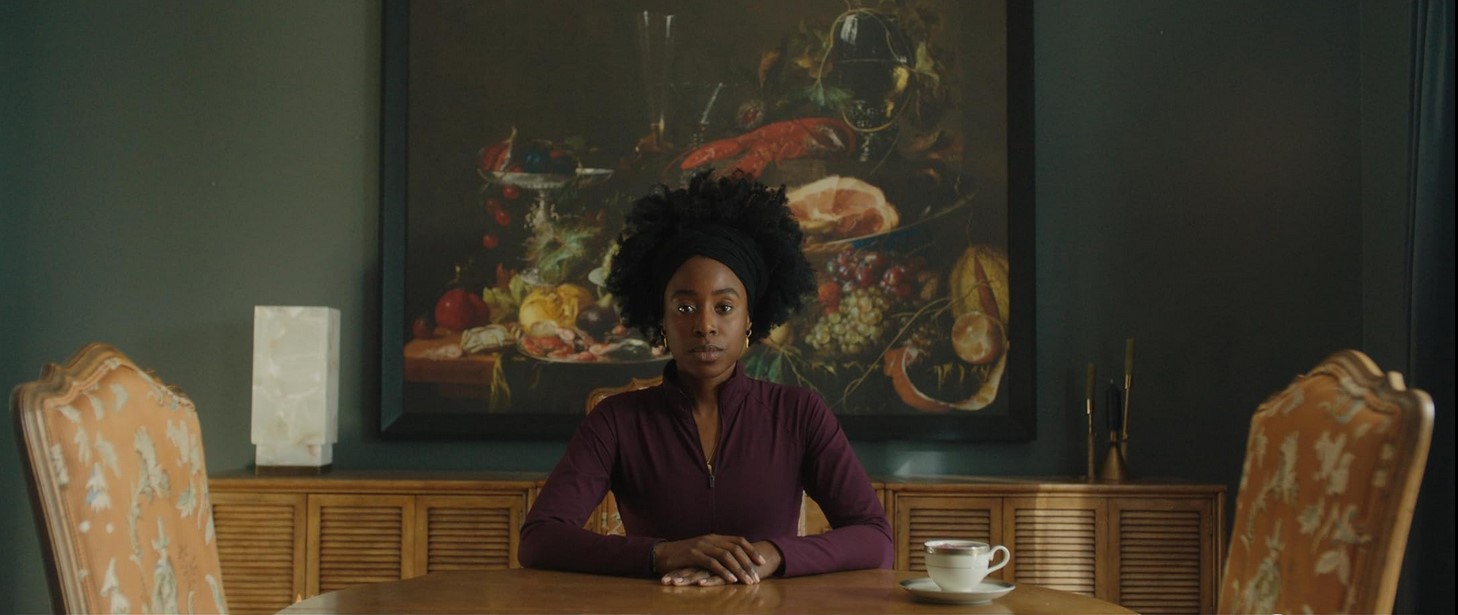
This scene near the end should tell you a lot about what she puts up with from the other characters.
Previously on Midlife Crisis Crossover:
It’s that time again! Since 1992 my hometown of Indianapolis has presented the Heartland International Film Festival, a multi-day, multi-theater celebration of cinema held every October. Local moviegoers have the opportunity see over a hundred new works in the realms of documentaries, narrative features, shorts, and animation made across multiple continents from myriad points of the human experience. Some participants stop in Indy on their grand tour of Hollywood’s festival circuit; some are local productions on shoestring budgets; and a wide spectrum of claims are staked in the innumerable niches between, projects with well-known actors screening alongside indies with enormous hearts.
Heartland’s 33rd edition runs October 10-20, for which I’ve made plans to catch at least eight films in all (Lord willing). Longtime MCC readers know the rule: every film I see in theaters gets its own entry…
…and we come at last to the final theatrical recount in this very special MCC miniseries: We Strangers (not to be confused with last year’s All of Us Strangers), a dramedy that premiered at South by Southwest back in March and caught my eye in Heartland’s listings on the strength of its star Kirby Howell-Baptiste (whose recent roles, including this one, have been billed mononymously as just “Kirby”). Best known to geeks as Dream’s big sister Death in Netflix’s Sandman, I’ve also seen her in Veronica Mars season 4 (as a bartender who doesn’t appreciate being a murder suspect), the Apple TV+ series Sugar (as Colin Farrell’s handler), the Cruella prequel (as young Anita Darling), HBO’s Barry (blink and miss her as a recurring student in Gene Cousineau’s acting class), and so on and so on. Okay, I’ll stop now.
Suffice it to say she’s no stranger to me in that sense, though “stranger” can mean different things, and switch context at any moment without notice, even when you’re finally #1 on the call sheet.
Kirby is Rayelle Martin (“Ray” for short), a woman who works for a commercial cleaning service but gets an under-the-table offer from a doctor client (Hari Dhillon of the BBC’s Holby City, and a recurring SVU attorney) interested in having his personal residence attended to as well. The money’s pretty good, he and his spoiled family aren’t around much, and Ray believes she can balance the gig with her existing responsibilities and her family. One side gig becomes two when he recruits her to do likewise for another couple he knows. Double your rich clients, double your dough.
While that other household’s husband Ed (Paul Adelstein of The Menu and Prison Break) mostly sits in the basement with a large TV and his collection of US flag photos taken in 26 different states so far, his wife Jean (Maria Dizzia, now in theaters in My Old Ass; I last saw her in the Oscar-nominated short The Neighbors’ Window) is a bit more in her way and likewise not the brightest bulb in the chandelier. Ray dusts and cleans up around Jean while she’s watching her favorite show, Monica the Medium, a basic-cable John Edwards knockoff that’d fit right in with today’s glut of ghost-hunting “reality” shows.
Ray impulsively gambles on an unspoken hypothesis: if this lady can buy into that sort of con, and makes the sort of baseless generalizations that she does, just how stupid is she? So Ray offers her services as a personal psychic…for an additional fee, of course. Soon Jean also ropes in the doctor’s wife (Barry‘s Emmy-nominated Sarah Goldberg), who’s a tad skeptical but just as susceptible. Maybe the two Karens just finished watching Apple’s Bad Monkey and Ray’s intimidating hair and “gift” remind them of the Dragon Queen.
Dollar signs keep piling up in Ray’s eyes as both households keep finding new things they’d love her to do for them. She certainly feels the unwitting condescension that comes naturally to wealthy, obtuse whites. A mere 10-15 minutes elapse before the first use of “those people”. But they’re willing to dip into their petty cash for extra services — the more frivolous, the better. Ray doesn’t find it so hard to fit in at first, but when the time-suck begins affecting the family she actually cares about, she has to decide: just how badly does she really need those people to want her around?
Writer/director Anu Valia, who’s built up considerable TV credits (She-Hulk, The Afterparty, et al.), was raised in northern Indiana and shot most of the movie in Gary. The city isn’t specifically named in-story, nor do they mention the part where we here in Indy have historically known of Gary as “the Murder Capital of the World“. (Full disclosure: I’ve been there only once, years ago on a late-night return trip from a Chicago comic-con when I apparently ignored an I-90 exit sign and wound up unwittingly cruising a deserted Gary street till I made my way back without stopping for directions. It was a brief, unfair first impression.) Valia isn’t telling that sort of story about race and class, but something subtler. Montages of ordinary cleaning can exhibit a curious grace in household drudgery while at the same time reminding us it’s not fun and people are a crass, disgusting lot. Valia captures the way some folks (we Midwesterners definitely included) will overlook a certain number of sins to be polite or self-serving among a crowd that outnumbers us — letting microaggressions slide, keeping our Halpert-faces at wildly inaccurate statements to ourselves, dabbling in unconscious code-switching, and so on. Some can live their entire life that way as long as no one rocks the boat. For Ray, the ongoing compromise isn’t so simple and chips away at her conscience.
We Strangers clocks in at a mere 80 minutes, but sags a little in its last 15-20 as Ray grapples with her despondence (sometimes in isolation, but there’s also a melancholy bar dance) and would rather not keep hanging around the wealthy walking punchlines just so the film can rack up more snickering at their expense. I wouldn’t have minded, but Valia refuses to reward them with extra spotlight time and avoids escalating the proceedings into a slapstick climax. She wraps nearly everything up in a single, succinct confrontation that’s amusing if almost too tidy, which is fair. It reminds us that with those people sometimes all it takes is a single wrongheaded question to topple an entire friendly facade that was months in the making. After that kind of damage is done, cleanup is their problem.
…
Meanwhile in the customary MCC film breakdowns:
Hey, look, it’s that one actor!: Fun footnoted trivia: the aforementioned Paul Adelstein and Maria Dizzia also just appeared in last week’s episode of Agatha All Along as another couple in over their heads, but for rather different reasons.
Ray’s family includes Tony Award Winner Kara Young (Clyde’s, and an M.E. in Marvel’s Punisher) as her partner and Tina Lifford (Queen Sugar) as her mom.
How about those end credits? No, there’s no scene after the We Strangers end credits, but I’m guessing the list of bands in the music section, none of whom I recognized, are all local acts. That’s my loss, as some of their excerpts felt like bangers.
After the names and thanks wrapped up, we were treated to a special Q&A with Gordon Strain, one of the film’s producers. (His last film The Duel held its world premiere here in Indy last July.) Usually whenever Heartland shows a film more than once (as was the case with We Strangers), cast and/or crew attend only the first one and not the encore. The first showing was at a bad time for me, but Strain was gracious enough to attend both.
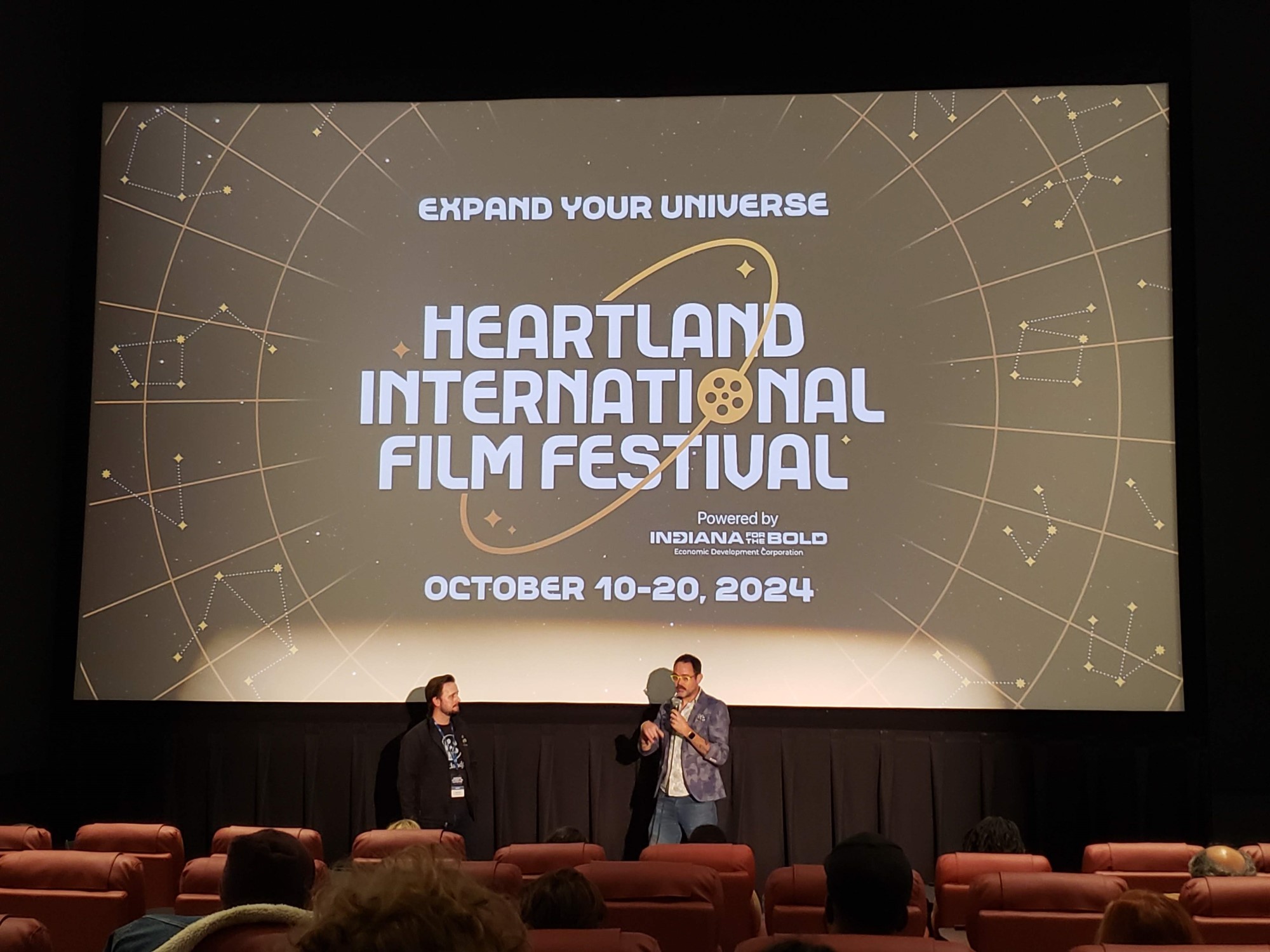
Gordon Strain at right, chatting with our host Greg Sorvig, Artistic Director of the Heartland Film Festival.
He began by reading a short statement from Anu Valia in absentia, confirming the film’s message about “the feeling of assimilating and what it takes from you”. Among other tidbits, he revealed the shot of a boiling volcano used as a recurring motif was not footage of Mount Pelée, whose name is invoked in-story for an apt metaphor.
The crew had “a lot of police run-ins” throughout the shoot, not to mention communication issues with the locals. They obtained the necessary clearances from all locales and businesses used in the film, but had headaches when a grocery store owner who’d okayed their presence failed to tell their own staff. A bar where they’d planned to shoot after closing time stayed open and kept letting in more customers. Some citizens also thought it’d be a total hoot to show up near their sets, shoot off guns and disrupt filming just for kicks.
Then there was the best story: Strain was enlisted to go to Elkhart, renowned as the RV Capital of the World (we’ve been there more than once!) and pick up a van that they’d bought for the film. Understandably for an indie budget, the van was a cheap junker (no heat, stuck windows, etc.) and no fun to drive. Police soon pulled him over because they’d forgotten to put dealer plates on it, only to look it up and discover it’d been reported stolen.
On the bright side, not one person in the cast or crew was murdered, so at least The Making of We Strangers isn’t that sort of story.
Discover more from Midlife Crisis Crossover!
Subscribe to get the latest posts sent to your email.
 Midlife Crisis Crossover!