Who’s gonna believe the star of such dramas as Dopesick and Clean and Sober could possibly headline a comedy?
Seems only fair if the Ghostbusters can stage a comeback tour decades past their prime, so can one of the biggest ghosts they never caught, right?
I was 15 when a young Tim Burton followed up his feature debut, the wacky and eminently quotable Pee-Wee’s Big Adventure (in theaters when he was only 27!), with the even wackier and definitely more expensive Beetlejuice. The first few times I saw it, his hyperactive imagination, his fanciful take on afterlife bureaucracy, his mixed-media creations, and the ensemble’s zest were a welcome escape from reality into fun-house tomfoolery. But the more times I watched it, the more I noticed cracks in the seams and nitpicking got easier. Apart from a few low-key exceptions over the next few decades (Big Eyes, Big Fish) I’d come to accept Burton generally has little vested interest in narrative coherence. Many of his works are thin clotheslines from which he hangs edgy gags, fantastical monstrosities, and non sequitur set-pieces that were fun to draw in his concept sketchbooks and entertain best if you don’t pay close attention to what’s happening. They’re popcorn flicks for us art-class loners.
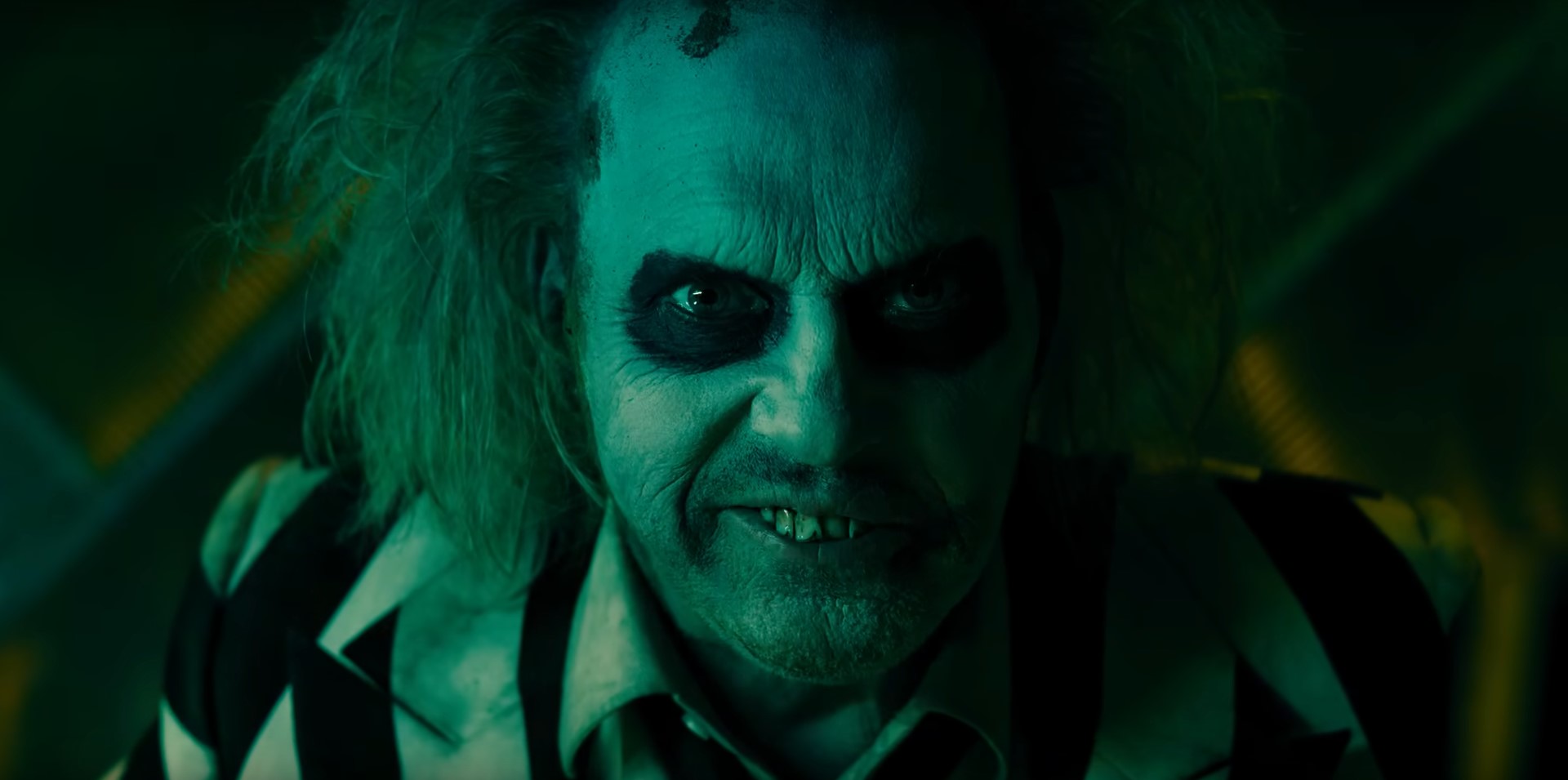
Now Burton is 66, our ghost-with-the-most Michael Keaton is a 73-year-old Emmy Award Winner, and I’m a middle-aged married loner, but 36 years later, here we all go again with Beetlejuice Beetlejuice. The old pals and two-time Bat-collaborators have locked elbows for a new nostalgia-fest with much of the same gags, same lines, same makeup ‘n’ wardrobe, same nearly everything.
Decades after the events of the first one, Beetlejuice manages an entire office for his scare-assistance business, which, as guys with offices go, has about as classy a reputation as Saul Goodman. If you’re a ghost seeking his assistance, of all people, there must be a terrible reason why you can’t do better. He hasn’t spent the intervening decades pursuing his onetime quarry Lydia Deetz (former teen Winona Ryder), but he never forgot her or his failed plan for a shotgun marriage. Per the first film’s mostly random Rules of the Dead, if someone would marry him, then he can stay in the Land of the Living. The spirit realm is just another foreign country and he was an immigrant trying to score a green card into our land of liberty and living.
He revisits that plan when his past comes back to haunt him and leads to revealing the unnecessary Secret Origin of Beetlejuice. Once upon a time during the Black Plague when he was alive, he had a wife named Delores (Monica Bellucci, from The Matrix sequels and The Passion of the Christ) whom he murdered before she could murder him first, except she also succeeded even as she lay dying. Yadda yadda yadda, her parts were boxed up in an afterlife backroom and forgotten like the Ark of the Covenant, until they aren’t, and she’s loosed and lusting for revenge. Her entirely SFX-driven reassembly sequence is the film’s genuinely scariest moment, setting her up as a force of reckoning who can actually kill ghosts and consume their souls. Then she disappears from the film for about an hour because Burton can’t be bothered and besides, she wasn’t in the first one, so he figures who cares. Her part in the climax is a dashed-off afterthought, like a response to some studio exec’s Post-It after watching a rough cut asking, “Hey, where’d Delores go?”
And what of the Deetzes? Boys my age may recall Lydia being pretty cool, or even cute, when she was a nihilist teen poet wallowing in depression that she soon forgot after being chased around by a phantom perv in pinstripes and a lot of puppets. Sadly, like a lot of us fellow Gen-X-ers, she grew up cheerless and apparently self-destructive. She’s a widow who still hangs out with her performance-artist stepmom Delia (huzzah for Catherine O’Hara!). She can still see ghosts, but wastes this power on hosting one of the sixteen thousand ghost-chasing reality shows out there, indistinguishable from the rest even though her power actually works. She’s moved on to a boyfriend named Rory, played by Justin Theroux (HBO’s The Leftovers, Apple’s The Mosquito Coast remake), who’s also her producer — a selfish clod who passive-aggressively manipulates her into a meal-ticket relationship. Did grief make her stupid, or was she always this bad and we were too similarly self-absorbed to notice?
She also has a teen daughter named Astrid who, apropos on too many levels, is played by TV’s new Wednesday Addams herself, Jenna Ortega (whom I last saw avoiding ghosthood in the last two Scream sequels). Astrid inherited Lydia’s angsty-goth moodiness but stubbornly insists there’s no such thing as ghosts and thinks her mom is a charlatan. For reasons that may or may not be related to the disappearance of her father, she’s escaped her mom — or was banished from her presence? — and gone off to boarding school, where no angsty goth in recorded film history has ever graduated, flourished, or accomplished anything besides trash-talking the popular kids in self-defense.
The surviving cast members from the first one reunite when tragedy strikes: Lydia’s father Charles is dead! That’s to be expected as former star Jeffrey Jones is Sir Not Appearing in This Film for highly publicized and understandable reasons. But in a story where the line between the lands of the living and the dead is a barely enforced formality, “all the way dead” means “basically honorarily alive”. Rather than exiling Charles to the same remote island prison as Dr. Lewis Dodgson and Steven Hyde, Burton keeps Charles around — not only illustrating the means of his demise, but tagging along where he goes next. His sub-subplot is largely pointless, but his new Great Beyond form feels like a virtual, extended middle finger to Jones. Also, I guess, they had to leave him in because he was in the first one.
The occasion of Charles’ funeral arrangements brings the cast together and entangles the disparate plot threads. Two marriage proposals are made, both at inappropriate times from potentially awful grooms. Ghosts mince and prance hither and yon. The law enforcement offices of the dead are visited but don’t affect much. Astrid visits her step-grandma’s attic for seemingly the first time in her entire life and discovers the town diorama from the first film. Inevitably Our Villain’s name is said three times and Keaton gets to act obnoxiously in both worlds again. Quotes are re-quoted. The otherdimensional sandworm performs an encore. Characters face the prospect of a permanent relocation from one realm to the other. Composer Danny Elfman plays the hits. Yet another ghost-controlled lip-sync dance number is performed because they did it in the first one, but with the added benefit of Ortega teaching TikTok another new dance-meme set to a bloated oldie.
Our credited screenwriters are Wednesday showrunners Alfred Gough and Miles Millar (also the team behind Smallville) and Seth Grahame-Smith (Abraham Lincoln, Vampire Hunter; Burton’s Dark Shadows revamp), who seemingly fought to keep in every draft they wrote, resulting in a frantic, exhausting busyness. Burton clearly enjoys this “return to form” as he veers back and forth between practical effects, animation styles, and/or visual homages (stop-motion! Claymation! Miniatures! Heavy makeup! Italian Expressionist cinema, if that was a thing!), but he refuses to engage with any serious implications of his defiantly individualistic interpretation of post-corporeal existence. One unexpected reunion with a dead loved one is fleetingly weightless, handled with all the gravitas of bumping into a familiar barista at a party. A heel-turn betrayal leaves no trace of an emotional stab wound or evinces one whit of a temper-shift after the truth is out. A five-second glimpse of Actual Hell, implying all this is not The Final Destination, is a throwaway gag to dump a new character who barely matters, not a foreshadowing of any deeper mythos or faith. A Major Character Death, which might amount to something in other franchises, is but a cutesy trifle. With everything going on, they ain’t got time to grieve.
The final act caps off everything by reprising Corpse Bride‘s madcap ending, where everyone’s running and running and running and the border between the living and the dead is an unguarded doorway jamb. The rules are all made up and the points don’t matter. The answer to every questionable choice is either “Because it felt fun!” or “Because we did it in the first one!” The antics are intermittently amusing, mostly whenever O’Hara’s self-unaware art-diva takes center stage and thrives on the utter ridiculousness. Longtime Burton fans may not care when the effects shift from practical to computer-drawn and back again, especially if all the noisy distractions do their job.
Keaton, for his part, does what he did best way back when, but doesn’t really exert much to one-up himself. His career has come a long way over the decades since everyone kept calling him “Mr. Mom” back when they wrote him off awfully quickly as a one-hit wonder, but Beetlejuice the character thoroughly hasn’t changed one bit. Our star performs exactly the job he was hired to do. Only the props he’s reacting to have changed. But the original Beetlejuice charmed and energized ’80s kids with the shock of the new, the audacious, the clash between thanatopsis and circus-colored silliness. Beetlejuice Beetlejuice doesn’t examine a new angle between that duality; it’s just more of the same, but also. It’s a popcorn flick for us art-class loners who’ve had a few more life experiences since then and won’t be wearing the same old dark outfits to the reunion because they don’t fit anymore.
…
Meanwhile in the customary MCC film breakdowns:
Hey, look, it’s that one actor!: The always great Willem Dafoe occupies his own little corner of the film as a dead action star who parlayed his iconic Dirty Harry-esque franchise into a new career as afterlife police chief. He’s having a total blast, but all his scenes could’ve been deleted with nary a difference to the “narrative”. Burn Gorman (Pacific Rim, Enola Holmes) is the town preacher whose church hosts the big finale and who’s prone to garbled platitudes (among the best satirical bits here, albeit drowned out). TV’s Danny DeVito, a.k.a. Burton’s Penguin in Batman Returns, has two scenes as an afterlife janitor. Why the afterlife, whose average denizen was first admitted through six feet of cemetery dirt, needs or values cleaning services is not explained.
I’m actively irritated that I didn’t recognize Santiago Cabrera, once the cantankerous Captain Rios from Star Trek: Picard, who’s unrecognizable here — doused in mood lighting and covered in piranhas. Sami Slimane (the head rioter in Netflix’s galvanizing French thriller Athena) is a graffiti artist who assists Delia with an installation. Amy Nuttall (Downton Abbey‘s fired maid Ethel) is a local realtor.
How about those end credits? No, there’s no scene after the Beetlejuice Beetlejuice end credits, but they do confirm that the overlong Soul Train sequence — a single Dad-joke upconverted into an entire film-halting dance number — was indeed co-opted with the express permission of the current copyright holders as well as the Estate of Don Cornelius. I furrowed my brow a lot in the theater, and was gratified later to learn I wasn’t the only viewer who had a lot of questions.
Discover more from Midlife Crisis Crossover!
Subscribe to get the latest posts sent to your email.
 Midlife Crisis Crossover!