
Coming to you not-quite-live from Mass Ave. in downtown Indianapolis!
Previously on Midlife Crisis Crossover: last year we attended a genuine film festival! For more than a single film! My wife Anne and I enjoyed the Heartland Film Festival experience so much that we’ve resolved to seek more of those opportunities where possible. As it happens, Heartland isn’t the only game ’round these parts.
Indianapolis is also home to the Indy Shorts International Film Festival, which began as a sort of Heartland spinoff but has taken on a life of its own. It’s the largest Midwest festival of its kind, enjoys a lofty status as an official qualifying event for consideration in the three Academy Awards short-film categories, and has indeed seen past participants go on to Oscar nominations (e.g., last year’s The Barber of Little Rock). This year they fielded 5,130 submissions from filmmakers worldwide and whittled them down to 200 selections that have screened over the course of 34 programs across six days up to and including this very weekend.
I scored two free tickets courtesy of my employer, one of the festival’s sponsors, to attend one program of my choice. I’m game for just about any sort of genre or category and didn’t feel beholden to seek the most geek-forward material, but their “Science Fiction and Alternate Realities” program lined up neatly with an open time slot in what’s proven a rather hectic weekend for us, so we leaned into our geek-aesthete side anyway.
Friday night we drove out to downtown Indy’s Living Room Theaters, where we’d previously come for Heartland screenings (Dr. Bird’s Advice for Sad Poets and most of A Disturbance in the Force) but don’t normally frequent it. Living Room is a small chain that offer full-service meals to complement patrons’ cinematic experience. Every seat has its own table, just like in a college auditorium; waitstaff will bring your meal to you when it’s ready.
Anyway: the Science Fiction and Alternate Realities program comprised six short films from three continents. I recognized none of the directors, but a few actors had familiar names. My totally subjective rankings are listed below. For lack of online materials on the majority of them, IMDb links are provided where available.
6. Corn. The program began with no intro and no opening credits. The short itself likewise has no opening card and does that pretentious thing where it withholds its title till the very end, which irritates me in films and comics. So when this Egyptian animated short, about someone in a hazmat suit fleeing forces unknown in a tiny flying ship, first rolled onscreen, I didn’t know if this was a trailer or a “Welcome to Living Room Theaters!” bumper or what, so I was disconcerted from the get-go even before writer/director Youssef Mahmoud intended us to be. After the chase has ended and a quiet moment precedes a crowded fight scene, at the exact moment explosions broke out, a Living Room waiter arrived to bring dinner to the nice lady sitting on my right while standing directly between me and the screen for several long, crucial seconds. She wasn’t the last one tended to — another viewer/diner was among the last served in a row farther up but still distractingly in my line of sight. With apologies to Mr. Mahmoud, my viewing experience of his glistening, frenetic, nighttime-setting thriller was about as immersive as walking past a PS5 cutscene demo on a GameStop monitor.
5. The Call. Dueling priorities between a concerned adult daughter and her distracted, possibly addled mother come to a head when they disagree on what’s more important, an eviction notice or the ostensible end of the world. As the younger, Amarah-Jae St. Aubyn (Small Axe, Amazon Prime’s upcoming Anansi Boys) mostly gets to fret about her seemingly senile mom while Jo Martin, a.k.a. Doctor Who‘s delightful Fugitive Doctor, tries to explain what’s really on her mind, or “really” on it, depending on whom you believe. Director Riffy Ahmed and screenwriter Vanessa Rose hide the short’s true genre for as long as they can, but once it’s revealed…again, this is where a “me” thing interferes as it’s a genre I’m extremely familiar with, having consumed tens of thousands of tales’ worth of it across all media for a good 46 years and counting. So I’ve pretty much seen this done, and done better. Regardless, Martin’s take is a good bit of cheesy whimsy.
4. The replacement. Fans of stark black-and-white cinematography, dollops of chiaroscuro, and asymmetrical halving will appreciate the visuals of Alberto Ortega’s angry German-Expressionist tug-of-war between a middle-aged man (Jan Cornet from Almodóvar’s The Skin I Live In) chafing in de facto house arrest and the machines who’ve taken his job, granted him early retirement and cursed him with unlimited free time. Lack of responsibilities makes him useless, restless, and reckless, though at short length we don’t learn enough of his “before” life for much emotional contrast to match the visual contrast. The robots’ primary objective is classified till the final scenes and further telegraphed during the end credits, which accompany real-life footage of assorted Boston Dynamics projects in progress. Worth a second viewing, which would alleviate the first one’s shortcomings.
3. Leaf. The only post-apoc tale in the program is also the most poetic, as director/co-writer Thom Lunshof follows a Dutch mother (Monic Hendrickx) and teenage son (Nino van Ginkel) as they wander a series of pretty wasteland panoramas from Point A in search of an unnamed Point B. Life signs between them and the horizon are nearly nil, and Mom’s alarmed at her son’s increasingly bizarre symptoms that indicate he’s slowly turning into Groot. (I’m also reminded of an obscure Wild Cards character.) Their low-key relationship gives leads to the lamentation of a highly protective parent who slowly learns their child was perhaps better equipped to handle the journey than they were.
2. Sardinia. Paul Kowalski writes and directs the most blatantly pandemic-inspired piece, which also features the most well-known actors. Philip Ettinger (the unhinged husband from Paul Schrader’s First Reformed) is a depressed office drone whose life was already awful before a laughter-plague sweeps the world. Any and all amused people are at risk: if anyone so much as chuckles, soon they can’t stop until they’re dead, like aerosolized Joker Venom. Once he realizes he might be a carrier, he fears for everyone around him as a possible victim — his wife Breeda Wool (Mr. Mercedes, National Treasure: Edge of History), a newspaper subscriber who loves her improbably Sunday-sized 7-days-a-week funnies; his aging father Olek Krupa (a frequent heavy and a Big Bad in Home Alone 3), consigned to a safely bleak nursing home; Dad’s nurse Sorel Carradine (daughter of Keith); immature coworker Goran Ivanovski (For All Mankind‘s friendly cosmonaut Dr. Mayakovski); and so on. It nearly passes for an unofficial Smile sequel called Laugh, but leavens its morose COVID parallels with a sharp black-humor streak, most winningly wielded by Martha Plimpton (The Goonies, Raising Hope) as Our Hero’s no-nonsense boss whose killjoy management style might just save lives.
1. Sincopat. Polish director/co-writer Pol Diggler’s near-future vision is the most Twilight Zone-ready of all. Núria Florensa is an inventor excited for the launch of her cutting-edge music system that uses a thin super-bracelet to generate tunes directly inside the consumer’s brain, a sensory treat that bypasses the auditory canals altogether (perfect for Apple users who’ve already ditched earbuds) and doesn’t bother anyone else around them. I can already simulate that myself without Silicon Valley’s help (or Spain’s equivalent here), so I couldn’t help snickering as her user experience descends into a cautionary tale of tech-whiz hubris in human testing, early adopters, shipping with bugs, updates with different bugs, and errors that I.T. can’t see to diagnose. But any audience Schadenfreude drains away as we realize, more so than any ordinary scary film about physical agony, Diggler soon makes her pain our own, aptly more aggravating than Anatomy of a Fall‘s steel-drum earworm torment.
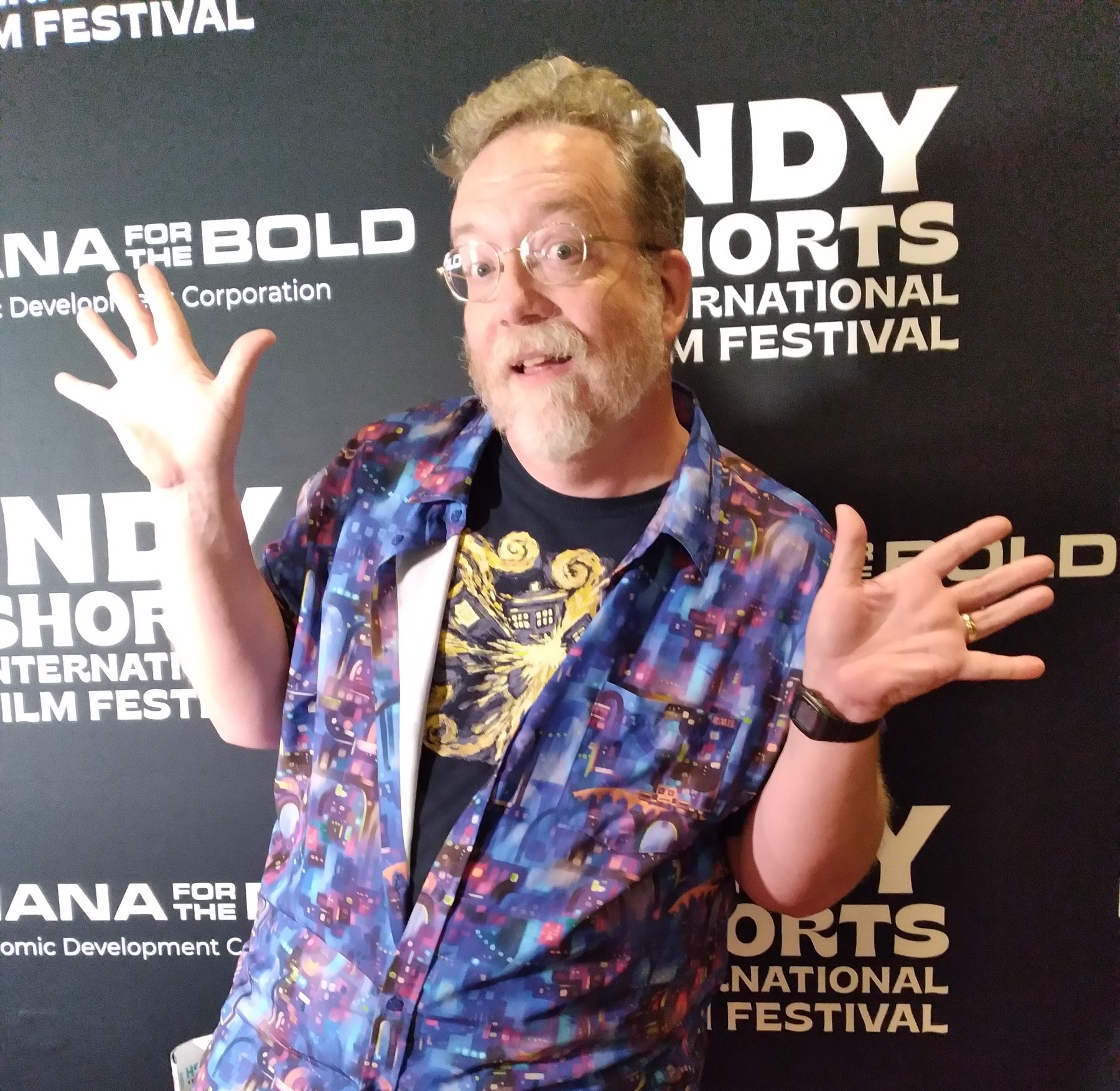
This viewer after the program, gallivanting on the Indy Shorts red carpet.
But wait! There was more! Unbeknownst to me, after the program we were privileged to a 20-minute Q&A with special guest Paul Kowalski, the mind behind Sardinia. I’m terrible at questioning people on the spot (hence why I’m no real journalist), but he and our host enjoyed a healthy chat plus at least one audience question. Born in the UK to Polish parents, Kowalski name-checked some of his influences (Polanski, Lanthimos, Kubrick) and reconfirmed the pandemic parallels that he tweaked. He disclosed the aforementioned Sorel Carradine is in fact his wife and Martha Plimpton’s half-sister. And he revealed a few projects he hopes to get off the ground, such as a miniseries about Chopin and a psych-horror piece set in a 1990s British boarding school (a la Saltburn, though I hope not that traumatizing).
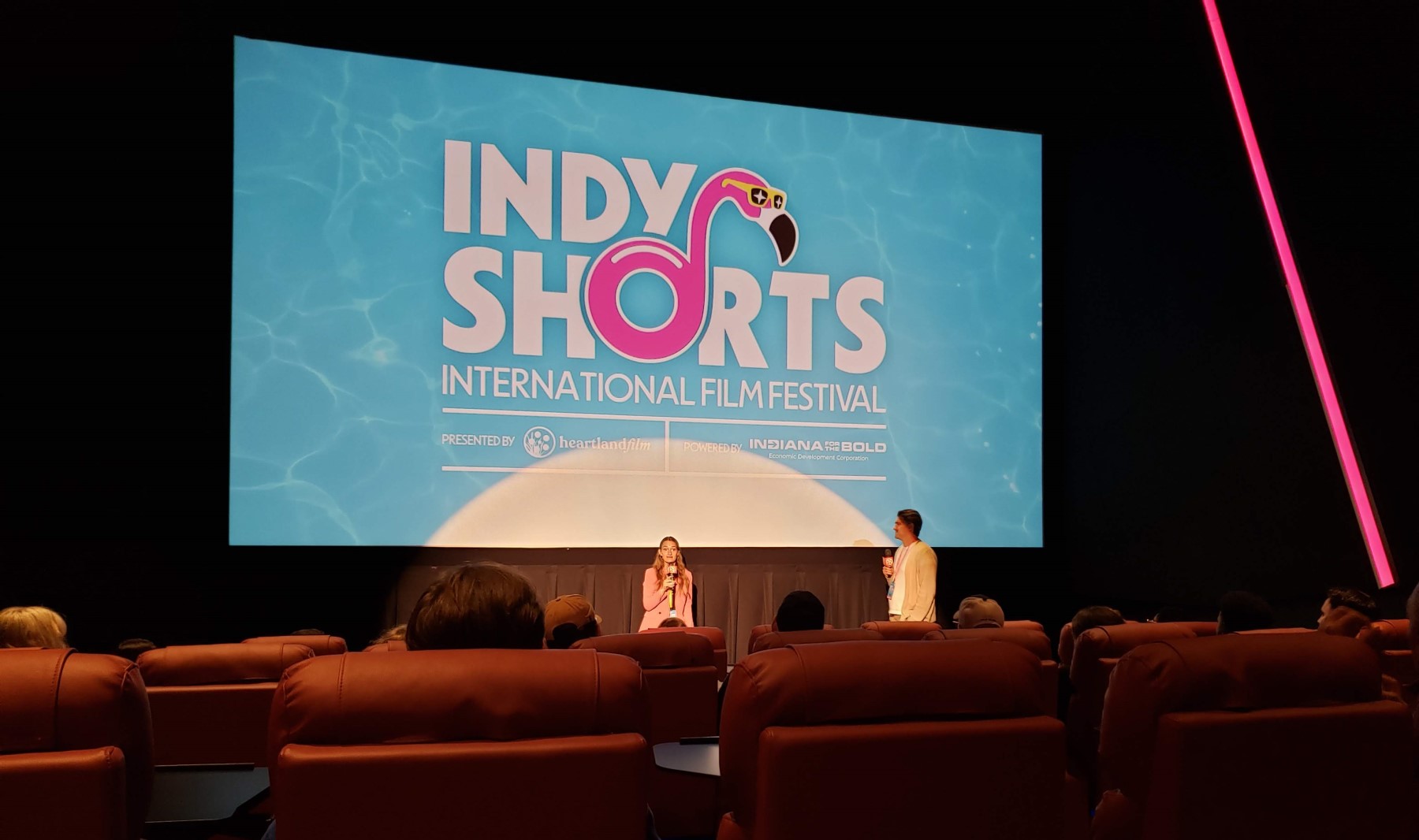
Our least worst shot of Kowalski and our host, with whom we chatted before the program. She’s a fellow Whovian!
One last guest rounded out the evening, a representative from the good folks at Starbase Indy. Longtime MCC readers may recall some of our past experiences at Indy’s long-running fan-owned Trek convention held every Thanksgiving weekend. She plugged this year’s event, apropos of the subject matter at hand.
With that, we concluded our too-brief Indy Shorts Film Festival experience. As we exited and made our way to the parking garage, we kept mum as we passed Kowalski on the street and saw him reunite with his agent or manager…whom I recognized as the same nice lady whose dinner had been delivered in the middle of Corn.
We appreciated the opportunity and will definitely consider attending the festival again next year, possibly above and beyond my comped-ticket allotment if time permits. I am not ordering dinner during the show, though.
Discover more from Midlife Crisis Crossover!
Subscribe to get the latest posts sent to your email.
 Midlife Crisis Crossover!