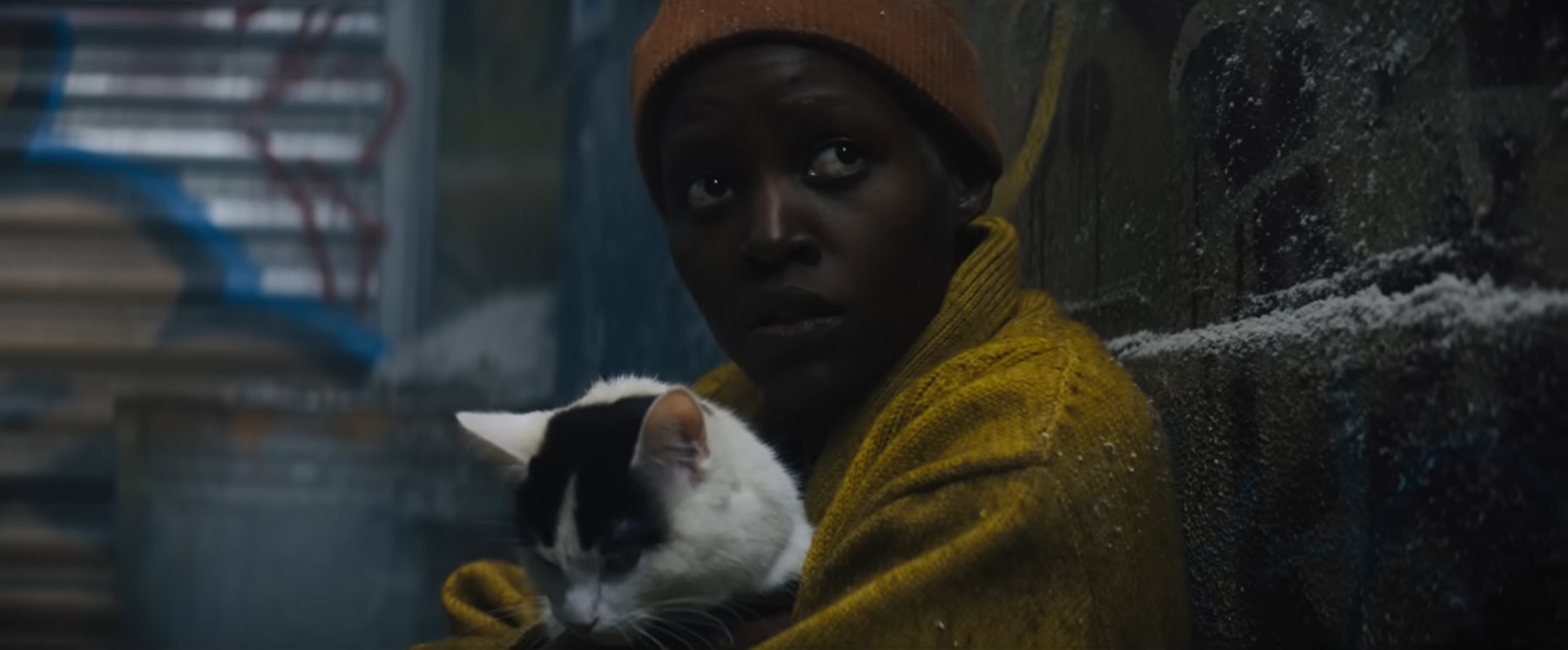
“I’m not coming out of this alley until you promise Nakia gets more scenes in the next Black Panther.”
Previously on A Quiet Place: Emily Blunt was a heroic mother surviving on a post-apocalyptic farm with her remaining kids and without her Concerned Husband until things once again went awry and they fled to a nearby island, the perfect hiding place from that unnamed alien army who jump-‘n’-slash at the slightest noises but whose fatal weaknesses happened to include bodies of water. Our Family’s happy ending was nice for about ten minutes until one of them learned how to boat. Nevertheless, the day was later saved and human life found a way.
Director John Krasinski kept A Quiet Place: Part II‘s premise simple: “What if the first flick just kept going and was actually three hours long?” The sequel was more an expansion pack than a standalone tale unto itself. It came packaged with a free mini-prequel on the front, needlessly depicting how Day One of the invasion quickly devastated their small town. It was a satisfying course of more-of-the-same, but not in any groundbreaking way that left me yearning for further adventures in the Hyper-Hearing Horror-Horde Cinematic Universe.
Nevertheless, here we go again with some more prequel, A Quiet Place: Day One. With Krasinski off doing other things (i.e., IF, which I skipped), apparently any new AQP extensions are forbidden from moving the main characters forward, much like the Star Wars universe’s treadmilling-in-place spinoffs. Within that common yet exasperating genre-series boundary, what were the odds of a substitute filmmaker steering away from more-of-the-sameness?
Enter writer/director Michael Sarnoski, whose feature-film debut was a remarkable indie called Pig in which Nicolas Cage embarks on a quest to rescue his closest companion, a truffle-hunting porcine prodigy kidnapped by an evil foodie’s hired goons. It was an ambitious, heartbreaking tale with more soul-searching than action, more foodie-facts than fistfights, and an uncharacteristically serene Cage far more contemplative than cuckoo. It defied so many expectations that I couldn’t help getting my hopes up for Sarnoski’s first big-budget project. I can definitely say more-of-the-sameness is not an issue, equivocally speaking.
In lieu of Blunt’s mostly kickass Widow Farmer Abbott, the much-missed Millicent Simmonds, Baby Liability Abbott, and asking 19-year-old Noah Jupe to play the world’s huskiest-voiced 13-year-old, Sarnoski turns our attention to New York City and a totally unrelated duo. Academy Award Winner Lupita Nyong’o (last seen in Black Panther: Wakanda Forever) is a poet named Sam bearing different baggage — no kids, no guns, just her wit and a wily cat to keep her company during her final days in a hospice somewhere beyond the boroughs. Her overseers pick the wrong day for a group field trip to Manhattan for off-Broadway stage merriment and, if she has her way, what might be her last slice of bona fide New York City pizza. Even before a familiar meteor storm slices through the skies, those of us who loved Nyong’o for such fascinating performances as 12 Years a Slave and Jordan Peele’s Us are rooting for her stubbornness in the face of waning mortality. We harbor a secret hope Sarnoski will be kind to her and this’ll just be a 90-minute cat-lady’s slam-poetry farewell address.
Alas, no, AQP:DO is still a big-budget alien-disaster flick, much flashier than the last one because the Big Apple has far more square acreage for showcasing widespread CG-bolstered drone footage of monster mayhem without the Abbott Farm’s upstate forest canopy occluding everything. In the film’s better moments, much of the chaotic thrills and wreckage happen out of sight, inflicted by offscreen claws from beyond. The aliens were more foreboding in the previous chapters when they existed purely as living anime speed-lines visible for mere split-seconds; here, more often than not they’re spindly yet hulking mini-kaiju, the nonverbal offspring of Spawn’s arch-nemesis Violator. They’re still intimidating, but in plain sight we lose the movie magic of them preying upon our imagination, where they could be much more horrific. One nail-biting scene in particular lets us peer deep inside their gargantuan tympanic membranes, which Sarnoski sustains for much-needed intensity until…well, until future AQP toymakers have gotten all the action-figure details they need and the moment utterly deflates. It’s much the same difference between Ridley Scott’s Alien and pretty much any of the unsubtle xenomorph tales that followed in every medium since.
As with Pig, though, Sarnoski is less interested in good-vs.-evil throwdowns than he is in crafting delicate moments of endearment between disparate lost souls. He could’ve settled for popping us a safely ordinary popcorn-film snack, especially now that enough time has passed since 9/11 so everyone’s apparently okay seeing NYC ravaged on big screens again. Rather, partway through the melee, as Sam wanders the shattered cityscape post-onslaught on what might be the last long walk of her life, a young stranger literally stumbles across her path. After his breakout performance in Stranger Things‘ fourth season as metalhead fugitive Eddie Munson, Joseph Quinn pops out of a most ignominious hidey-hole as a British law student named Eric. Trapped in the business suit he was wearing before civilization crumbled all around him, Eric is a fish-out-of-water far from home, whose few tenuous support systems have now been effectively disconnected, same as everyone else’s. His everyday anxiety has devolved into abject terror. Everything meaningful has been stripped away from him — or what he thought of as “meaningful” — amid all that noise, noise, NOISE, and he has no idea what to do. He’s at an utter loss to go it alone, much like Eddie Munson, but Eric has no Hellfire Club around to save him.
Then along comes Sam, less frightened and far more confident because she has few stakes left to fret. Sam’s already lost nearly everything dear thanks to the ravages of illness. While he freaks out about the immediate future, Sam is focused squarely on the past as she pursues her final personal quest: the perfect slice of NYC pizza that absolutely will be hers, or she’ll die trying. To Eric it’s perhaps a tad absurd, but for him it soon becomes everything.
Dangers mount as the no-longer-hidden mega-Muppets flagrantly patrol their newly conquered domain and Our Heroes tiptoe from Lower Manhattan to a very specific place up in Harlem that once meant the world to Sam. So, too, do bits of silliness mount. The film’s second half follows what promises to be an epic journey, but there isn’t nearly enough time left, so those miles pass in a few heartbeats — ludicrously faster in the final act when they have to pivot from Harlem and soft-shoe back to the South Street Seaport on the opposite end of the island. (Our family has set foot in one and come within a few blocks of the other. Without subways it is not a next-door jaunt.) As they roll on, the monsters’ running speeds have only two settings: faster-than-light and just-a-tad-slower-than-Our-Heroes. Those predators can hear a pin drop from six blocks away but can’t hear a hysterical human five feet away whose heart and lungs are about to explode in their chest. Sam’s cat (named Frodo in the credits but I never heard it spoken aloud) is sometimes a cute companion and sometimes a liability, yet curiously never freaks out, arches his back, or hisses or shrieks with all his fur standing on end like, say, a cat in actual danger. I’ve seen other viewers praising Frodo for that supernatural calm, when what we’re really seeing is a cat completely oblivious to any imaginary, computer-drawn bugaboos.
As with the last two Quiet Places, the sound designers do perform another round of heavy tension-ratcheting whenever anyone’s trapped in a totally still situation bewaring the inevitable, piercing clarion of a single misstep. But the original novelty, the whole point of deadly silence as the baseline, is too often overshadowed whenever those crescendos come and crank up the volume to 11 with set pieces more ostentatious than ever. Sarnoski is obviously keener on justifying Day One‘s separate existence through the charming chemistry negotiated between its opposite leads — not exactly as an old-fashioned will-they-or-won’t-they romance based on intense experiences, but as a graceful duet between two grade-A actors in their respective primes exploring grief and acceptance, surrender and purpose, nostalgia and survival.
The power of this quiet place isn’t as a prequel to Krasinski’s pop-SF thrillers, but as a thematic sequel to the better Sarnoski film. Call it Pig II: Frodo in the City.
…
Meanwhile in the customary MCC film breakdowns:
Hey, look, it’s that one actor!: Straught outta AQPII, Djimon Hounsou returns to reveal his secret origin as a family man at the same theater as Sam and her hospice-mates. His part of the runtime is minimal, but he offers a human-element cross-connection among the films that’s a tad more satisfying than the shared label on that other once-touted alien-invasion “series”, the Cloverfield films.
Among the new faces, Alex Wolff (Young Rock in the the nü-Jumanji series) is Sam’s primary nurse. Elijah Ungvary, one of Pig‘s junkie pork-nappers, has a couple lines amid the post-carnage exodus. Alfie Todd, a kid who finds refuge in a fountain, was briefly in an episode of Andor.
How about those end credits? No, there’s no scene after the A Quiet Place: Day One end credits, but all those internet articles praising the cat’s performance clearly didn’t stick around to learn li’l Frodo was played by two different cats. I leave it to those Frodo-fans to decide which one they liked more.
Discover more from Midlife Crisis Crossover!
Subscribe to get the latest posts sent to your email.
 Midlife Crisis Crossover!