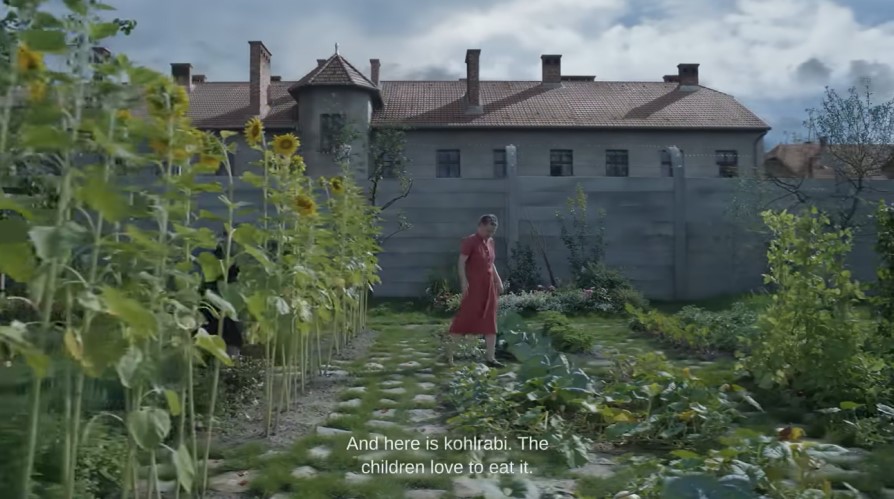
A tour through a spacious, beautiful backyard garden. Meanwhile out of sight, thousands are murdered.
Previously on Midlife Crisis Crossover: my Oscar Quest continues — that annual ritual where I catch as many newly Academy Award-nominated features and shorts as I can before the big, fancy, low-rated TV ceremony. In the case of The Zone of Interest, though, as soon as I learned of it from last autumn’s professional film-festival write-ups. I’d already decided I’d see it once it was available to us commoners, with or without the compulsory power of statuettes. Back in 2000 its writer/director Jonathan Glazer first made his mark with Sexy Beast, in which Sir Ben Kingsley terrified one and all as a gangster whose supernova force-of-will nearly pulverized every other actor in frame. If Glazer could coax the Gandhi Oscar-winner of all people to go there, I figured the sky would be the limit for him.
23 years later, Glazer examines a different kind of killer, one whose body count is no bloody trail of gangster-rage casualties. His new subject’s life’s work is the Holocaust. Christian Friedel (from Babylon Berlin, which is leaving Netflix at the end of February) plays Rudolf Höss, commandant of Auschwitz — a family man with a nice house and no outward symptoms of psychosis or flamboyant evil. Not only is he in charge of one of Nazi Germany’s most notorious mass-murder machines, he also lives right there by its grounds with his five kids and his wife Hedwig (Sandra Hüller, on a back-to-back winning streak in this and Anatomy of a Fall). Only a concrete courtyard wall separates their lawn from the unsightliness of workaday genocide, but their huge, pretty flower garden helps offset that foreboding gray slab. And one couldn’t ask for a quicker commute unless one actually bunked with one’s prisoners.
The Hösses spend quality time together on his days off. They’ve invested in home improvements. Their cowering servants maintain it all expertly and diligently while fearing for their lives. Sometimes they have Hedwig’s mom (Imogen Kogge) over to see her grandkids, maybe even comfort their latest baby who’s having trouble sleeping over the roaring and the blood-red glow of the new crematorium’s smokestack.
Like any other nuclear family, even though that wasn’t a phrase till well after Oppenheimer, the Hösses have their little victories and big challenges. SEE Rudolf complimented for his workplace efficiency. FEEL the conflict when he’s offered a promotion that might uproot the family to a new neighborhood. REMINISCE about outdoor barbecues with your visiting relatives and workplace buddies while the Hösses kick back, relax, and enjoy the fruits of Dad’s sins, which will never be forgiven or forgotten, but they sure put food on the table.
And so on. The banality-of-evil approach rebukes postwar Germany’s implausible deniability of its years-long slaughter campaign, posing for the tribunals as one big deaf commune with all the situational awareness of Sgt. Schultz. All this is roughly based on a novel by Martin Amis, which laid a fictionalized veneer over the original participants as if there were some bizarre fear that one of the guilty parties might’ve lived to sue. Contra every adapted biopic ever, Glazer rejected Amis’ roman à clef approach and changed most characters’ names back to those of their real-life counterparts, up to and including Rudolf and Hedwig, who really did live meters away from the scene of the crimes. The chosen sliver of his lifespan tiptoes near certain career milestones — say, that time his impressed superiors named an entire operation after him, or a board meeting with all the camp commandants to hammer out details of the Hungary subsection of the Final Solution, negotiated with all the urgency of a Dunder Mifflin inventory review. For the masters of death it’s just another day at the office.
Glazer refuses to settle for biopic mundanity, though. Its discordant opening overture could be a nightmare experiment out of Andy Warhol’s Factory — no credits, no imagery, no voices or words, just minutes’ worth of black borders around an even blacker screen, accompanied by an abyssal cacophony wrought by composer Mica Levi (who also defied comfort-norms in Glazer’s Under the Skin). Untold minutes later we creep through that airlock tentatively into the heart of darkness with nowhere to go except all the way through the obsidian looking-glass. Long stretches of Nazi housekeeping pass with minimal staging artifice, no closeups, no fight scenes, no Allied forces, nary a single footstep into the abattoir next door, nearly all bloodshed tucked cleanly away. The avant-garish score retreats to the shadowy corners, making way for a diegetic sound design that’s intermittently quaint in its naturalist moments, only to be disrupted — a lot — by what lies just around the corner. The Hösses hardly blink at the stray effects we recognize — bellowed orders, rat-a-tats, snarling dogs, incineration, arriving trains whose cargo we can guess. They’re used to it by now. We’re not. And we’d prefer never to be.
The Zone of Interest isn’t the sort of satire that evokes smiles or knowing nods, or prides itself on cleverness. The tenth and final Best Picture nominee alphabetically and in my watching order is the creepiest in the lineup, a penetrating work of bleak horror-poetry that haunted me the whole drive home. Glazer didn’t invite us here to jeer at Höss from an imagined pedestal of safety and innocence. He implies and indicts our own willingness to lead everyday lives in feigned ignorance of all the tragedies and travesties that overrun and threaten to define this broken world, much to the sorrow of anyone watching from the plane of existence above ours.
If you have a strong rapport with your local projectionist, beg them to crank the speakers, because mediocre output would utterly negate the film. If it never plays at a nearby theater and you have to wait for home video, this is a rare case where I’d recommend headphones over speakers. Then, as the trauma sears your conscience, curse your own ghoulishness for wanting to hear it all.
…
Meanwhile in the customary MCC film breakdowns:
Hey, look, it’s that one actor!: The only other cast member with credits viewed Stateside is Ralph Herforth (Speed Racer, Aeon Flux), who plays key concentration-camp bureaucrat Oswald Pohl up at the home office. His eventual execution came four years after Höss’ own.
How about those end credits? No, there’s no scene after The Zone of Interest end credits, only a parting barrage from Levi in the form of a discomfiting march, one last parade of orderly torment.
Discover more from Midlife Crisis Crossover!
Subscribe to get the latest posts sent to your email.
 Midlife Crisis Crossover!