Remember what happens when you walk past purple in a field and don’t notice it.
Previously on Midlife Crisis Crossover: Oscar Quest 2024 continues! I’m still seeing how many of this year’s Academy Award nominees I can watch before the big night on March 11th. Used to be, I’d only hold myself accountable for the Best Picture nominees, but this is my fourth year trying to track down all works from all categories, even those with a single nomination to their credit. If I left the house to catch them in an actual theater, they get their own entry. That’s the MCC rule, no matter how much I might end up rambling.
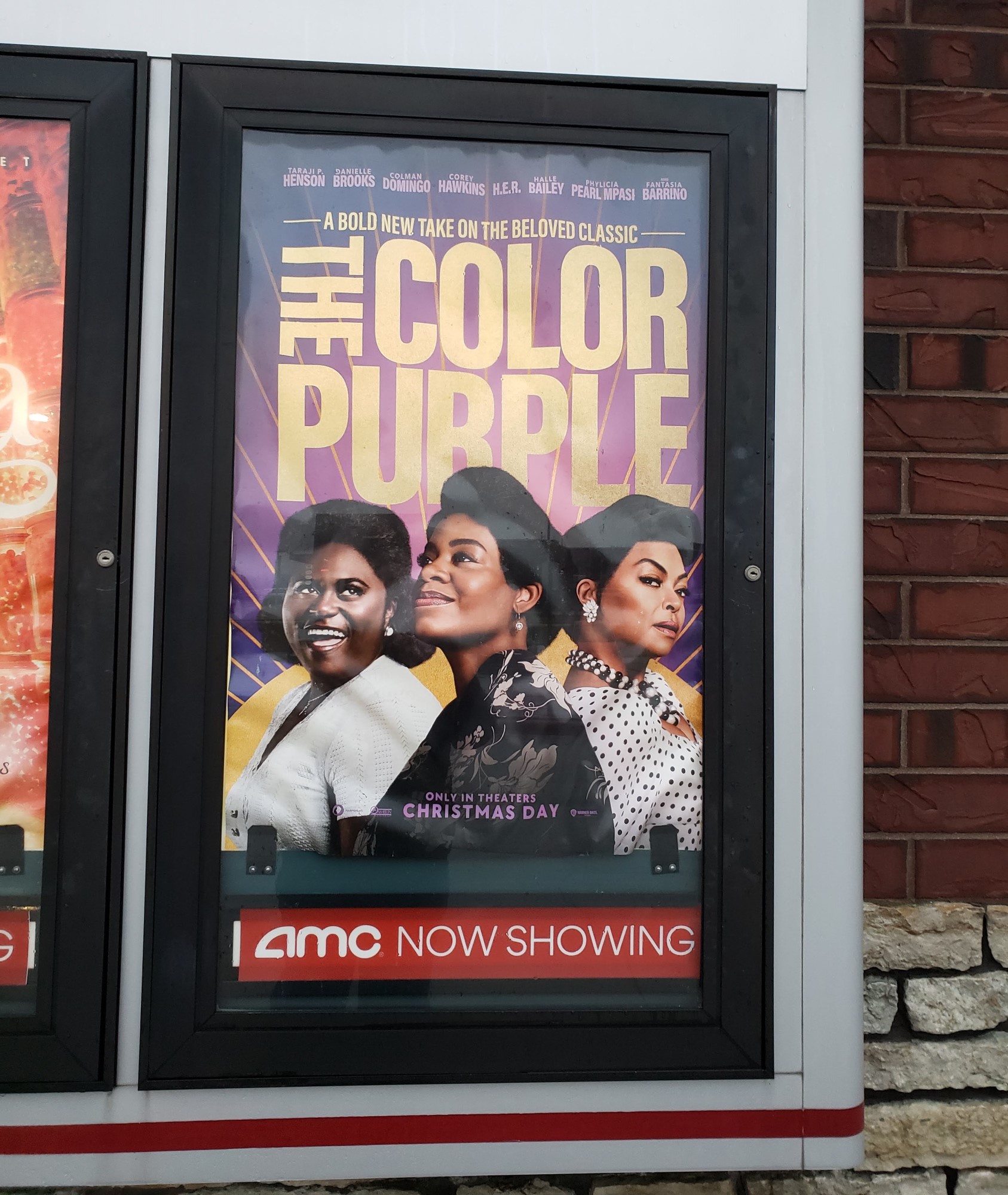
That brings us to The Color Purple, the movie based on the musical based on the novel, not a movie based on the musical based on the movie based on the novel, because that would just be silly. The 1985 adaptation of Alice Walker’s novel, directed by Steven Spielberg and written for the screen by a white Dutchman (one of three guys credited for Indiana Jones and the Last Crusade), was nominated for 11 Oscars but left the ceremony statueless. The latest version, from first-time feature-length director Blitz Bazawule (one of the co-directors of Beyoncé’s Black Is King) and screenwriter Marcus Gardley (The Chi, Foundation), has only a single nomination, tying with several other wannabe-luminaries such as the fifteen short films and Flamin’ Hot. But it’s still in the running.
I didn’t watch Spielberg’s version till a few years ago, because his early attempts at non-genre drama fell during my teenage years and therefore off my young geek radar. Viewed three decades after the fact, his adaptation was…fine, I guess? At the time I faintly recall hearing its earnestness seemed quaint even for the ’80s. Driving Miss Daisy didn’t yet exist to lower the bar, but it lines up with other works I’ve seen from the era in recent times like, say, Places in the Heart, though it doesn’t hold a candle to others (say, A Soldier’s Story). If nothing else I appreciated learning firsthand why folks were so excited about the big-screen debut of the up-‘n’-comer Oprah Winfrey, whose career trajectory arced much higher into the exosphere than virtually any other Best Supporting Actress or Actor nominee ever. It would’ve been twice the crowd-pleaser if it’d just been two solid hours of her Sofie putting abusive men and racists in their places, but that isn’t how Walker went about it, lest someone need to invent the term “Mary Sue” for her 10-15 years early. Instead Sofie’s is but one among the several examples that poor Celie slowly learns from during her lifelong evolution from victim to independent woman.
Beyond a certain point I’m not sure how much detail I need to delve into here, especially after American Fiction pointed out the guardrails on, shall we say, white effusiveness over such matters. If I may anyway: from this humble internet hermit’s amateur perspective, taking the story down a Broadway-lighted path was a brilliant idea…well, setting aside a sizeable stretch in the middle where everyone’s too miserable to sing. The stage-to-screen recreation drops us right next to the performers who bring bigger-than-life emotional swells, grand gestures, unstoppable rhythm sections, compelling presences, and big finishes amid some southern Black gospel revival (which doesn’t go on for hours but I’m sure could’ve long after the cameras paused) and of course a declarative ballad near the end for our heroine Celie (American Idol winner Fantasia Barrino) to soar upon to the heavens. I’m sure out there somewhere is a viewer who prefers Spielberg’s vision to Bazawule’s; if so, I don’t get them.
Of course, all that’s in between the early-twentieth-century survival-horror, the panoply of tales from the non-monolithic tapestry that is The Black Experience, and the novel’s exploration of sexual identity, a fleeting fragment in Spielberg’s version that’s upgraded here from a single kiss to “this one time in college” yet with a higher text-to-subtext ratio than the original producers perceived socioeconomically feasible in the ’85 mainstream. 38 years on (ow ow ow), this version airs in much different times (he understated) and has the added advantage of a filmmaker at the helm who might have a better sense of how far things can be pushed — with the story, the actors, the domestic violence that’d be too quickly written off as “poverty porn” by inured satirists. All told, this Purple feels…less tense, less hesitant, and less worried about blowback, even when no one’s at the mic.
No two Purples appear to use all of Walker’s components. The various alt-timeline versions — novel, Movie 1, Musical, Movie 2 — keep most events, differ on some, reinterpret here, skip there — but one bell’s rung the same in every corner across the Celie-verse: Sofie is the best. Not to take away from Fantasia’s Celie at all if I can help it, but Danielle Brooks (Orange Is the New Black, Peacemaker) brings a unstoppable-force gusto to Sofie, the same role that nabbed Oprah her Oscar-nom. Lightning’s struck twice, as she’s this rendition’s only nod. Though Sofie’s years of tribulation are utterly heart-rending even if you know they’re coming, Celie and the audience need a bold fervor like hers to get us through this world with families torn asunder, home-wrecking abusers, the perpetuation of vicious cycles, the racism that’s foundational to so much of the above, and, on a different plane of reckoning, the tragic disconnections between relatives who escape their surroundings and those they leave behind.
My only petty quibble is with the final fifteen minutes or so, when Purple veers away from the looming cliffs of period-piece Importance toward a relentless happy-ending festival where God smiles upon those who’ve been noticing all those pretty colors He festooned around the fields and rewards them with all their hearts’ desires, passing out round-trip plane tickets to every last prodigal child and booming “YOU get a reunion! And YOU get a reunion! And YOU get a reunion!” Nothing short of divine intervention or an earthly author’s approximation could organize a nexus that uplifting in the face of all the preceding chaos. Then again, that can be His way when we least expect it. One could argue it’s also the Broadway way.
…
Meanwhile in the customary MCC film breakdowns:
Hey, look, it’s that one actor!: I’d be remiss in failing to mention Celie’s sister Nettie, whose absence across the decades haunts her more than any other crime committed against her. In their youth, Young Nettie is Halle Bailey from The Little Mermaid; much later on, Ciara cameos as Final Form Nettie. Taraji P. Henson (Person of Interest, Empire) rocks the plum role of Shug Avery, the legendary chanteuse whose homecoming inspires everyone and shows how her escape didn’t solve all her problems. Fear the Walking Dead‘s Colman Domingo (nominated separately for Rustin) takes over for Danny Glover as the ogreish Mister, whose sins ultimately render him justly pathetic. Corey Hawkins (In the Heights, Walking Dead) is his son Harpo, following a tad too closely in Dad’s misguiding footsteps.
While Sofia and Harpo are on the outs, he makes time for a new flame he keeps calling Squeak, played by Academy Award Winner H.E.R. (for Best Original Song from Judas and the Black Messiah). For too-brief moments, Aunjanue Ellis-Taylor (last nominated for King Richard, now in theaters starring in Origin) is but the warm memory of Celie and Nettie’s mama.
Among the least detestable men is In Living Color‘s David Alan Grier (fresh off his appearance as Santa Claus opposite Eddie Murphy in Candy Cane Lane) as the town’s right reverend, preaching that gospel but letting his heart turn hard toward his daughter Shug because of (*gasp*) The Devil’s Music. For a time she consoles herself with a husband (and beard?) named Grady, played by Academy Award Winner Jon Batiste (for Best Original Score for Pixar’s Soul, now also nominated for Best Original Song from his own documentary American Symphony). Far worse men include Deon Cole (Black-ish, The Harder They Fall) as Alfonso, who watches out for Young Celie and Nettie after their mother’s death, but I wouldn’t call what he does “fathering”; and Academy Award Winner Louis Gossett Jr. (An Officer and a Gentleman) as Mister’s dad, Ol’ Mister, who confirms what runs in the family and/or gender.
The white people all suck, but loudest among them is the mayor’s lily-whitest wife, played by Elizabeth Marvel (House of Cards, Netflix’s Unbelievable).
And! There’s a special cameo by OG Celie herself, Academy Award Winner Whoopi Goldberg (don’t forget Ghost!), as a midwife for young Celie, helping birth this entire Kelvin-timeline divergence from the previous Purples.
How about those end credits? No, there’s no scene after The Color Purple end credits, but as one would expect in a Broadway adaptation, the music-credits section goes on and on. It doesn’t distinguish between the tracks from the original production and the new tunes added For Your Oscar Consideration. Whichever ones they were, they sadly didn’t make the category’s final cut.
Discover more from Midlife Crisis Crossover!
Subscribe to get the latest posts sent to your email.
 Midlife Crisis Crossover!