What if Little House on the Prairie but Charles Ingalls is a retired badass?
Previously on Midlife Crisis Crossover:
Since 1992 Indianapolis has held its own celebration of cinema with the Heartland International Film Festival, a multi-day, multi-theater marathon every October of documentaries, shorts, narrative features, and animated works made across multiple continents from myriad points of the human experience, usually with an emphasis on uplift and positivity. Ever since the “International” modifier was added in recent years, their acquisition team steadily escalated their game as they’ve recruited higher-profile projects into their lineups. For years my wife Anne and I have talked about getting into the spirit of the festivities. This year we will do better. The festival’s 32nd edition will run October 5-15. I’ve committed to at least five different Heartland showings — one of them virtual in-home, while the others will screen at four different theaters throughout central Indiana…
During his downtime between playing villains in four out of every five Hollywood films, Mads Mikkelsen enjoys the occasional smaller production back home in Denmark. Last time we saw him at this level was for the Oscar-winning Another Round, in which he played a gregarious family man who turns frivolously alcoholic with his buddies For Science, only to have things spiral out of control. He starts in a completely opposite corner yet descends into chaos once more in his latest film, a historical farming drama called The Promised Land that one could argue is a Western with smaller hats.
(Minor housekeeping trivia: The Promised Land is no relation to Promised Land, the 2012 Gus Van Sant film that starred Matt Damon and John Krasinski, which I totally forgot existed. It’s blander than the original Danish title, Bastarden. I get why the renaming, but they could’ve kept brainstorming.)
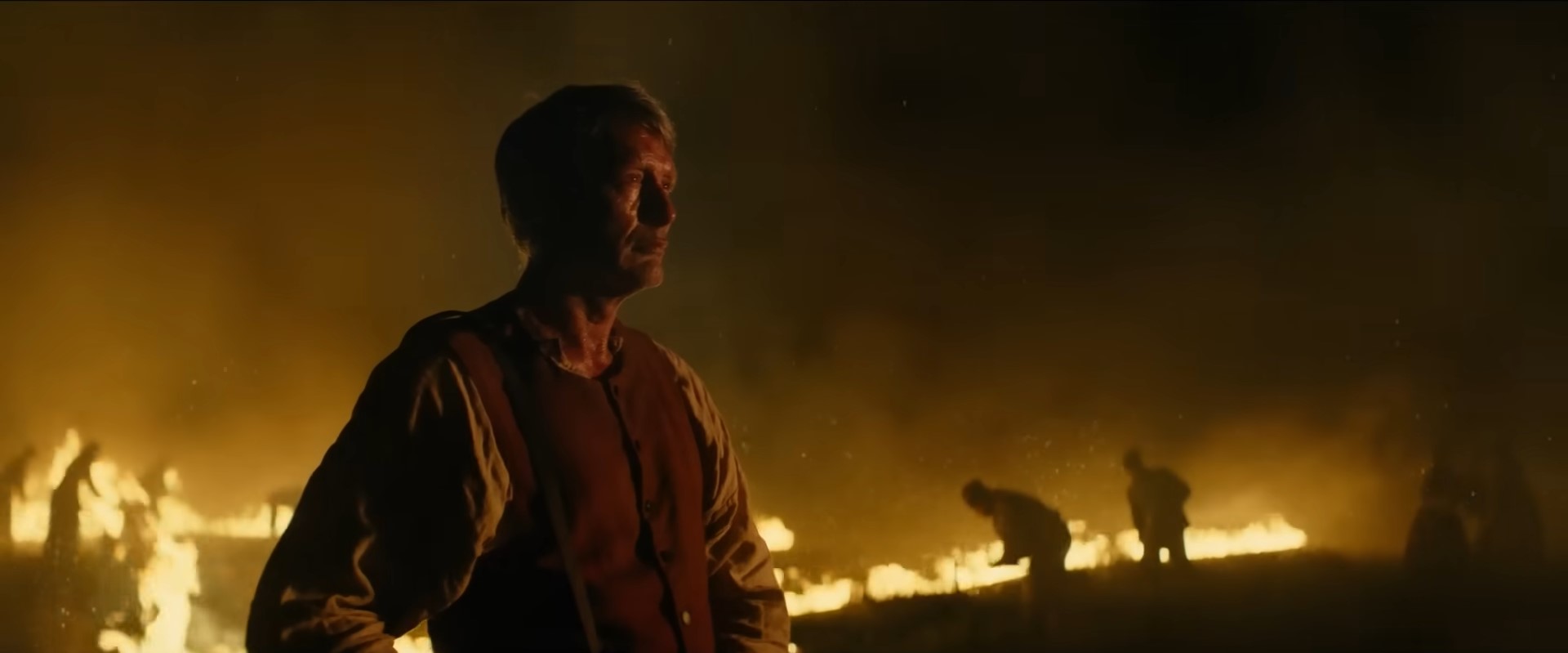
The mid-18th-century King of Denmark (whose name and face are oddly hidden from us) proclaims his version of “Go west, young man!” and promises riches and titles to anyone who can establish an arable plot in the Jutland heath, the country’s desolate northern third, a wasteland of infertile brambles. Mikkelsen is Ludvig Kahlen, a 25-year military man who worked his way up from poverty to captaincy, only to retire back into poverty. The king’s offer may be his best hope of climbing the ladder the rest of the way to fortune and privilege if he can turn barren dirt into gold and coax his top-secret crops into taking root. Ludvig’s plan is “If you build it, they will come”, but the “they” he imagines don’t quite match the real “they” who do come. He can’t do it alone, but his career didn’t exactly nurture him into a people person. His allegiance to King Anonymous seems righteous, but he can be a taskmaster as harsh as the heath itself. (When he fires one worker for sloppiness, his pink slip is a punch in the face.)
Helpers come and go — married fugitive serfs, a mouthy kid who suffers the most abuse by dint of her skin color (the adults’ subtitles call her a “darkling”), assorted clans of “Taters” (read: Romani) and Germans (before Germany became a full-fledged country), and so on. Every team he tries to assemble is thwarted by the machinations of comic-relief rapist/lunatic nobleman de Schinkel, who proudly added his own “de” and flaunts it like a tinfoil crown. His family technically owned some of that heath until the king’s decree voided their claim since it’s lain fallow, but he refuses to let it go because it’s mine-all-mine. Resembling a lantern-jawed clone of Matt Smith’s manic Morbius foe, de Schinkel is a spoiled child ignoring his discarded toy till Dad tries to give it to Goodwill, and then suddenly it means the world to him.
Thus the veteran who seeks better living through agrochemistry may find himself at war once again. Much as it could’ve surprised the audience to break with the Mikkelsen tradition and let Ludvig persevere in this “historical farming drama” through clean living and virtuous willpower alone, he isn’t that character, nor is the director that sort of kindly hand-holder. Moviegoers may or may not remember Nikolaj Arcel for his Oscar-nominated 2012 work A Royal Affair, which earned him much acclaim; more likely they kindasorta remember his 2017 take on Stephen King’s The Dark Tower with Idris Elba and Matthew McConaughey. Arcel now counts among the many overseas filmmakers who struck cinematic gold in their homelands, got invited to jack in to the Hollywood money machine, only to retreat to a safe distance after the experience burned them. That said, not unlike The Dark Tower, The Promised Land‘s bleakness rarely lets up, turning downright brutal in the second half as de Schinkel escalates his campaign and refuses to be thwarted by a…by a mere poor.
In the isolated moments when fate does favor Ludvig, Mikkelsen’s stoic facade strains to the limit whenever he’s forced to show the slightest positive emotion toward other people. When it’s time to unleash Hell, those violent reflexes kick in and Mikkelsen is at his Mikkelsen-iest, but he rises to the challenge of conveying Ludvig’s tentative lessons in human connection. Among his subordinates, most intriguing is Amanda Collin (Max’s Raised by Wolves) as his unpaid housekeeper Ann Barbara, who has seen some stuff in her own journey through class-war oppression, and slashes an indelible image through the reels by the end.
Arcel allows them a muted sentimentality amid the unforgiving landscape, but almost lets the reins go too slack in the codas, as the sometimes on-the-nose metaphors reach their tipping points. (Can compassion blossom in Ludvig’s cold heart in the same way he hopes those top-secret crops will blossom in his fields? Was the real harvest the friends he made along the way?) The Promised Land doesn’t always perfect its balancing act between the extremes of spartan idyll and revenge thriller, but Mikkelsen’s serenely controlled inner fury is always worth checking out. Also, I know 100% more about 18th-century Danish history now than I did going into this. That still isn’t a lot, but it’s a welcome sprout in the desolation that is my shameful ignorance of world history.
…
Meanwhile in the customary MCC film breakdowns:
Hey, look, it’s that one actor!: The only other actor I’ve consciously seen before is Gustav Lindh (last seen getting trounced by Alexander Skarsgård in The Northman), here playing a young local pastor who sides with Ludvig but keeps popping in and out of the film for lack of consistent onscreen odd jobs.
How about those end credits? No, there’s no scene after The Promised Land end credits, but anyone who yearns for simpler films thriving in the shadow of today’s blockbusters may or may not be encouraged by how the crew members in the separate Special Effects and Visual Effects sections total less than 100, if that helps. American audiences are also notified of the title change when the BASTARDEN logo steamrolls through, stretching nearly ceiling-to-floor.
…
Other chapters in this very special miniseries:
Discover more from Midlife Crisis Crossover!
Subscribe to get the latest posts sent to your email.
 Midlife Crisis Crossover!