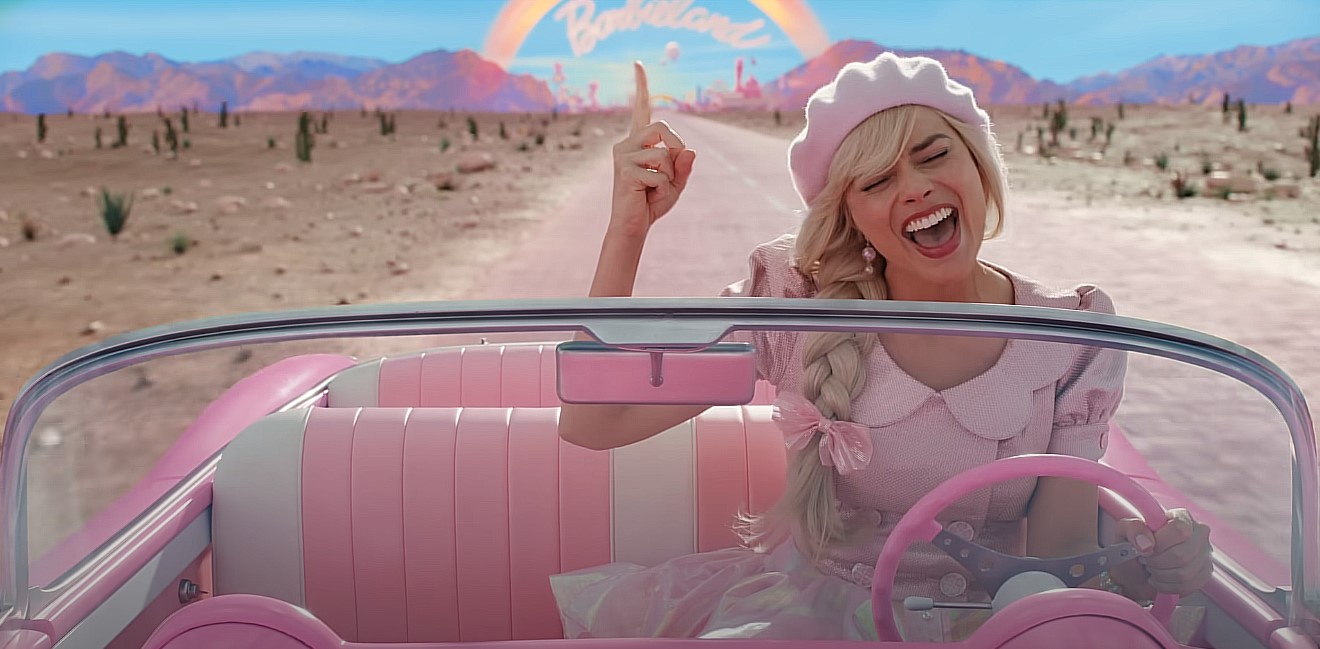
It’s Stereotypical Barbie With New Hat! On sale now!
One of the cool benefits of having your “man card” revoked (a hoary internet phrase that hasn’t amused in years) is you’re under no macho mandate to throw a grizzly-postured tantrum whenever someone in the world dares tell a gynocentric story in which males just might have a lesson to learn about not making manhood their religion and sole personality trait. Mine was plucked away decades ago without a fight and without regrets, which might explain my uncanny superpower to make any dudes-only group disband merely by joining them. I’ll concede masculinity has some uses, such as in my household roles of Chief Spider Hunter and Crabgrass Appeasement Negotiator, but what few signs of ostensible manliness I ever bother to exhibit aren’t really a source of chest-thumping pride, nor are they a weak spot with fontanelle sensitivity whenever they’re justly and sharply skewered.
From over here in the wallflower seats in the corner, the Barbie movie was 98% brilliant. I’d enjoyed director/co-writer Greta Gerwig’s last two films, Little Women and Lady Bird, as well as the insightful Frances Ha, which she starred in and co-wrote with her partner/director Noah Baumbach, who in turn co-wrote Barbie. I hoped they’d be up to the challenge of crafting a big-budget battle-of-the-sexes satire that also had to double as a feature-length ad for a major corporation’s massive merch-line, after Jon M. Chu failed to achieve this dream of mine with Hasbro’s G.I. Joe: Retaliation.
The film’s structure is simple: a line of popular toys that have entertained kids and adult collectors for generations actually exists in its own weird little community in a magical pocket dimension or whatever, where our anthropomorphic playthings are sentient and living in eternal happiness inside dwellings that we can buy in our reality from big-box stores and from the few surviving toy stores not already plundered into oblivion by swaggering vulture capitalists. Technically the toys have free will, but their lives are affected by emotional traumas suffered by their “owners” in our world. When events here bleed into theirs, the toys have to band together, collect some clues and wits, save their reality by changing ours, and stop Will Ferrell from ruining everything by convincing him he’s overstepped his authority in regard to toys that no longer even belong to him. And thus do the products live happily ever after.
Yes, The Lego Movie was awesome. You can also see the DNA of the three even more awesome, unFerrelled Toy Story films, which used much of that recipe first. Nevertheless Barbie persists, driving up its Lego streets, building new roads where the Lego city plates didn’t quite reach. Among other major differences, Lego’s track record for causing sociopolitical disturbances and intergenerational debates about gender roles is minuscule compared to Barbie’s. At worst, Lego’s occasional frilly pink-and-purple playsets may have given a few paranoid boys psychosomatic cooties.
Barbie, by contrast, has carried custom baggage for decades, the contents of which change with each new feminism wave. She’s withstood criticisms time and again, sometimes through redefinition by succeeding marketing departments, including whoever’s staffed there today, probably via work-from-home. An unfazed Mattel keeps on selling Barbies and her friends by the metric ton as long as kids and parents keep lining up for them.
Hence her seemingly ensured immortality, which we witness as Gerwig transports us to live-action magical Barbieland. Though it’s ostensibly one nation under President Barbie (Issa Rae), the center of attention is Margot Robbie’s Stereotypical Barbie, which sounds insulting but which she proudly claims as her identity because she doesn’t do value judgments. To their credit, none of her friends snicker when they say it, so it’s not a community-wide practical joke at her expense.
And she has so many friends! Half of them are also Barbie; the other half are Ken. No two Kens are alike, yet none bear modifiers. Like many Barbies, the Kens exist to stand around and have fun all day. The Kenniest Ken of all the Kens is of course Ken, played by Ryan Gosling, As he boasts more than once, “My job is beach.” That’s his life, day in, day out — standing on the Barbieland beach and waiting for his turn to coexist with Barbie through the fun times and the, uh, the other fun times. His Mattel gods gave him a gift; he beaches well.
One day Stereotypical Barbie wakes up and everything about her has gone wrong. All of that’s in the trailer. Is a malevolent force from beyond threatening to tear apart the very fabric of her existence and end all life as she knows it in her bright plastic corner of the multiverse? Thankfully, no, this isn’t that kind of film-made-to-sell-toys. Her breakdown is a side effect of something amiss in the Real World, which here and only here is defined as “Los Angeles”.
Our Heroine first consults with the wise hermit Weird Barbie, who has seen some stuff and then some. Whenever I’d go visit my great-aunt Dodie as a kid, the only toys she had around for me to play with were my now-adult cousins’ left-behind Barbies. At least one was marked up, dressed like an undiscerning Goodwill shopper, and suffered broken hip joints. Kate McKinnon executes this childhood memory of mine disturbingly impeccably. If I were to start collecting, as a kid or today, Weird Barbie would be my choice of first Barbie.
Weird Barbie sends Stereotypical Barbie on a quest to L.A. to seek the cure for her thanatoptic musings, her foot mutilation, and her malfunctioning accessories. Our Heroine doesn’t invite Ken, but of course Ken invites Ken, because without her in Barbieland to validate him, why even bother beaching?
A series of Barbie-branded transports carry them through the X number of psychedelic lands/Earths/dimensions/wallpapers separating Barbieland from L.A., which is mostly east. Fish-out-of-water culture-clash hi-jinks ensue. If you’ve seen and loved The Brady Bunch Movie (or even the underrated A Very Brady Sequel), you get the gist. In one corner: shiny-happy innocents defined by the kind of irony-immune naivete that hermetically sealed living spaces tend to produce. In the other corner: “normal” people turned spiteful and sinful to endure our broken “real world”, which the filmmakers totally subvert in one of the Moral of the Stories — life doesn’t have to be like that, if only we’d all stop acting like edgy, hollow sitcom characters.
Barbie‘s satire shrewdly escalates beyond the Brady family’s amiable self-spoofs did as she meets the corporate overlords she didn’t knew she had. Every last board member is a necktied dude who imagines himself a feminist and probably begins every gender-related mild-outrage-of-the-day Facebook post with “As the father of a daughter…” or “As the son of a mother…” as if merely branching from a family tree is an accomplishment that makes them Not Like All the Other Guys. (Chairman Ferrell strongly believes sparkles symbolize female agency!) Meanwhile, Ken runs around the sunny streets unchecked learning men rule the real world. It looks so easy and feels so empowering, he plans to carry this lesson back home, deny his destiny as Barbie’s eternal plus-one, band together with the other Kens and become The Protagonist of Barbieland. This kind of horseplay (literally so, later on) is why most boy-toys should be kept in a locked box.
Barbie is besieged on all sides, including her very inside, which is more than compliantly molded plastic. As her everyday relentless smiles — i.e., how she was “born” — recede into confusion and angst and tears, Robbie seesaws deftly daffy comedy and serious examination of What It Is Like Being a Woman in a Man’s World, somewhat akin to her Harley Quinn films that she has to keep sharing with others, but from another, differently skewed angle. Her initial goal to reset the Everything-Is-Awesome status quo makes way for the search to figure out who she is, in and of herself, with or without an owner, with or without relationships. Is all this an empathic extension of this specific Barbie’s original owner, or has she discovered self-determinism?
Even when it’s heady, it’s hilarious…well, for grown-ups. Beyond a certain point, younger viewers may be completely lost, especially as they hear the word “existential” used more times here than throughout the entire history of kiddie flicks. If they’re patient, hopefully they’ll be drawn back in when everything culminates in a battle-of-the-sexes between the Barbies and the Kens, who’ve been deluded into making themselves worthy of Our Heroines by becoming their villains. Pretty sure I’ve known a lot of guys like that. Leading the charge of the muscle-headed patriarchy is of course Gosling, who, in a welcome return-to-form, has five times as much dialogue here as he did in his last three films combined. (Add ’em up, in chronological and descending-quality order: Blade Runner 2049, First Man, The Gray Man.) He and his dudes find some nuances as they tire of being relegated to the roles of villain, sidekick, or neighbor in Barbie’s world. Gentle reminder, though: the entire original point of Barbie is that women got exhausted with the male-led confines of role relegation first.
Amid the fancy outfits, pristine mint buildings and furniture, and ubiquitous pinkness, things sort of land where you’d expect, and yet they don’t, because the point isn’t “Women rule, men drool,” despite what some one-dimensional pundits have taken away from it. My only major reservation: once Ken assumes the Antagonist mantle, Ferrell and the Mattel board slink into the background and don’t really receive any comeuppance for their sins (such as, say, the part where they try solving everything by stuffing Barbie in a box) or learn much of a lesson, except maybe “Actually listen to a woman, possibly more than one.” Anyone hoping Ferrell and his all-male minions reap a DEI-driven downsizing from their billion-dollar sowing will be left wanting. As with countless other companies who’ve licensed their own versions of Our Product: The Motion Picture, Mattel draws a firm line between self-deprecation and self-overthrow.
Maybe Gerwig and her Ken would wield even sharper knives had they returned to the microbudget-indie route and financed their own thoroughly anti-IP screen-screed called Schmarbie. Instead they’ve compromised…but, y’know, with billion-dollar results. At least this way, some lessons got seen and maybe even heard.
…
Meanwhile in the customary MCC film breakdowns:
Hey, look, it’s that one actor!: Barbies I’ve previously seen around include singer Dua Lipa, Alexandra Shipp (X-Men: Apocalypse, Tick, Tick..BOOM!), and Lucy Boynton (Bohemian Rhapsody, The Pale Blue Eye). Over on Team Ken, say hi to Simu Liu (Shang Chi himself), Kingsley Ben-Adir (wasted in Secret Invasion, far better in One Night in Miami…), Ncuti Gatwa (future star of Doctor Who), and the John Cena.
Shockingly, Barbieland isn’t all about Barbies and Kens. Other dolls from Mattel history are represented for hardcore Barbie fans. Emerald Fennell (writer/director of Promising Young Woman and a short-timer on The Crown) plays Midge, an old “best friend” of Barbie who once came in a pregnant variant. But my favorite non-Barbie is Allan — perfectly, pathetically embodied by Michael Cera as Barbieland’s least wanted. If I lived in Barbieland, I’d be lucky to aspire to be an Allan.
Meanwhile in the Real World, most important is America Ferrara (Superstore, Ugly Betty) as a Mattel product designer and Barbie owner. Her jaded Barbie-hating daughter is Ariana Greenblatt (Love and Monsters, Avengers: Infinity War). Presiding over all is Dame Helen Mirren as our lovably candid narrator.
How about those end credits? No, there’s no scene after the Barbie end credits, though if you at least stick around for two minutes, you can enjoy a montage of some of the real-world Barbie rejects and has-beens used as punchlines throughout the film. I was hoping for a last-minute end-credis inclusion of Shonen Knife’s “Twist Barbie”, but I guess they had to save something for the sequel soundtrack.
At the very, very end of the credits is one last image: the Barbie™ logo, big and bright like the toy aisle decor at a big-box store near you!
Discover more from Midlife Crisis Crossover!
Subscribe to get the latest posts sent to your email.
 Midlife Crisis Crossover!