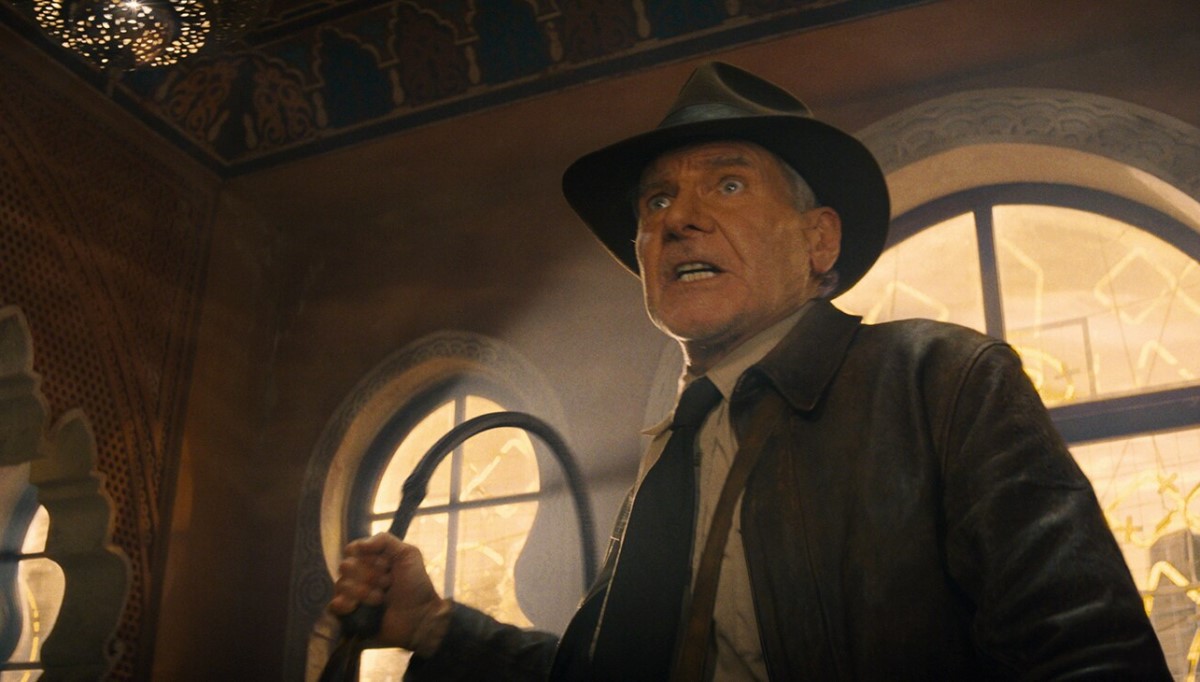
Funny how Disney’s official movie site gallery has more pics of Imaginary Plastic Surgery Indy than of Keepin’-It-Real AARP Indy.
Like most of Generation X, I grew up with Indiana Jones as a surrogate uncle. I saw Raiders of the Lost Ark at the drive-in when I was 9, possibly the perfect venue for a thrill-ride throwback to the Saturday-matinee serial era that outraced every action flick ever made up to 1981 and for decades after. I’d just turned 12 when I was awed by the breakneck speed-runs of Temple of Doom at an indoor theater (the perfect age to fall for it), though my grandma walked out at the heartectomy scene and waited in the lobby for the rest of the runtime. I was 19 when our family skipped Last Crusade in theaters, but I bought it years later when one of McDonald’s bizarre ’90s merch experiments had them selling the entire trilogy on VHS alongside their Extra Value Meals. I finally got to watch Our Hero reunite with his dad as I reunited with Fun Uncle Indy.
As for Kingdom of the Crystal Skull: now in our late 30s, Anne and I were among along several hundred fans at a free advance screening who’d been told for 19 years that Harrison Ford had hung up his hat and whip for good. But hey, if Star Wars could make a comeback after a period of dormancy, why not Indy? I was reminded often of the prequel trilogy as I watched, and not in a complimentary way. Though intermittently fun, the old Spielberg/Lucas magic wasn’t quite recaptured for me, and the marathon of escalating absurdities felt less like high adventure and more like a trio of wheezing fogies giving The Kids These Days what they imagined they wanted without talking to said Kids first. By 2008 moviegoers had collected a lot of other fun uncles in Indy’s absence. Adding insult to injury, the free screening cut off the end credits altogether. Longtime MCC readers know how I am about end credits. This was NOT COOL.
I confess there’s extra lingering bitterness that isn’t Indy 4’s fault. That same night I stayed up till after 2 a.m. to pound out an overlong review for a fledgling wannabe news-site that had been paying me neither in money nor in exposure. I was excited to have it online in time for the next day’s premiere. I found to my horror within a few hours after I’d hit “Publish”, the site had crashed. And it stayed crashed ALL WEEKEND LONG. I was furious and helpless. Months later the site owner shut it all down and deleted every last byte of content without the courtesy or decency to give us contributors advance notice in case we might’ve wanted to save anything first. Admittedly I was the idiot who didn’t back up his own works, but to this day I mourn those tens of thousands of words’ worth of aspirational essays and articles that I wrote in the summer of 2008 for absolutely, thoroughly naught.
Hence why reflecting on Crystal Skull always irritates me. Someday I should revisit it with a clearer mind and see if Mutt Williams wasn’t the whiny greaser Cousin Oliver that I recall through rage-colored glasses.
Anyway: fast-forward another fifteen years. We’re now over 50 and Ford is 80, the same age Christopher Lee was when Attack of the Clones was released in 2002, and three years younger than him circa Revenge of the Sith. Here we go again with what we’re told is the series’ swan song for sure, no takebacks this time, Indiana Jones and the Dial of Destiny. With Spielberg and Lucas withdrawn to executive-producer backseats, the reins were passed to director James Mangold. Frankly, I was more enthusiastic about seeing his name in the credits than Ford’s. I loved his last two films — Logan, the best X-Men film to date, in which an over-the-hill hero embarks on one last road trip; and the Best Picture nominee Ford v Ferrari, in which blowhard corporate execs stifle their most gifted employees’ attempts at innovation involving well-oiled speed machines. Some of each film’s DNA is palpable in this one.
The biggest hurdle for a Crystal Skull detractor to leap past is the prologue (there’s always a prologue) that’s impossible to pay attention to because you can’t help fixating on Ford’s all-CGI facelift and boggling at the wobbly topography in his uncanny valley. It isn’t seamless, it’s barely more realistic than Lucasfilm’s other digital mannequins (cf. Rogue One, Jedi Master Luke in The Mandalorian), and I could swear one of his cheeks was bigger than the other. I had to wonder if it would’ve been cheaper or at least more aesthetically sound to have put Ford on an operating table and let Zsa Zsa Gabor’s teams fix him up the old-fashioned way. Or, y’know, maybe they could’ve cast a younger actor. (Maybe not Alden Ehrenreich.) The late River Phoenix was a perfectly fine Young Indy in Last Crusade, but imagine if they’d fired him in favor of putting 47-year-old Ford in a Ben Cooper mask of his own face and a disturbingly tight Boy Scout uniform.
While the audience works toward willing suspension of distraction, the WWII prologue sets up Indy 5’s game board, starting with the integral component to the best Indy films: Nazi-punching time! In 1944, six years after failing their Holy Grail quest, once again an entire squad of them seeks a magical MacGuffin for der Führer. Abetting them is one Jürgen Voller (Mads Mikkelsen, a mere babe at 57, who can play villains in his sleep, and sometimes has), their science field advisor whom they heed till he bores them. Naturally the only thing standing between them and world domination is a plucky Indy PS4 avatar. To Our Hero’s dismay they have a captive — a newly retconned old friend of Indy’s named Basil Shaw (the ubiquitous Toby Jones, a year younger than Mikkelsen, last spotted in Netflix’s The Pale Blue Eye) who dismisses their MacGuffin and points them toward an even better MacGuffin, which in fact is only a half-MacGuffin, and we later learn they can’t find the other half-MacGuffin without first locating a pre-MacGuffin. All these MacGuffins belong in museums, which, if you really think about it, are largely just fancy MacGuffin stores where you can’t buy any actual MacGuffins, only MacGuffin replicas and fan accessories.
The opener goes on for twenty minutes and catapults us into a standard train chase, which isn’t a new thing, but Mangold’s crew have the reflexes and precision timing for sharp action choreography even when he’s hurrying us through some derivative motions. To an extent he isn’t just reacquainting us with the natural rhythms of Indy’s chaotic world: it’s a warmup for Ford and his stunt doubles after fifteen years of atrophy. Once our muscle memory for Indy basics has been awakened, then we can move on to the differently derivative fetch-quest at hand.
Fast-forward to 1969: Professor Jones is no longer the cute hunk all the lady students adore; now he’s the wizened, rambling bore everyone dreads on their schedule. His retirement party honors him and gently shuffles him to the door, to the relief of disaffected Vietnam-era teens who thought archaeology classes would be groovier. Yadda yadda yadda, danger shows up at his workplace unannounced. In one corner is Voller, who survived the train set-piece and grew up to become Evil Wernher von Braun. He’s parlayed his second-act NASA career into a secret launchpad for his real life’s work: finding and uniting the two half-MacGuffins into the Antikythera, which can reputedly locate “fissures in time” like the ones in Bioshock Infinite. Later Voller’s double-secret real agenda is revealed — Mikkelsen’s one relishable moment of gusto — and feels original in the moment for a movie fascist unless you remember Captain America: The First Avenger.
In the other corner is Shaw’s daughter Helena, played by Fleabag mastermind Phoebe Waller-Bridge (see also: season two of Broadchurch, Solo‘s fed-up droid voice). Helena has grown up to be an archaeologist pf sorts like her dad and kindasorta like her godfather Indy, but with a twist: she’s all about cashing in on antiquities, and doesn’t perform morality screenings on her buyers. As long as she gets paid, she doesn’t care whether her MacGuffins go in a museum or a crime lord’s mansion vitrines. Fans of Star Wars “New Canon” comics have seen this before: basically she’s Doctor Aphra. To the film’s credit, she does have a layer or two to her, though she delivers no drawn-out soliloquy to spell out deeper motivation. Discerning viewers are instead invited to follow the clues. They aren’t that subtle, but turning them into a DIY jigsaw puzzle is a slightly more satisfying viewer dare.
Indy is of course caught in the middle, and much running and fighting ensue. Have fun filling out your Indy-motif bingo card as Mangold calls out the numbers like Jimmy McGill shilling at a nursing home. James Bond globetrotting! Red-line flight transition! Indy pulling a gun in an uneven fight! “It belongs in a museum!” A daring horsey ride! (Albeit on a really rubbery fake horse.) The hat! The whip! Carvings! Snakes! A deep hole full of improbably coexisting squirmy critters! All this and more! Like most of today’s geek-targeted products chockablock with nostalgia prompts, the Easter egg hunt isn’t much of a treat when the Easter Bunny is tossing eggs everywhere. But a few do get creative variations. (This time the snakes aren’t just snakes. Nature offers an upgrade.)
A few moments of ingenuity are allowed. The best, longest, most surprise-filled chase sequence is a romp through the streets of Tangier, which packs Indy, Helena, and her shortish, roundish sidekick Teddy (French teen newcomer Ethann Isidore) into a rickety tuk-tuk with limited speed but some slight maneuverability advantages. Basic shootouts of any kind are tough to reinvent, but the energy levels keep rising as the runtime zooms toward the 2½-hour mark. On the roads to the MacGuffins and ever after, Mangold and his three co-writers (Crystal Skull‘s David Koepp and Ford v Ferrari‘s Butterworth brothers) avoid the phrase “time travel” for as long as possible to kid themselves that they’re somehow managing audience expectations so we won’t predict time travel in the final act. In a series that’s given us The Wrath of God, Indy casting Asian wizard spells, a nigh-immortal Knight of the Round Table, and literal aliens from beyond…yeah, we can see the inevitable down that particular train track. Can you introduce half a time-meddling device without bringing in the other half? Once they’re in the same room, can you go without joining them? Or using them? You can’t show us Chekhov’s time-gizmo and then not take it out for a spin.
When that moment does arrive, joys are unpacked on multiple levels — the unexpected final destination, the old-fashioned delight of practical stunts performed amid the computer-drawn sound ‘n’ fury, and — most crucial of all — the sometimes forgotten pleasure of Ford in his element. Not just our pleasure, but his own. His ballyhooed return for the Star Wars sequel trilogy had its heartfelt moments, but longtime fans can tell when he feels what he’s saying, and can sense his every molecule stultify one by one whenever he’s coaxed into reciting codswallop with glazed detachment (flagrantly on display in his Rise of Skywalker Ghost Han cameo). Indy is as ornery and stubbornly righteous as ever, but Ford throws himself into it with all the sincerity he has left after a five-decade career rife with compromises, flops, and annoying new generations of media drones who keep asking him the same banal questions as their slightly less vacuous predecessors.
And it’s not just the cheer-worthy Heroic Grandpa parts (which scale back as he gets battered and Helena has to step up as his action understudy): Ford openly carries the Jupiter-hefted gravity of Indy’s mistakes, failures, and regrets…only to reawaken as he’s reminded of his accomplishments and driven to meet the challenges before him, regardless of how deafening the sound of his own creaking might get. All told, Old Man Indy is better served than Old Man Han was, and the best surprise of all for us equally creaky Gen-X-ers is the ride-along with Fun Uncle Indy, who’s likewise having fun in his own way.
Sure, Indiana Jones and the Dial of Destiny has a list of nitpicks (the ending alone raises so many questions), but so does every Indy movie. The bugs are features. The trick is whether each one can match the wavelength of the Saturday-matinee serial vibe that was their entire goal from frame one. If you’re combing an Indy film with a magnifying glass in a cynical search for flaws, might I recommend you go gorge yourself on a Transformers sequel instead. Just as the epilogue spends a few quiet moments with the remaining characters clumsily finding their way toward forgiveness, so is Mangold, in his own artfully blustery way, inviting old viewers to do the same for the series as it draws to a close, hopefully this time for sure, no takebacks.
…
Meanwhile in the customary MCC film breakdowns:
Hey, look, it’s that one actor!: Among the biggest shocks is former action star Antonio Banderas (still in the game at 62) as another new/old friend of Indy’s who provides nautical support. It’s such a small role for such a towering actor, but if you had the chance to pal around with the Indiana Jones, wouldn’t you?
The trailers already revealed the return of John Rhys-Davies as old/old friend Sallah. He’s one year younger than Ford and less is asked of him, but he’s at long last given the gift of some concrete backstory to call his own.
Another familiar face shows up for the final scene: I’ll give you three guesses who. (No, not Shia. To those curious about any lingering threat of either him or cartoon monkeys: no, Crystal Skull‘s forced heir-apparent Mutt is never shown or mentioned by name, which everyone dutifully keeps out of their mouths. On the way to the theater, our family had had fun brainstorming possible excuses for his absence. When the film’s serious answer turned out to be Anne’s jokey one, I laughed myself silly for a good minute or more.)
If it’s an American film full of German baddies, union rules dictate at least one of them must be Thomas Kretschmann (last heard as Tom Hanks’ unseen Nazi taunter in Greyhound). He’s the head Nazi in the opener, and a fitting choice to play Indy’s Final Flashback-Nazi-Commander. (At 60 he’s barely Mikkelsen’s senior.) Among other coworkers from Mangold’s past, Boyd Holbrook (Logan‘s chief nemesis, even more evil in The Sandman as dreamworld serial-killer The Corinthian) is Voller’s head minion, a bit dumber than his usual characters.
Other newcomers include Shaunette Renée Wilson (one of Black Panther‘s Dora Milaje) as a CIA operative in the wrong alliance; 7-foot-2 bodybuilder Olivier Richters (blink and you missed him as a Black Widow Easter egg) as the requisite man-mountain henchman; Billy Postlethwaite (Deputy Hank from Silo) as a fellow professor; Martin McDougall (a mid-level Foundation member) as still another, much shorter Nazi henchman; and Nasser Memarzia (The Night Manager) as a mathematician.
How about those end credits? No, there’s no scene after the Indiana Jones and the Dial of Destiny end credits, though older geeks can perk up whenever they recognize names here and there, such as stuntman Mike Massa, who used to be the lead double for TV’s Angel and is one of Young Indy’s subs; and storyboard artist Gabriel Hardman, whose comics work has included Batman, Star Wars, Aliens, and his creator-co-owned Invisible Republic.
Best of all, we confirm that yes, the John Williams himself returned for one last Indy score at age 91. The longer you sit through the end credits, the more you get to hear whether he’s still got it.
Discover more from Midlife Crisis Crossover!
Subscribe to get the latest posts sent to your email.
 Midlife Crisis Crossover!