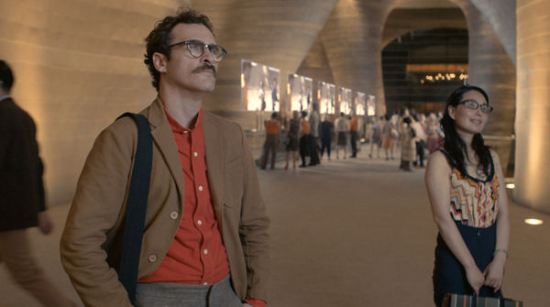
If an entire crowd is engaging their Bluetooths and ignoring their surroundings, are they still a crowd?
Short version for the unfamiliar: In a near-future L.A. where adults are worse than ever at simple social interaction, a professional love-letter writer named Theodore Twombley (Joaquin Phoenix, in a rare moment of mild-mannered sheepishness) is still coming to terms with his recent divorce and struggling to direct his emotional energies elsewhere. When normal dating fails and future phone sex proves too disturbing (as this fallen world continues to decay, so do its fetishes get too weird for words), Theodore finds an endearing companion in the unlikeliest of places: the new AI named Samantha that runs his home computer (voice actor Scarlett Johansson, whose previous credits include Robot Chicken and The Spongebob Squarepants Movie).
Hey, look, it’s that one actor!: Academy Award Nominee Amy Adams is one of Theodore’s best friends, who seems happy in her relationship and tries to encourage him and certainly won’t change her relationship status later in the film or anything. Chris Pratt from Parks and Rec is the receptionist at Theodore’s love-letter company, who’s totally tolerant of unconventional pairings. Rooney Mara has the same role and screen time as she did in The Social Network — the protagonist’s embittered ex who probably wasn’t the broken one in their failed relationship. Olivia Wilde (Tron: Legacy) appears briefly as a blind date who wants serious commitment NOW NOW NOW NOW NOW. Britain’s own Brian Cox pops up later as an A.I. presumably “owned” by someone else. And as the world’s scariest phone-sex date, there’s a cameo from Kristen Wiig!
Nitpicking? As with pretty much all modern romantic films (whether happy or tragic), Her is based on the premise that dating is all about sex first and love later. Not really my thing. This is one of a dozen reasons why modern romantic films rarely catch my attention.
Also, if we subscribe to the theory that we’re all part of a multiverse in which exists an infinite number of alternate Earths and timelines, I still refuse to believe infinity is large enough to include a version of Earth where Chris Pratt’s Ed Grimley high-water pants ever become the latest fashion.
Meaning or EXPLOSIONS? If this were a Star Trek episode, Samantha would become corrupted, threaten to destroy the world, and have to be taken down by a convoluted logical paradox that any debate-class student could unravel if given a minute to think it through. While Samantha is much saner than Dr. Daystrom’s Ultimate Computer or HAL 9000, she’s also not the perfect woman. Plot points pivot on the significant difference between Theodore’s average human brain and Samantha’s super-advanced, ever-evolving functional capacity. Even though her program is an amalgam of millions of human personality profiles that jointly allow her to experience or at least approximate real human emotions with a high degree of accuracy, Her subtly makes the case that emotions aren’t the only aspect of humanity that thinking constructs lack.
All of this comes about in the first place because the future here is a charmless, isolationist society where people talk more to their voice-activated tech than they do to others around them. Theodore’s love-letter career thrives in an environment where people have given up on expressing sincere emotions to their loved ones and need to hire a Cyrano de Bergerac to craft their sweet-nothings for them. Theodore is enough of a consummate pro that he can articulate such third-party feelings from afar, and he composes each letter individually — no assembly lines printing 500 copies of the same letter and just swapping out the names. In that sense, he’s above average.
So did I like it or not? A large chunk of the movie is basically scenes of Joaquin Phoenix staring into space and talking to voices in his head. As a one-man show, it’s interesting to me to watch his more subdued performance here than, say, the histrionics of Commodus in Gladiator. I was disappointed but unsurprised that the subject of souls never came up. (To some of us, that’s kind of a key component in matters of love.) What nagged at me most: once I realized halfway through that Her was taking a largely pragmatic approach to things between Theodore and Samantha, developments became easier to predict as we went along. There’s much sweetness to be had throughout, but I expect a Spike Jonze film to be more surprising than that.
How about those end credits? There’s no scene after the Her end credits, though they do include a special dedication to some of Jonze’s recently passed collaborators — Where the Wild Things Are creator Maurice Sendak; Wild Things costar James Gandolfini; Adam Yauch of the Beastie Boys; and cinematographer/music-video vet Harris Savides.
Discover more from Midlife Crisis Crossover!
Subscribe to get the latest posts sent to your email.
 Midlife Crisis Crossover!
Reblogged this on PAPAN NAMA TEMPAT USAHA and commented:
Nice
LikeLike