
Harry Fonseca, Dialogue with a Deer, 1995. (I’m reminded of the Deer Lady from Reservation Dogs.)
Previously on Midlife Crisis Crossover: last weekend my wife Anne and I visited the Eiteljorg Museum of American Indians and Western Art in our hometown of Indianapolis and checked out their annual, widely advertised Jingle Rails exhibit — a festive collection of elaborate toy train dioramas that recreate a variety of well-known settings using myriad natural materials to exacting specifications and festooned with Christmas trimmings. Walking laps around the hall in childlike, wide-eyed wonder was a neat feeling.
Obviously the Eiteljorg has more to offer beyond the one special happy-holiday attraction. I’ve worked a few blocks away from the Eiteljorg for years, but the last time we went there was waaay back in early 2007 to view a special exhibit of Roy Lichtenstein’s rarely mentioned Old West-themed works from his pre-Pop Art days. The two of us were online regulars back in that pre-MCC, pre-social-media era, but I don’t think we ever posted about it anywhere. I aimed to rectify that oversight for this special occasion and the rest of the museum.
The Eiteljorg’s permanent collections are a mix of paintings, sculptures, and other works from or inspired by the Old West. I’d thought the preponderance would be indigenous/Native American artists and depictions, but their comprehensive mission statement encompasses the American West in toto — hence significant space also devoted to cowboys real and idealized, as well as all those unpopulated landscapes on the other side of the Mississippi. I tried not to carry in too many preconceptions or expectations as a viewer who’s enjoyed the wave of Native voices in recent movies and shows such as Reservation Dogs, Dark Winds, Marvel’s Echo, Netflix’s Rez Ball, Fancy Dance, the film-festival entrant Jazzy, and the mostly forgotten Rutherford Falls…but I may have carried in a few anyway.
In that spirit, here’s a fraction of the total works on display that caught our eyes throughout our tour, in chronological order according to their labels (apart from our lead photo). Enjoy!

Grafton Tyler Brown, Castle Geyser, Yellowstone, 1891.

Because it isn’t an Old West gallery without the obligatory Frederic Remington: A Buck-jumper, ca. 1893.

Charles M. Russell, Indian Pictograph Writers, 1898.

Nicolai Fechin, Pietro, early 20th c.?

Harvey Dunn, Mounted Warrior, 1911.

Thomas Moran, The Grand Canyon, 1917.
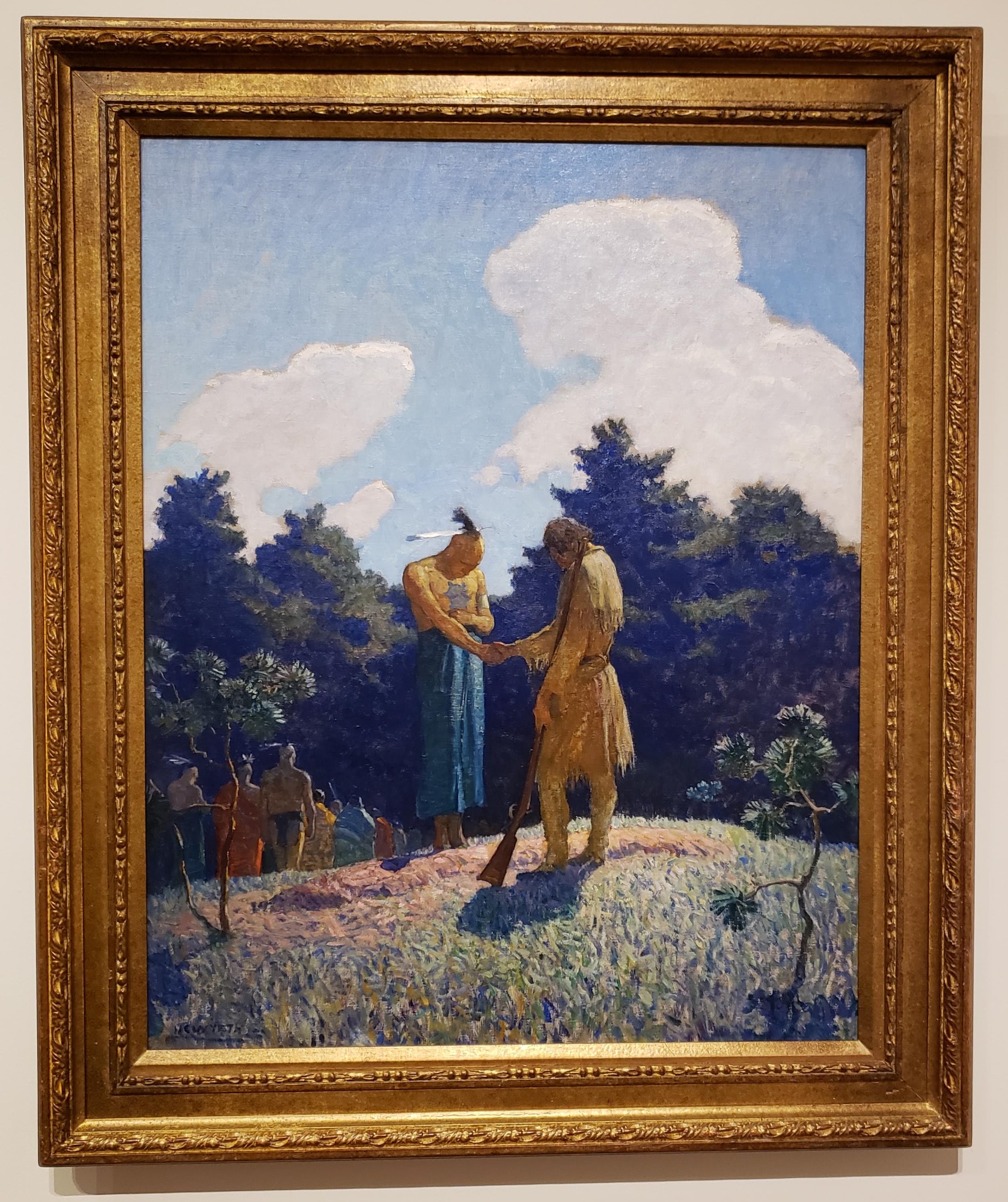
N.C. Wyeth, The Burial of Uncas, 1919.

In the back is the original The Twins by E. Martin Hennings, 1923. Up front is Susan Folwell’s 2017 pottery homage.

E.I. Couse, The Wedding, 1924.

Dean Cornwell, Americanization of California, 1927-1932.
At this point our gallery takes a curious 60-year time jump. I’m not sure whether that represents an unconscious bifurcation in our personal photo-posterity preferences, a gap in the museum’s collections, or a Dark Age in Native art that no one likes to talk about, as if everyone stopped painting for a while because of all the wars.

Fast-forward to the Eiteljorg’s 1989 grand opening and its signature installation out front, Kenneth R. Bunn’s Whitetail Deer. Technically it’s known currently as the Richard and Billie Lou Wood Deer Fountain.

Wilson Hurley, October Suite, Grand Canyon, 1991. Possibly the largest triptych we’ve ever seen.

Anne Coe, Snake River Sushi, 1993.

Bernard Williams, Black Cowboy – Bill Pickett, 1995.

Linda Nez, Weaving, 1997-2002. Or this tapestry might simply be “a weaving by Linda Rez”, not clear which.

A Lakota tapestry from 2001, creator unrecorded.

Mian Situ; The Golden Mountain – Arriving San Francisco, 1865; 2003.

Robert Griffing, Secrets of the Dark Forest, 2008.

Anita Fields, Considering the Earth and Above, 2008.
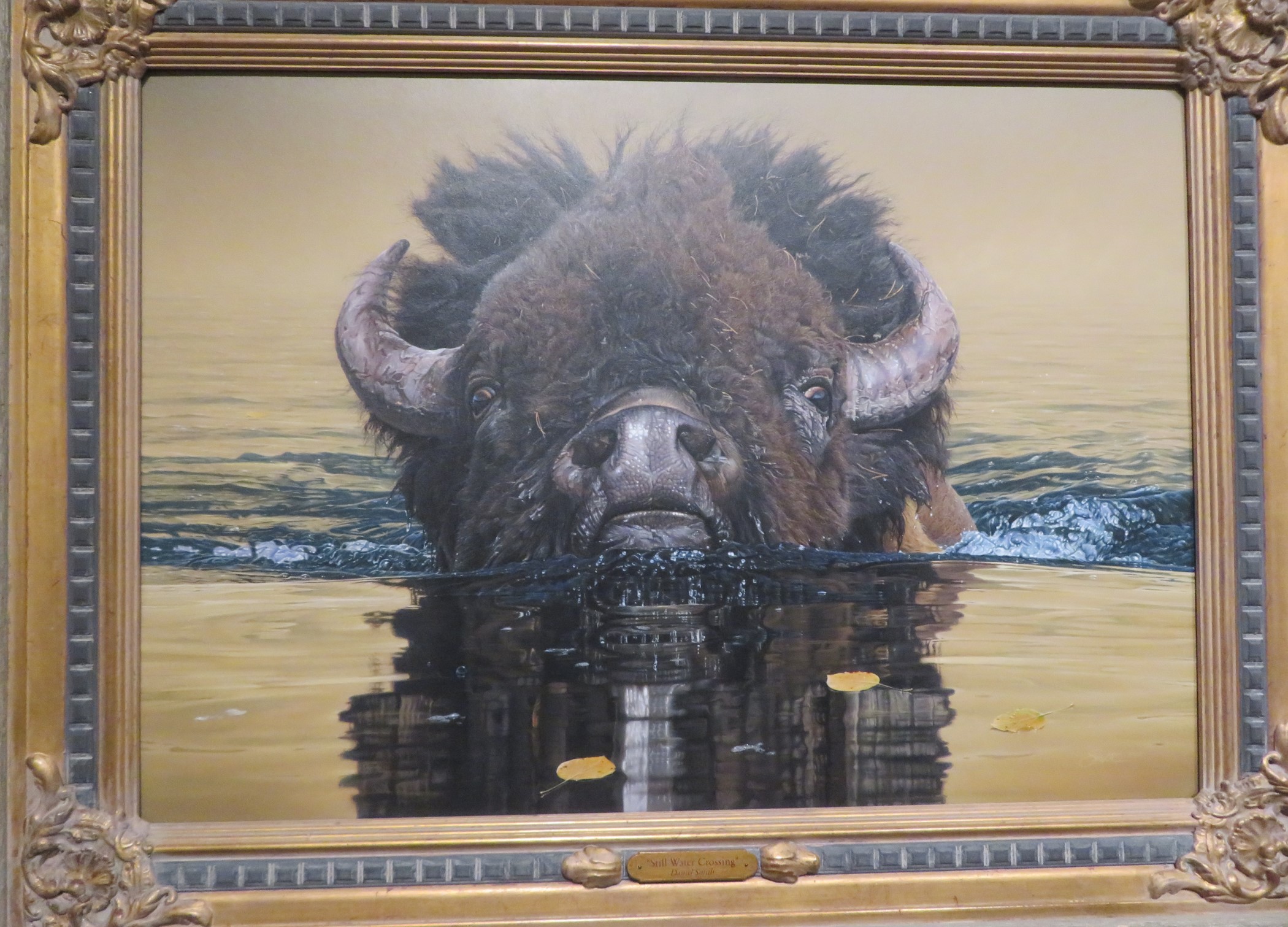
Daniel Smith, Stillwater Crossing, 2009.

In addition to Jingle Rails, another temporary exhibit called “Preston Singletary: Raven and the Box of Daylight” showcases works by the Tlingit artist through March 9, 2025. Much like the Lume at Newfields, the walls have been turned into light shows to accompany the pieces they surround.
(The cards for Singletary’s works each carried their names in English and in Tlingit. My apologies for taking the coward’s way around the HTML and ASCII coding challenges those pose for the next three captions.)
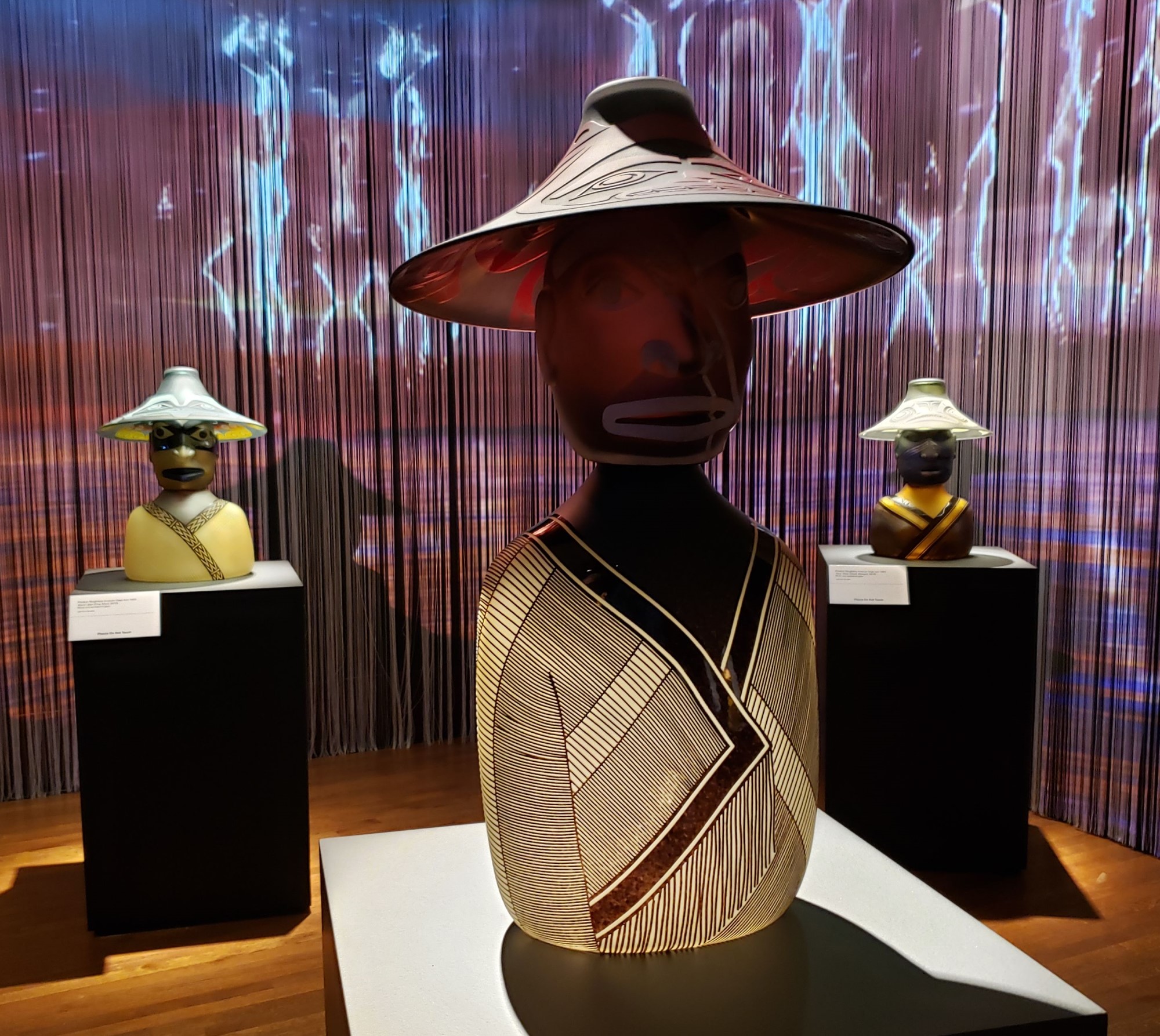
Singletary, Killer Whale Man, 2018.
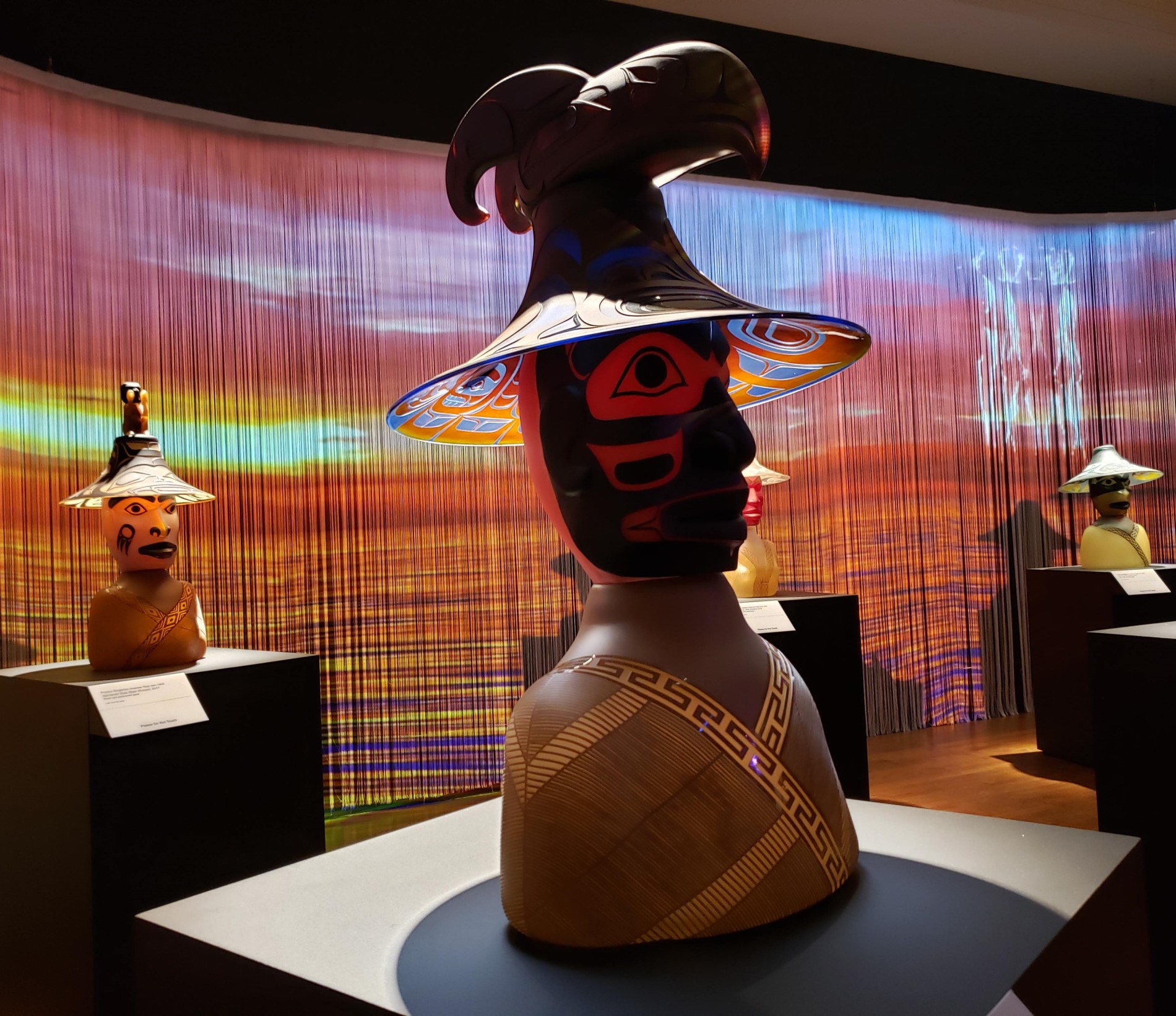
Singletary, Thunderbird Man, 2018.

Most of this is the backlit wall behind three Singletary works, all 2018: Box of Stars, Box with Daylight, and Box with the Moon.
The two best pieces as judged by this particular aficionado of cutting satire:

Ryan Singer, Kill the Indian, Save the Toys, 2021.
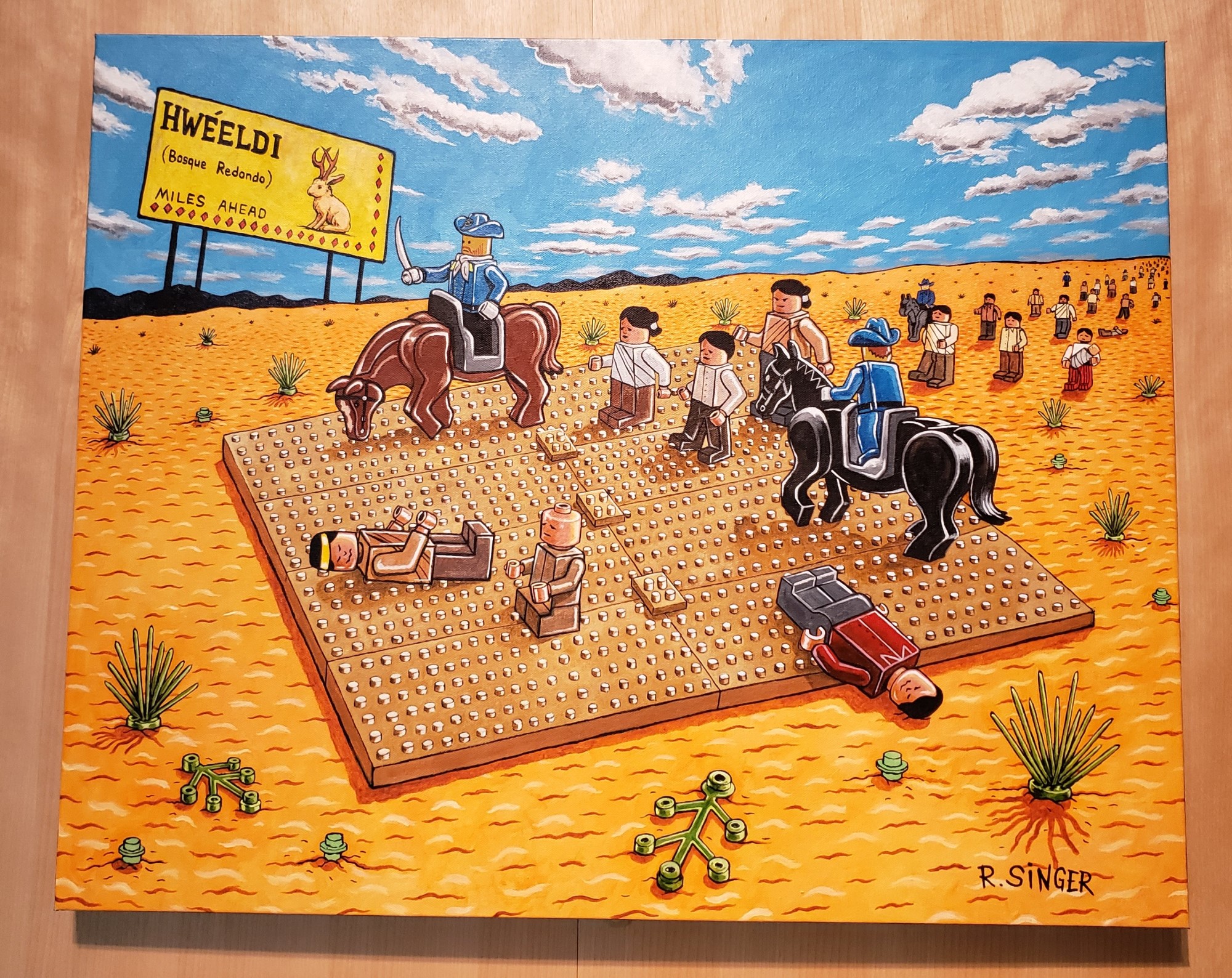
Ryan Singer, Lego Long Walk, 2021.
…and we break format for the last three photos of other sorts of items on display:

Sample jewelry crafts. This particular room was dark; if there was a label, I overlooked it.

A wall essay in one corner called “Fact Over Fiction: Perceptions of Native Peoples” discusses stereotypes throughout American culture, starting with sports teams, their mascots and their merchandise.
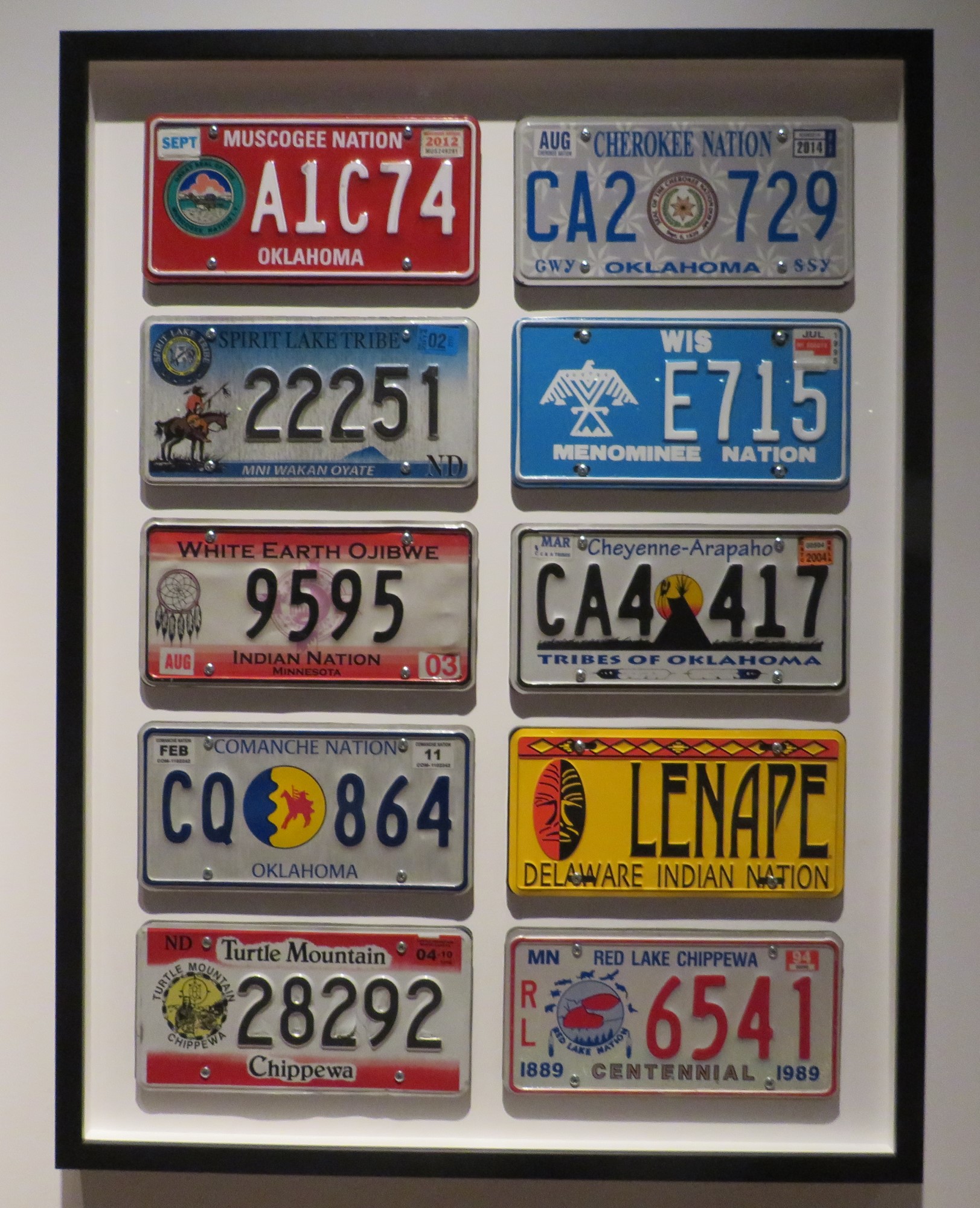
On a more empowering note: an array of nations and tribes who issue their own license plates, a practice pioneered by the Red Lake Ojibwa in 1974.
We walked around one more special exhibit, about a 19th-century Scottish artist and traveler whose every painting was three-fourths blank sky to one-fourth subject matter, which wasn’t really our thing. By the time we reached those, we were worn out due to oldness and called it a day. We considered grabbing lunch at their cafe, but the prices were a tad steep and I found it extremely weird they don’t serve frybread. They did offer the option to go home and make some ourselves — the gift shop had one (1) box of frybread mix on the shelf.
The gift shop held other mild disappointments. Anne had already checked in advance and knew they wouldn’t have a smashed-penny machine for obtaining her favorite kind of travel souvenir. I’d hoped their wares, like many other gift shops we’ve encountered throughout our years of road-tripping, might include relevant DVDs for sale. I would’ve paid good money for physical copies of Smoke Signals or Powwow Highway, but the only two DVDs I could find were over in the DEI memorabilia section — two different tributes to Martin Luther King, Jr.
Also, after perusing and enjoying all the Jingle Rails dioramas and displays, Anne couldn’t help noting the inclusion of world-famous Mount Rushmore and their ironic omission of the controversial Crazy Horse monument, which we visited back in 2009. I can understand the reasons for dodging that particular subject, but in their defense, at least their cafe served frybread.
Nevertheless: petty nitpicking aside, the Eiteljorg is an institution worth checking out. Here’s hoping we don’t let another seventeen years slide by till our next visit.
Discover more from Midlife Crisis Crossover!
Subscribe to get the latest posts sent to your email.
 Midlife Crisis Crossover!